Once you understand position and stack depth, the next step is mastering preflop ranges. A range is simply the group of possible hands a player might have in a given situation.
Every time you make an action, whether it’s raising, calling, or folding, you’re defining your range and shaping how opponents interpret your play.
Why Thinking in Ranges Matters
Beginners often focus on a single poker hand. They ask questions like “Do I have a good hand?” or “Does my opponent have Ace-King?” But poker doesn’t work that way.
Strong players think in terms of ranges, not individual hands. They evaluate situations based on all the hands that make sense given the action so far.
This way of thinking keeps your strategy balanced and prevents opponents from easily reading you. When you understand ranges, you stop reacting and start predicting.
Let’s go over some different poker terms that will help us describe our preflop ranges and build a strategy.
Linear Ranges
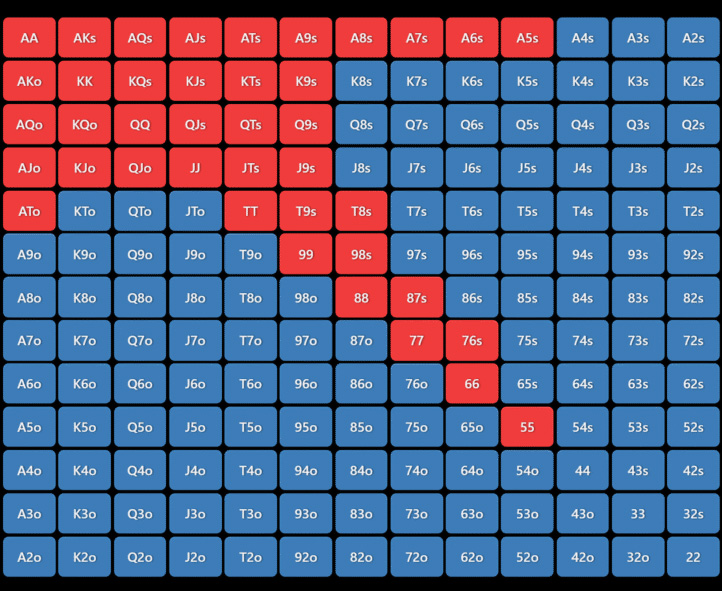
A linear range consists mostly of value hands arranged in order of strength. It’s called linear because it moves in a straight line from the top of your strongest hands down to slightly weaker ones.
You might use a linear range when facing opponents who call too much. In those cases, it’s best to raise with all the hands that perform well postflop, from A-A and K-K down through hands like A-J suited and pocket 9s.
Linear ranges apply steady, consistent pressure. They make money from value.
Polarized Ranges
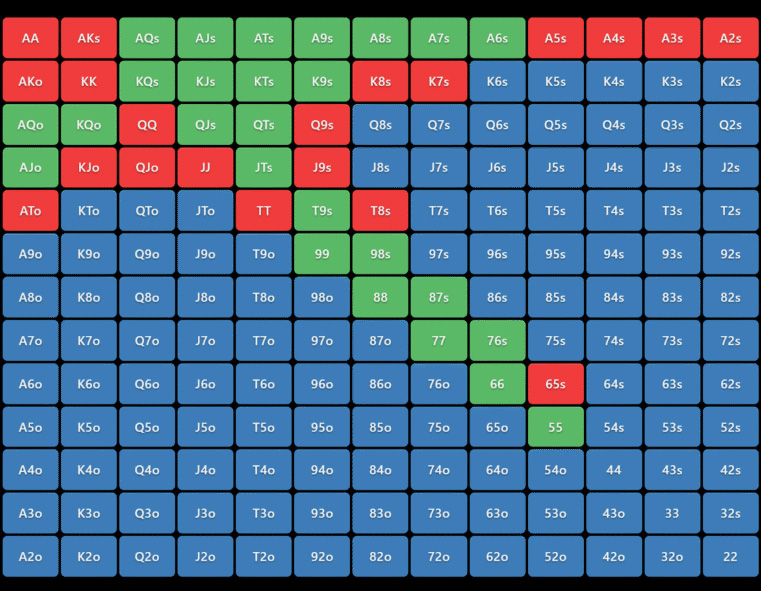
A polarized range contains both very strong hands and weaker hands used as bluffs. It’s polarized because the middle-strength hands are often excluded.
You might 3-bet with a polarized range, using strong hands like A-A and K-K for value and hands like A-5 suited or K-7 suited as bluffs. The goal is to mix premium hands with hands that can’t profitably call but still have good playability.
Polarized ranges create uncertainty. Your opponent knows you either have a monster or a potential bluff, which makes you difficult to play against.
Capped and Uncapped Preflop Ranges
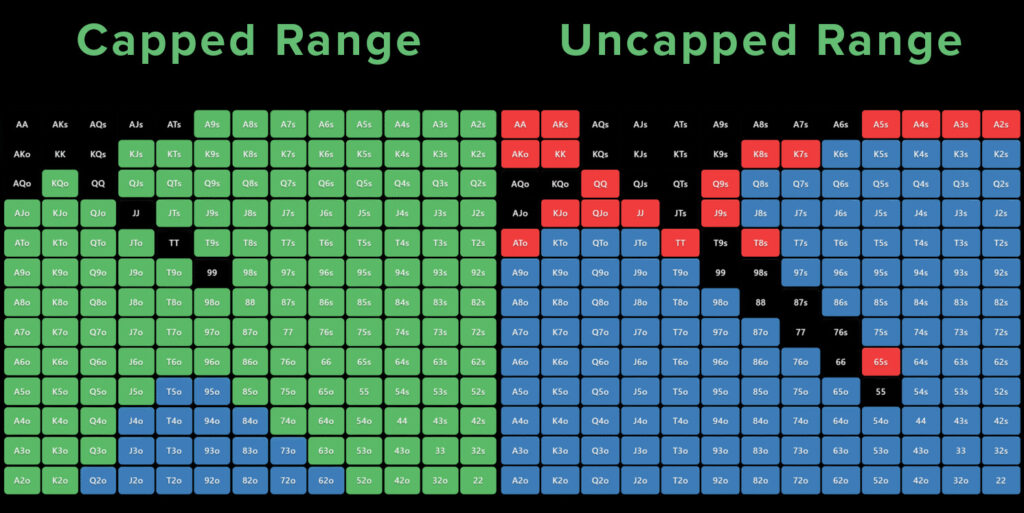
A capped range means your hand selection doesn’t include the strongest possible holdings. You’re capped at a certain level of strength. For example, if you just call an open raise instead of 3-betting, you typically don’t have A-A or K-K in your range.
Your opponents can recognize this and apply more pressure, knowing your top hands are missing.
An uncapped range, on the other hand, includes all hands, even the strongest ones. A player who 3-bets or continues aggressively remains uncapped, since their range could still contain any hand in the deck.
Recognizing whether a range is capped or uncapped helps you decide when to apply pressure or when to protect yourself from it.
Condensed Preflop Ranges
A condensed range is tightly grouped around medium-strength hands. It lacks the strongest and weakest holdings and is made up mostly of hands like top pairs, good second pairs, and decent draws.
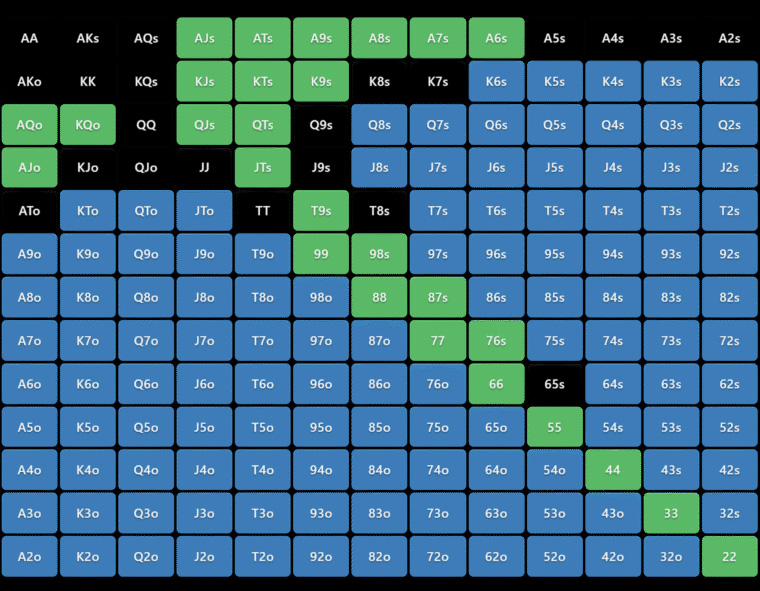
Condensed ranges often appear when a player calls a continuation bet on the flop or chooses not to raise with strong hands. They represent solid but not dominant holdings.
Knowing when an opponent’s range is condensed allows you to attack the parts they struggle to defend. For example, you can apply pressure on later streets where medium-strength hands may be forced to fold.
Adjusting Your Range to the Situation
Poker isn’t about using the same range every time. It’s about adjusting based on your position, stack depth, and opponent tendencies. From early position, your opening range will usually be linear, strong and straightforward.
From late position, you can add more polarized elements, mixing strong hands with creative bluffs. When you face an aggressive opponent, tighten your range and play more linearly for value.
Against passive players, widen it and use more speculative hands to steal pots. Good players always know why they’re choosing a specific range type in a given situation.
GTO and Balanced Preflop Ranges
Game Theory Optimal strategy uses mathematics to keep your ranges balanced and unexploitable. It ensures you have the right mix of value hands and bluffs no matter how your opponents respond.
You don’t need to memorize solver charts to apply this idea. Instead, aim for consistency in your approach. Use linear ranges when you expect calls, polarized ranges when you want folds, and stay aware of when your range becomes capped or condensed.
The more balanced you are, the harder you are to read, and the more mistakes your opponents will make against you.
Final Thoughts: Learn to See the Whole Picture
Understanding preflop ranges turns poker from a guessing game into a structured, strategic battle.
When you can identify whether your range is linear, polarized, capped, uncapped, or condensed, you gain control over the flow of every hand. You stop reacting emotionally and start responding logically.
Combine this awareness about position and stack depth, and you’ll already be playing better than most low-stakes players.