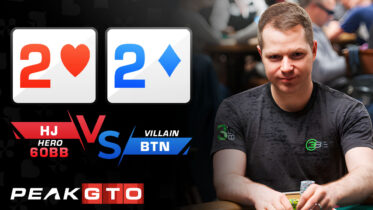

Some of the most revealing GTO poker hands occur in single-raised pots where both players choose control early, only for the action to accelerate later. In this 60bb MTT hand, we’re playing pocket 2s and face a flat call from the button.
What follows is a progression from range protection to value extraction, culminating in a decisive river shove that highlights how solver logic rewards patience and polarization.
Hand setup:
- Stacks: 60bb effective
- Positions: HJ vs BTN
- Action: HJ raises to 2.2bb, BTN calls
- Flop: 8♠7♠3♥ (Pot 7.1bb)
- Turn: 2♣ (Pot 7.1bb)
- River: T♥ (Pot 26.7bb)
Flop: 8♠7♠3♥
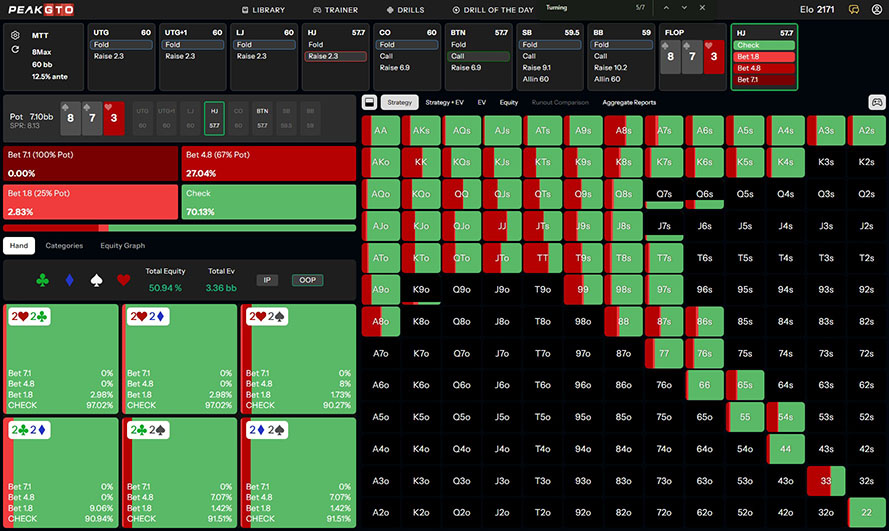
This is a highly dynamic, middling texture that interacts favorably with the button’s flatting range. The solver assigns HJ a 70% check frequency and a 30% c-bet frequency, preferring a 4.8bb size when betting. The reason is straightforward as the BTN holds more connected and suited combinations that interact with the 8–7–3 region, while HJ retains more unpaired high cards and overpairs.
Pocket 2s fits neatly into the solver’s checking range. It has minimal immediate equity, few clean runouts to improve, and no backdoor potential on this board. Checking maintains balance by protecting medium-strength hands and ensures that later-value combos like sets or overpairs can still emerge naturally.
When BTN checks back, both ranges remain relatively wide. Solver assigns this check-back around 43% of the time for BTN, reflecting that in-position players often preserve equity.
Turn: 2♣
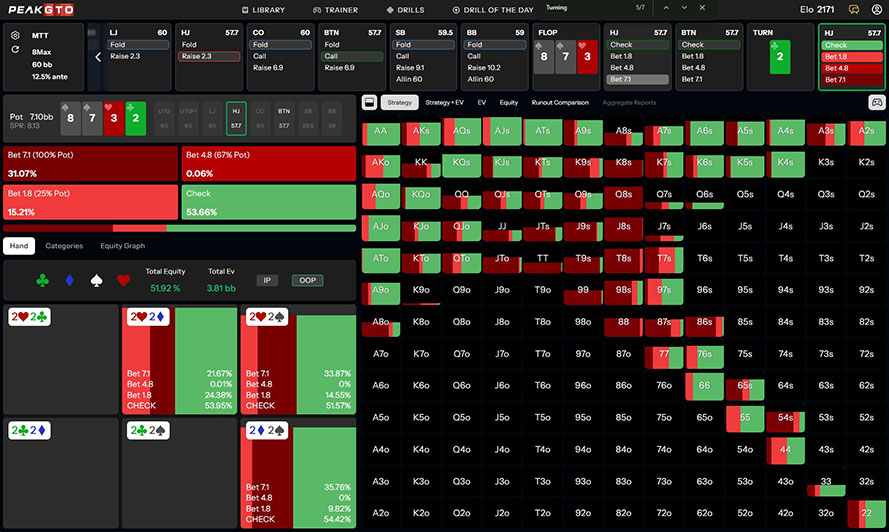
The 2♣ completely changes the landscape for the Hero as they now improves from one of the weakest preflop hands to a strong, disguised value hand. PeakGTO shows that HJ splits actions here across their entire range: betting 46% of the time and checking 54%. When betting, it uses a 1.8bb sizing 15% and a larger 7.1bb sizing 31% of the time.
Hero chooses the 1.8bb bet size to extract thin value from hands like A8, 9x, and flush draws while keeping the betting range flexible. Against this sizing, BTN raises 19% of the time to 9.8bb, calls 62%, and folds 18%. In this hand, the button raises to 9.8bb.
Solver’s response with range is primarily a call (44%), mixing in small around 8% of the time for range balance, but with 22 we can split pretty evenly between calling and raising. The call allows Hero to keep in dominated hand and bluffs that can barrel on the river, while disguising strength by maintaining a capped appearance.
River: T♥
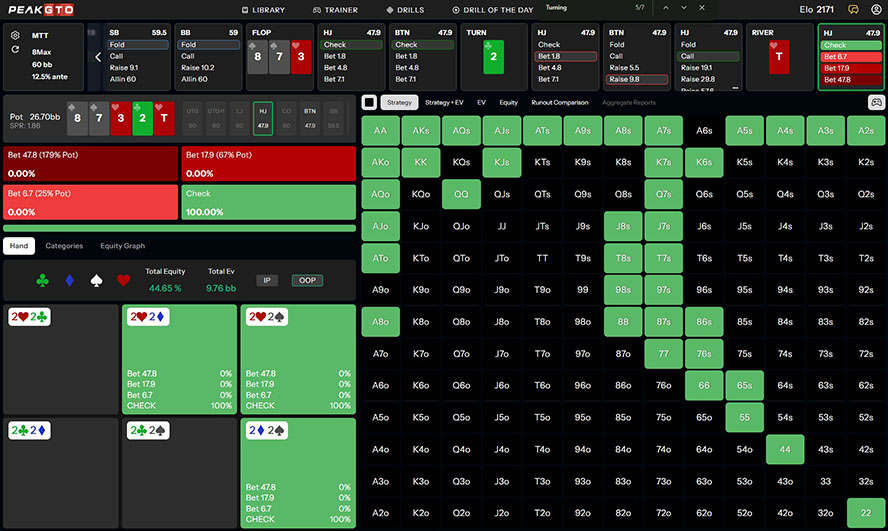
The river T♥ slightly shifts board texture by completing some two-pair and straight combinations for the button, but Hero’s hand retains near-top strength. Solver has HJ checking 100% of the time here, which is standard for the out-of-position player holding both strong value and marginal bluff-catchers. This preserves range protection and invites the button’s polar betting strategy.
BTN follows with a polarized approach, betting 13.4bb 11.7%, 26.7bb 43.9%, and 47.8bb 7.5%, while checking 36.9% of the time. Facing a 13.4bb bet, solver outputs show HJ mixing: check-raise all-in (47.8bb) 20.1%, call 43.0%, and fold 37.0%. Pocket 2s clearly falls into the check-raise jam category. It’s a premium value hand that benefits from polarizing the range and extracting maximum value from overpairs, top pairs, and thin two-pair hands.
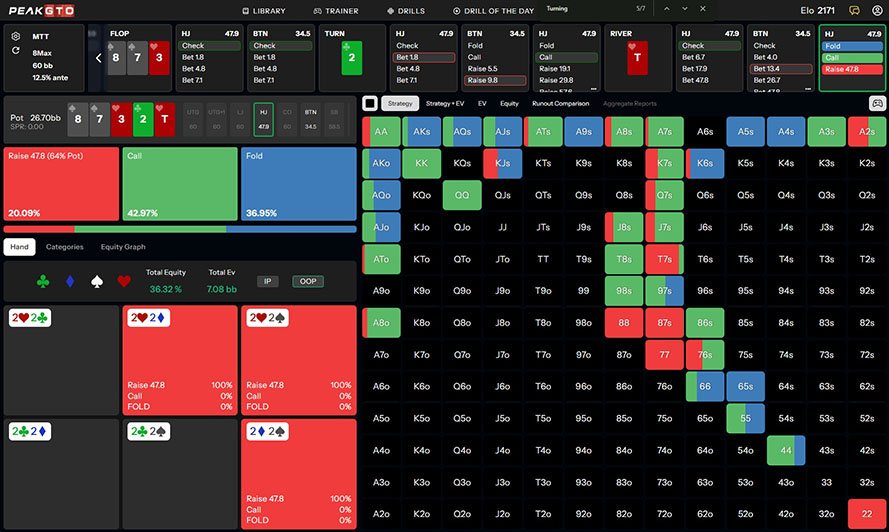
Solver shows the button calling the jam 45.9% of the time and folding 54.1%. This equilibrium response allows Hero’s shove to generate strong expected value. Importantly, this shove also completes the polarized structure of Hero’s strategy, balancing sets and straights against bluff candidates like missed 5–4 or 6–5 suited combinations.
Key Takeaways
- Flop: On connected textures, solver prefers high check frequency from out of position. Small pairs like 22 always check, preserving range strength.
- Turn: The 2♣ dramatically changes range equity. Solver prefers small bets to build the pot without forcing folds from dominated holdings.
- River: Out of position, GTO logic always checks to allow the in-position player to polarize. With a premium hand like 22, solver prefers a check-raise jam for value.
- Overall: Solver strategy rewards patience and range balance. Controlled flop play transitions into strong, polarized aggression when true equity advantage is secured.