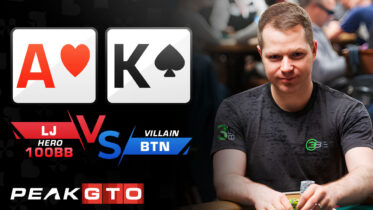
Deep-stacked single-raised pots often hinge on how well we navigate range advantage versus positional disadvantage. This hand highlights a common cash game spot where the preflop raiser holds a premium unpaired hand but must transition from passive defense to disciplined bluff-catching as the hand progresses. With A♥K♠ from the lowjack, solver logic emphasizes restraint early and carefully calibrated defense on later streets.
Assumptions
- Stacks: 100bb effective
- Positions: LJ (Hero) vs BTN (Villain)
- Action: LJ raises, BTN calls
- Flop: 7♣5♦2♥ (Pot 7.5bb)
- Turn: 9♠ (Pot 11.9bb)
- River: 2♠ (Pot 26.1bb)
Flop: 7♣5♦2♥
This is a low, disconnected board that favors the button’s calling range more than the lowjack’s opening range. Solver output reflects this by having Hero check at a very high frequency (80.8%), with betting used sparingly and primarily at small and medium sizes.
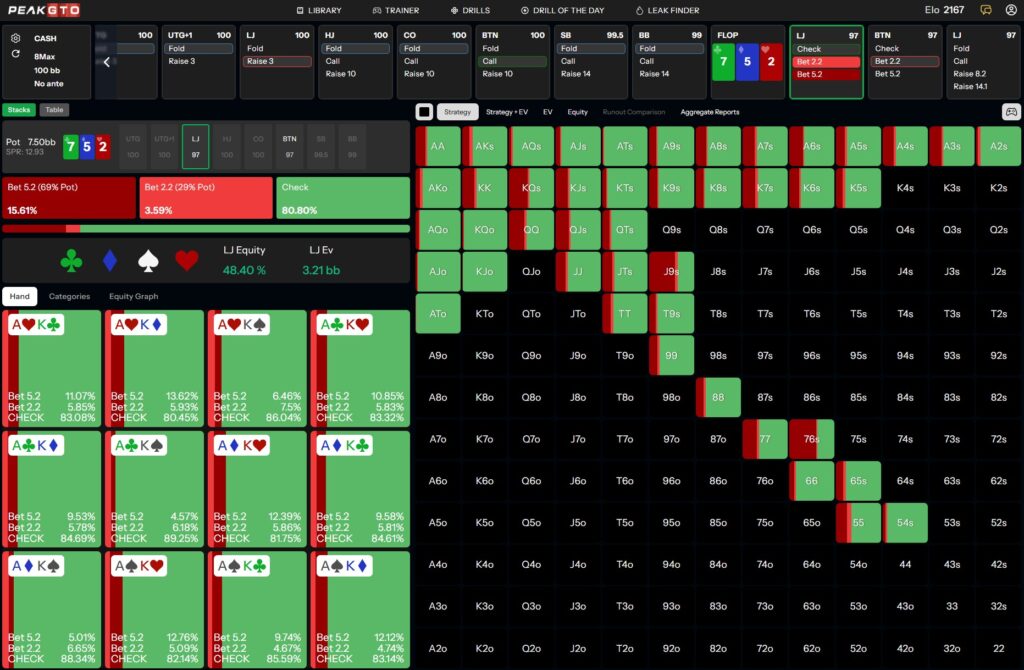
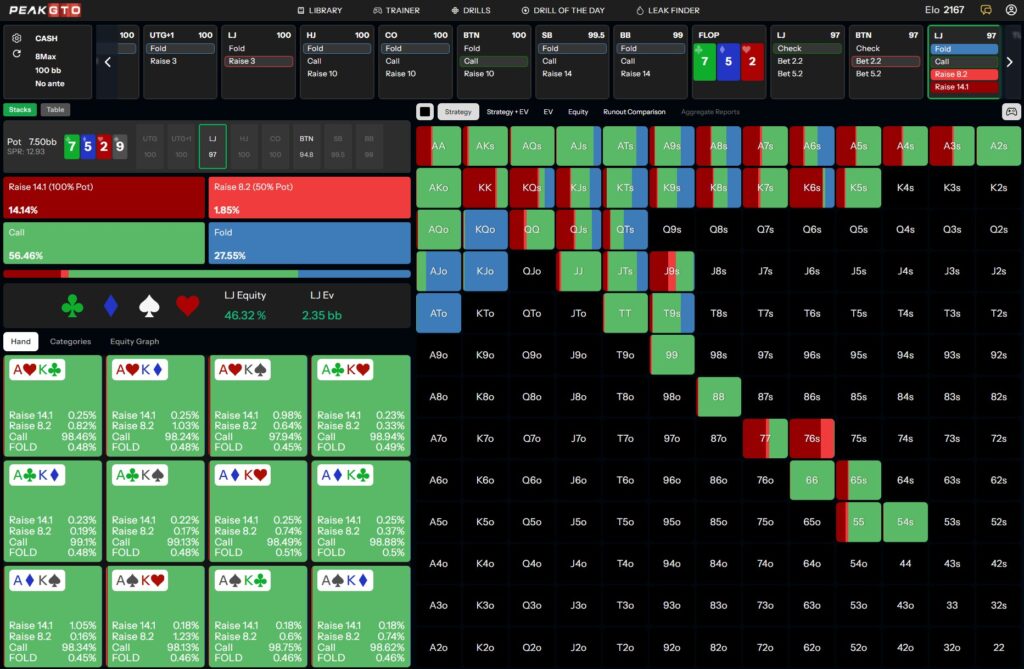
With A♥K♠, foregoing a c-bet and checking is standard. Despite holding two overcards, the hand has limited immediate equity and does not benefit from inflating the pot against a range dense in small pairs and straight draws. When the button bets small for 2.2bb (44.3%), solver prefers Hero to continue mostly by calling (56.5%) rather than raising. This keeps weaker bluffs in the pot and avoids isolating against hands that already connect well with the board.
Turn: 9♠
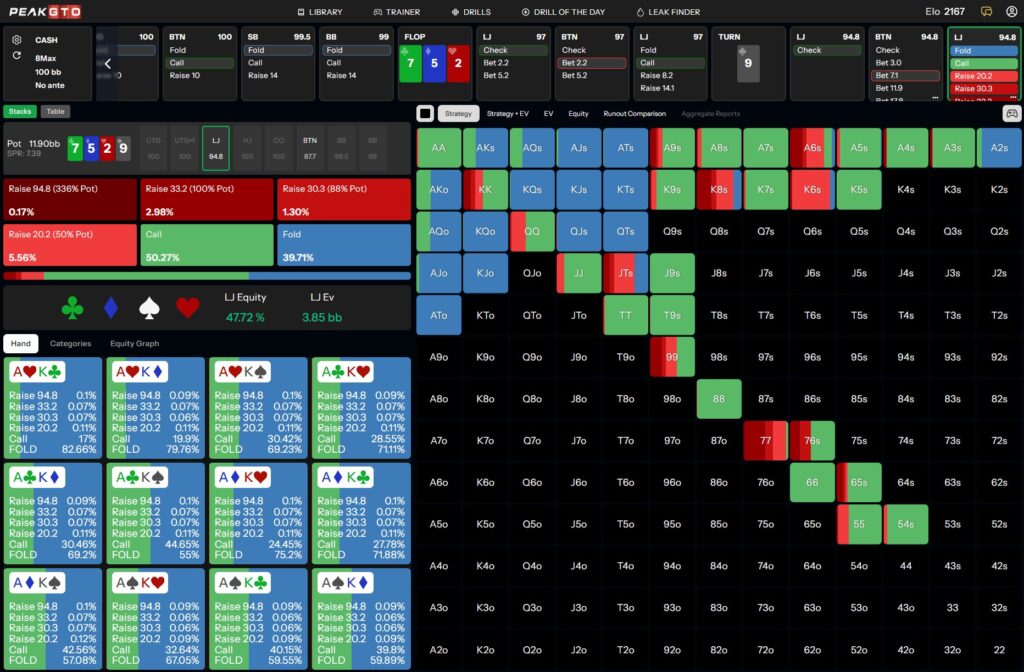
The turn introduces a middling card that slightly improves the button’s range while leaving Hero with only ace-high. PeakGTO has Hero checking 100% of the time, reinforcing that this is not a street for range advantage aggression.
The button chooses a 7.1bb bet (34.9%), one of its most common turn sizes. Facing this bet, solver has Hero calling just over half the time (50.3%) and folding the rest, with raises appearing at very low frequency. A♥K♠ It is folded at about 70% frequency, but AKo generally fits well in the calling range. The hand still beats bluffs and unpaired holdings, and folding too often here would allow the button to apply profitable pressure with a wide betting range.
River: 2♠
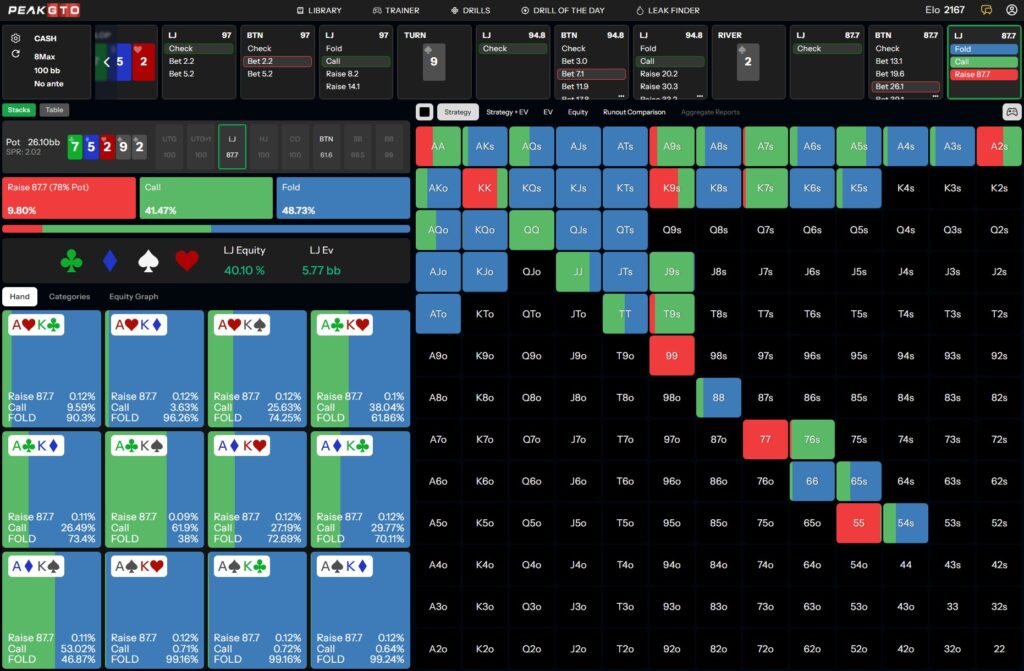
The river pairs the deuce, producing a largely static runout that does not meaningfully change hand strengths. Solver again has Hero checking 100%, forcing the button to decide whether to polarize or concede.
When the button bets pot for 26.1bb (12.1%), solver assigns Hero a mixed response: call 41.5%, fold 48.7%, and raise 9.8%. With A♥K♠, calling is solver-approved, but definitely has significant folds mixed in as well. Ace-high remains a strong enough poker hand to beat missed straight draws and bluffs, and the paired board slightly reduces the number of strong value combinations available to the button. Raising is reserved for very specific bluff-catcher-plus-blocker combinations and is not mandatory with this hand.
Key Takeaways
- Flop: On low, disconnected boards, solver favors heavy checking from the preflop raiser. A♥K♠ plays best as a passive defender rather than an aggressor.
- Turn: Continued checking preserves range integrity. Calling with ace-high prevents the button from over-bluffing.
- River: Even facing a pot-sized bet, solver continues with ace-high at meaningful frequency. A♥K♠ is a legitimate bluff-catcher on paired runouts.
- Overall: GTO play in deep cash games prioritizes discipline. Premium unpaired hands often win by defending correctly rather than forcing aggression.