You raise. Someone 3-bets you. Now what?
This is one of the spots where short-stack players leak the most chips. The decision is more complex than push/fold, and the correct response depends heavily on two things: your stack depth and your position relative to the 3-bettor.
Get it wrong and you are either spewing chips with weak 4-bets, overfolding hands with clear value, or missing the calling range entirely.
This guide covers how to handle a 3-bet at 60 and 25 big blinds, with separate breakdowns for when you are out of position and in position.

Position Is the Key Variable
Before looking at specific stack depths, understand the core principle that drives everything here.
When you raise and face a 3-bet, your position for the rest of the hand is already set. If the 3-bettor is behind you, you will be out of position on every street. If they are in the blinds, you will have position.
That single factor changes your entire response distribution.
Out of position, you want to reduce the number of hands you take to the flop. Playing multi-street poker without position is costly, especially with a short stack. So you 4-bet more hands to force a decision before the flop, and you fold more hands that cannot justify the commitment.
In position, the opposite is true. Playing the flop with position is valuable enough that calling becomes the preferred option across a wide range of hands. You 4-bet less and call more often.
This pattern holds across all stack depths. Keep it as your anchor when the specific details get complicated.
Facing a 3-Bet at 60 Big Blinds
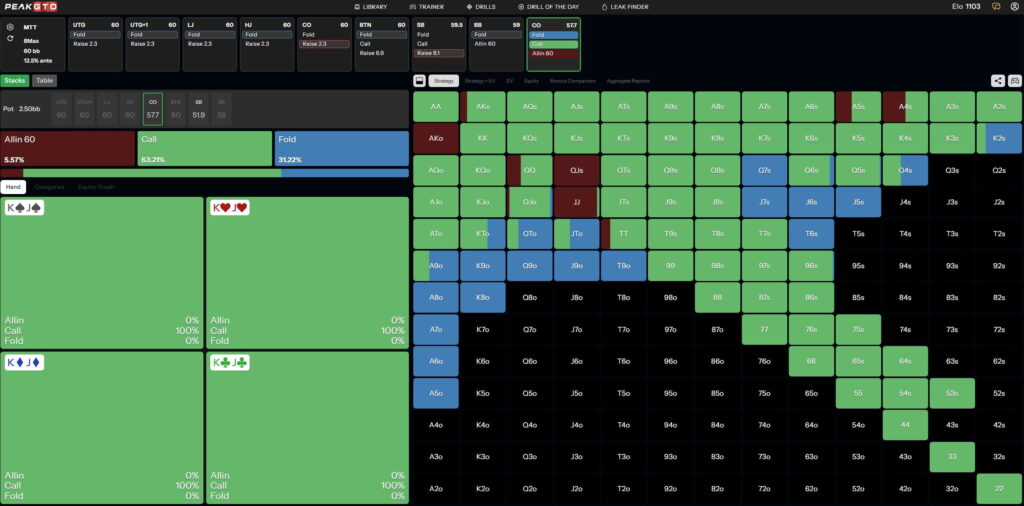
At 60 big blinds, you still have room to make a small non-all-in 4-bet. This gives you a fold equity tool that lets you separate your range into four buckets: 4-bet for value, 4-bet as a bluff, call, and fold.
Out of Position
When you raise, and the 3-bettor will have a position on you, your 4-betting range should include all your strongest hands. Tens and better and ace-king are clear 4-bets for value.
For bluffs, the best candidates are hands with good blockers: ace-jack offsuit, king-queen offsuit, ace-four suited, and ace-three suited. These hands block the strong 4-bet calling and calling range of your opponent, while not being strong enough to profitably call and play out of position.
Your calling range covers the middle ground: suited Broadway hands, most suited aces, suited connectors, and pocket pairs below tens. These hands have enough playability and equity to justify seeing a flop, even without position.
What you fold is just as important. Ace-ten offsuit, king-jack offsuit, queen-jack offsuit, jack-ten offsuit, and anything weaker are all folds once you raise and get 3-bet. These hands look reasonable when you first open, but they are not strong enough to call a 3-bet out of position and not worth 4-betting as a bluff.
One important note on sizing: when you 4-bet out of position at 60 big blinds, do not just shove. If you raise to 2.5 and they make it 7.5, a reasonable 4-bet is around 17 to 18 big blinds. This keeps the pot manageable enough that if they shove, you can fold the weaker end of your 4-bet range. A 4-bet that commits you to calling a shove with ace-three suited is not a good 4-bet.
In Position
When the 3-bet comes from out of position (such as the small blind), you call far more often.
Your 4-bet range narrows to a small group of premium hands: some combinations of aces, kings, ace-king, and jacks, plus a few suited ace bluffs. Even hands as strong as ace-king suited, queens, and tens sometimes just call here, because position makes them more valuable as calling hands than as 4-bets.
The calling range expands significantly. Suited Broadway hands, suited aces, suited connectors, and most pairs all call. You are happy to see a flop in position against an out-of-position 3-bettor.
The hands you fold are the same: weak offsuit holdings. Ace-ten offsuit, king-jack offsuit, queen-jack offsuit, jack-ten offsuit, and worse are all folds regardless of position.
Facing a 3-Bet at 25 Big Blinds
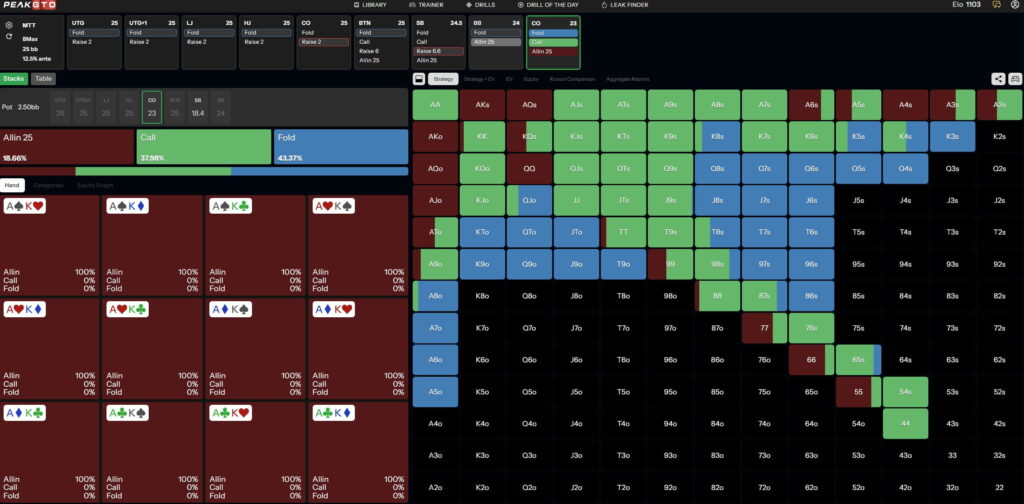
At 25 big blinds, the small 4-bet disappears. The math makes it unworkable.
If you raise to 2 big blinds and they make it 5.5, a “small” 4-bet to around 12 puts half your stack in the middle. Once you have half your stack committed, the pot odds on a call are so good that you cannot fold to a shove. Everything in your range effectively calls.
Because of this, the strategy simplifies to three options: shove all-in, call, or fold. There is no longer a fourth lever.
Out of Position
The hands that shove are your strong-but-not-premium holdings: ace-queen offsuit, ace-king, pocket sevens through pocket kings, and some low suited aces. These are hands strong enough to want to get the money in before the flop, especially without position.
The rest of your range calls, with two exceptions. Weak offsuit hands still fold. And suited connectors that might have called at deeper depths, things like ten-eight suited, nine-eight suited, nine-seven suited, and jack-nine suited, now fold too. At 25 big blinds, the implied odds that made those hands worth calling are mostly gone. You are not deep enough to stack your opponent when you flop a flush or straight.
One adjustment worth knowing: if your opponent makes a small 3-bet rather than a standard one (say they make it 4.5 instead of 5.5), stick around with more poker hands. Better pot odds means a wider calling range is correct.
In Position
The in-position strategy at 25 big blinds looks similar, with one key difference: you shove less often with pairs.
Ace-king and ace-queen still get in frequently. But medium pairs that would shove out of position are more comfortable calling when they have position. The ability to play a flop and realize equity changes their value.
The calling range ends up roughly similar to the out-of-position range, with ace-ten offsuit now making the cut as a call rather than a fold.
The Biggest Mistake Is Skipping the Calling Range

A lot of short-stack players react to a 3-bet with a simple mental model: either go all-in or fold. They see the 3-bet as a binary situation.
This is a significant leak.
At both 60 and 25 big blinds, the calling range is large and clearly correct. Hands like suited connectors, small pairs, suited aces, and suited Broadway hands all have enough equity and playability to justify a call. Folding them to a 3-bet is giving up real value.
Do not be afraid to see the flop. The 3-bettor’s range is not always as strong as it looks. Calling and playing your hand well is often the highest EV option across a wide portion of your range.
If you currently default to 4-bet or fold in these spots, start by identifying which hands belong in your calling range and commit to defending them.
What Happens at Even Shorter Stacks?
At 15 big blinds and below, the situation changes again. At this depth, most opponents will not make a small 3-bet when you raise. They will simply shove.
When that happens, the decision becomes straightforward: call or fold. There is no 4-bet and no flop to navigate, so you can just follow preflop charts.
How to handle that specific spot will be covered separately. For now, the key takeaway is that short 4-betting ranges and calling ranges are specific to stack depths where your opponent can still make a non-all-in 3-bet. Once they cannot, the decision tree collapses entirely, so you can just follow preflop charts.
Conclusion
When you face a 3-bet short-stacked, position and stack depth determine your correct response.
Out of position, reduce your exposure. 4-bet your strongest hands with proper sizing, fold your weakest, and call the middle ground when it makes sense. In position, call much more and trust the advantage position gives you postflop.
At 25 big blinds, small 4-bets disappear entirely. Replace them with a shove range for your best hands and a calling range for everything else worth playing.
Most importantly, do not skip the calling range. It is one of the most common and costly errors short-stack players make in this spot.