Most players never lead into the preflop raiser from the big blind. They check their entire range, wait for a continuation bet, and then decide whether to fold, call, or check-raise. On most boards, that instinct is correct. But on low, connected textures at shallow stacks, the solver uses a donk bet with surprising frequency, and the hands it chooses to lead with are not the ones you would expect.
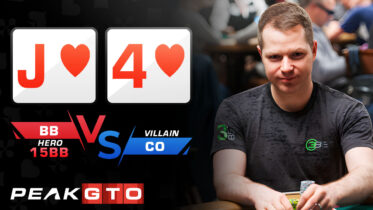
Today we will analyze a 15bb 8-handed tournament hand where the big blind defends J♥4♥ against a cutoff open, fires a donk bet a 7♠5♥3♦ flop with a gutshot and backdoor flush draw, fires a second small barrel on the T♠ turn, and shoves the 2♥ river with jack high. This hand shows when the big blind should lead instead of check, how small-small-shove trajectories work at shallow stacks, and why zero showdown value makes a hand a better bluff candidate than a marginal pair.
Assumptions
- Stacks: 15bb effective
- Format: 8-handed MTT
- Positions: BB (Hero) vs CO (Villain)
- Action: CO raises, BB calls
- Flop: 7♠5♥3♦ (Pot: 5.5bb)
- Turn: T♠ (Pot: 8.3bb)
- River: 2♥ (Pot: 12.5bb)
Preflop
At 15bb, every suited hand in the big blind gets to continue against a cutoff open. J♥4♥ is a call. The suitedness provides enough postflop equity through flush draw potential that the hand clears the threshold, even with a weak kicker. J4 offsuit, by contrast, folds. The extra equity from being suited is the dividing line at this stack depth.
Flop: 7♠5♥3♦
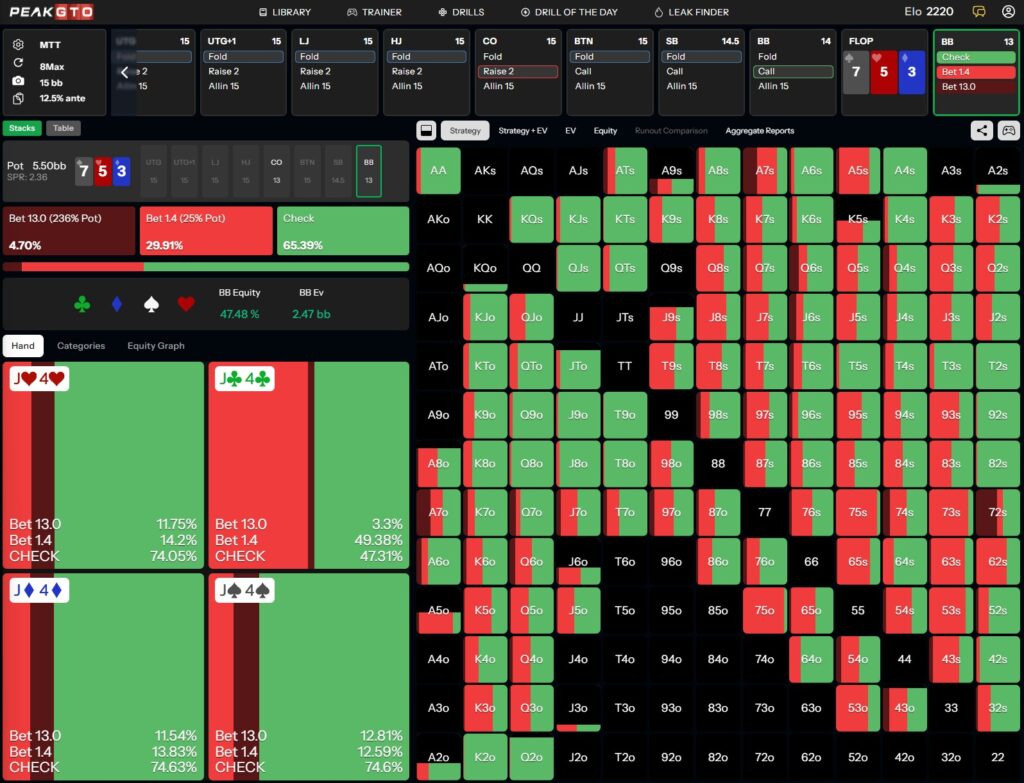
This is one of the rare board textures where the big blind can donk bet into the preflop raiser. On most flops, BB checks and lets the raiser decide whether to continuation bet. But low, connected boards like 753, 765, 764, and 743 favor the big blind’s range. BB defends with far more suited connectors, low pairs, and hands that interact with this part of the deck than the cutoff opens with. That range advantage justifies a donk bet.
The solver has BB leading 34.6% of the time on this flop, split between 1.4bb (29.9%) and a 13bb all-in (4.7%), with 65.4% checking. The small sizing is far more common because it accomplishes two things at once: it builds the pot with made hands like sevens and fives, and it starts a multi-street bluff trajectory with gutshots and backdoor draws at a low price.
J♥4♥ is one of those gutshot-plus-backdoor hands. The four gives a gutshot to 3-4-5-6-7 (any six completes), and the hearts provide a backdoor flush draw through the 5♥ on board. Other hands in this category include 8♥4♥, 9♥4♥, Q♥6♥, and K♥2♥. The common thread: a gutshot for immediate equity plus a backdoor flush draw for turn improvement potential.
CO responds by calling 76.8%, raising at a combined 14.9% across three sizes, and folding just 8.3%. The low fold frequency makes sense. CO has overcards, overpairs, and enough draws that folding to a minimum bet is rarely correct. Hero bets 1.4bb. CO calls.
Turn: T♠
The T♠ does not complete any draw for J♥4♥. The gutshot still needs a six, and the backdoor flush draw in hearts did not pick up a second heart. In many spots, a flop bluff that fails to improve on the turn should shut down. But this turn is an exception for two reasons.
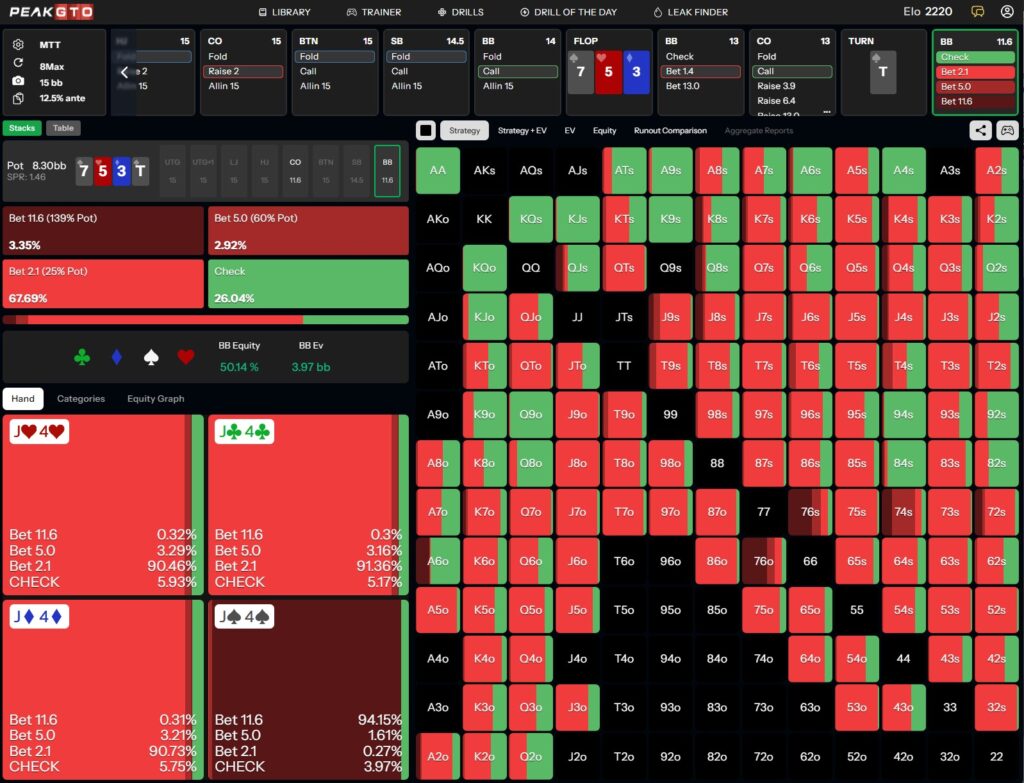
First, the ten is not a particularly good card for the cutoff. While CO will have some tens in range, PeakGTO shows BB also holds plenty of tens after leading the flop, plus all the sevens, fives, and even threes that want to keep betting for value. Second, because BB bet so small on the flop, CO had to call very wide, which means CO’s turn range includes a lot of unpaired high cards and weak ace-highs that will fold to continued pressure.
The solver has BB betting 74.0% on the turn, with 2.1bb as the primary size at 67.7%. The small sizing again serves double duty: it extracts thin value from made hands while keeping the bluff cheap. Hands with a six or four are especially happy to continue, because they hold gutshots or straight draw combinations. The key principle at shallow stacks: when you led the flop with a gutshot and still have the gutshot on the turn, you can continue with a small bet. Only shove when you pick up significant additional equity, like turning a flush draw. J4 of spades, for example, would prefer to jam because it turned a flush draw and has good equity even when called. J♥4♥ keeps it small.
CO folds 16.2%, calls 56.5%, and raises all-in 27.3%. Hero bets 2.1bb. CO calls.
River: 2♥
The 2♥ completes nothing. The board finishes 7♠5♥3♦T♠2♥. Hero has jack high, zero showdown value, and 9.5bb remaining in a 12.5bb pot.
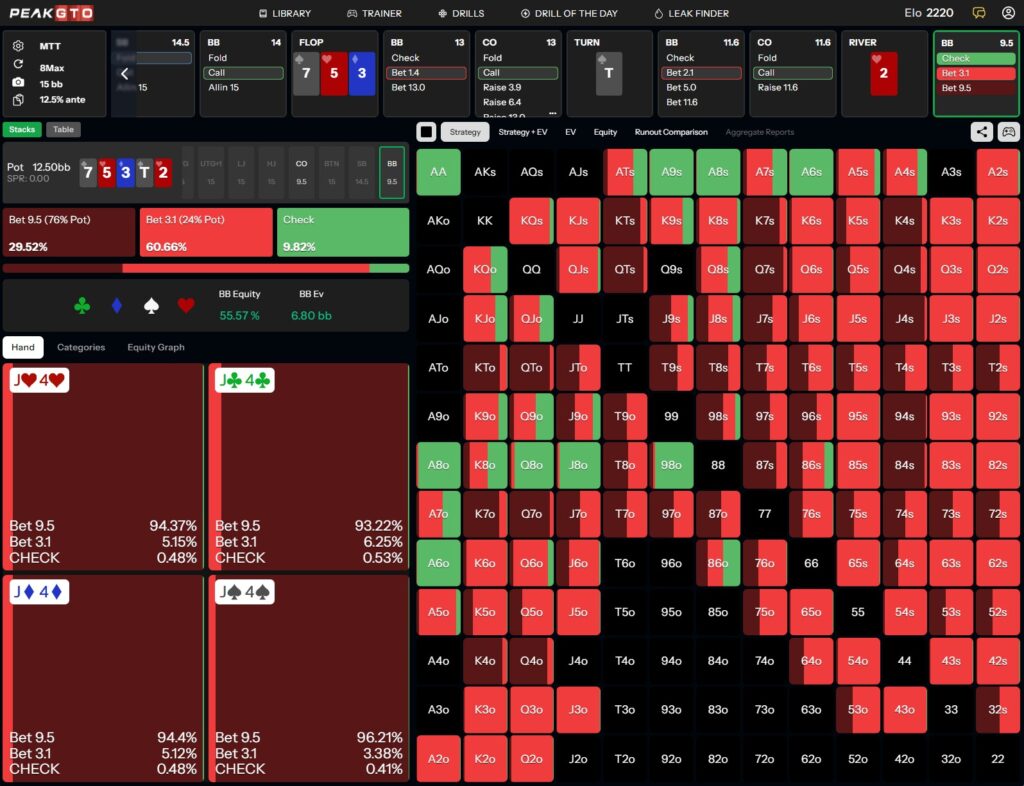
The solver has BB betting 90.2% of the time on this river, split between 3.1bb (60.7%) and 9.5bb all-in (29.5%), with only 9.8% checking. BB’s value range is strong here: tens for top pair, sevens for second pair, fives and threes that held up, plus occasional two pairs and straights. The medium strength hands primarily use the small sizing. The all-in shove is reserved for the top of the value range and the bluffs that need maximum fold equity.
J♥4♥ is a shove. The logic is straightforward: jack high cannot win at showdown, and BB needs bluffs to balance the value shoves. Hands like J4, Q4, K4, and J6, all of which took the same small-small trajectory through the flop and turn, are the natural bluff candidates because they have nothing to lose by shoving. Checking means giving up the pot with certainty.
The pot odds for the shove: 9.5bb into a 12.5bb pot requires CO to fold roughly 43% of the time to break even. The solver has CO folding 45.0%, clearing the threshold. In practice, many opponents who called two small bets on a low board will be sitting with ace-high and unpaired overcards by the river. Those hands fold to a shove. The only time to reconsider is if you believe your specific opponent drastically overfolds the flop and turn, because that means their river range is condensed to pairs and better, and pairs do not fold to this sizing.
In both the GTO solution and in practice, J♥4♥ shoves. It sounds aggressive to bet small, bet small, then jam for 9.5bb, but the stack math was building toward this from the flop. The two small bets kept the risk low while building a pot that makes the final jam profitable. Hero bets 9.5bb all-in. CO folds.
Key Takeaways
- Flop: BB leads 34.6% on 7♠5♥3♦, primarily using the small 1.4bb sizing (29.9%). Low, connected boards are one of the few textures where the big blind should donk bet into the preflop raiser. J♥4♥ qualifies because it combines a gutshot (any six) with a backdoor heart flush draw.
- Turn: The T♠ does not improve the draw, but BB continues betting 74.0% at the small 2.1bb sizing. At shallow stacks, when you led the flop with a gutshot and still have the gutshot, continue with a small bet. Only shove when you pick up significant new equity like a flush draw.
- River: The 2♥ bricks all draws. J♥4♥ shoves 9.5bb into the 12.5bb pot. Jack high has zero showdown value, making it a natural bluff candidate alongside Q4, K4, and J6. CO folds 45.0%, clearing the 43% breakeven threshold.
- Overall: This hand demonstrates the small-small-shove bluff trajectory at 15bb. The donk bet starts cheap on a board that favors the big blind’s range. The turn barrel continues because the gutshot persists and the opponent’s wide calling range includes many hands that fold to continued pressure. The river shove is the payoff: two small bets kept the risk low while building a pot that makes the final jam profitable. The transferable concept is recognizing which flops justify a donk bet. If the board is low and connected, the big blind has the range advantage, and leading with gutshots and backdoor draws is not just allowed but often better than checking.