One of the most common leaks in live poker is folding a perfectly good bluff-catcher because a big river bet looks scary. Players check a marginal made hand on the flop, check it again on the turn, and then talk themselves out of the call when the opponent finally fires. The irony is that the very act of checking twice is what makes the call correct. By showing weakness, you invite the opponent to bluff, and once you have induced that bluff, surrendering to it defeats the entire purpose of the line.
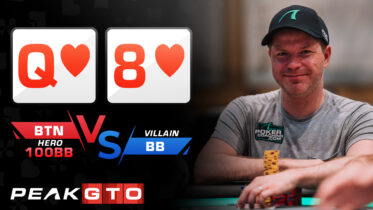
Today we will analyze a 100bb 8-handed cash game hand where the button opens Q♥8♥, flops middle pair on K♣Q♣9♦, checks it back through the turn, and then faces a river lead. This hand shows why middle pair with no kicker controls the pot by checking, why betting the turn is a trap, and why a checked-down marginal made hand calls the river against essentially any reasonable size.
Assumptions
- Stacks: 100bb effective
- Format: 8-handed cash game
- Positions: BTN (Hero) vs BB (Villain)
- Action: BTN raises, BB calls
- Flop: K♣Q♣9♦ (Pot: 6.5bb), checks through
- Turn: 3♥ (Pot: 6.5bb), checks through
- River: 4♠ (Pot: 6.5bb), BB leads 3.9bb
Preflop
From the button, Q♥8♥ opens routinely, and the big blind calls. We take a flop in position with a hand that will most often flop a weak pair or air, which is exactly what happens here.
Flop: K♣Q♣9♦ (checks through)
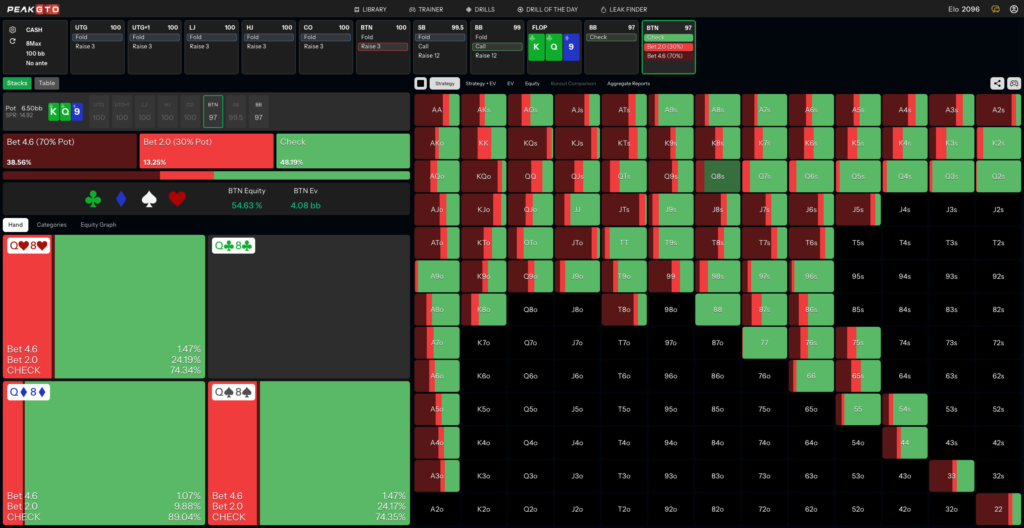
Hero flops middle pair with no kicker, a pair of queens on a king-high, two-club board. This is a clear marginal made hand, and the right play is to check it back the vast majority of the time rather than continuation betting. Betting a hand like this on such a coordinated, high board mostly folds out the air it already beats and gets action only from better hands and draws that have plenty of equity. Checking keeps the pot small, controls the hand, and protects Hero’s checking range, since that range needs strong hands mixed in alongside the air. Hero checks, and the flop goes check-check.
It helps to think about the texture from a range perspective. KQ-nine with two clubs is a board where the big blind’s calling range connects well, holding plenty of king-x, queen-x, straight draws, and flush draws. The button’s preflop raising range is not far ahead, so there is no big nut advantage to lean on, and that lack of an edge is precisely what argues against a continuation bet with a vulnerable holding. A pair of queens with no kicker is the kind of hand that wins a small pot or loses a big one, and the way to keep it on the right side of that ledger is to refuse to inflate the pot when you are out of clear value targets to bet against.
Turn: 3♥
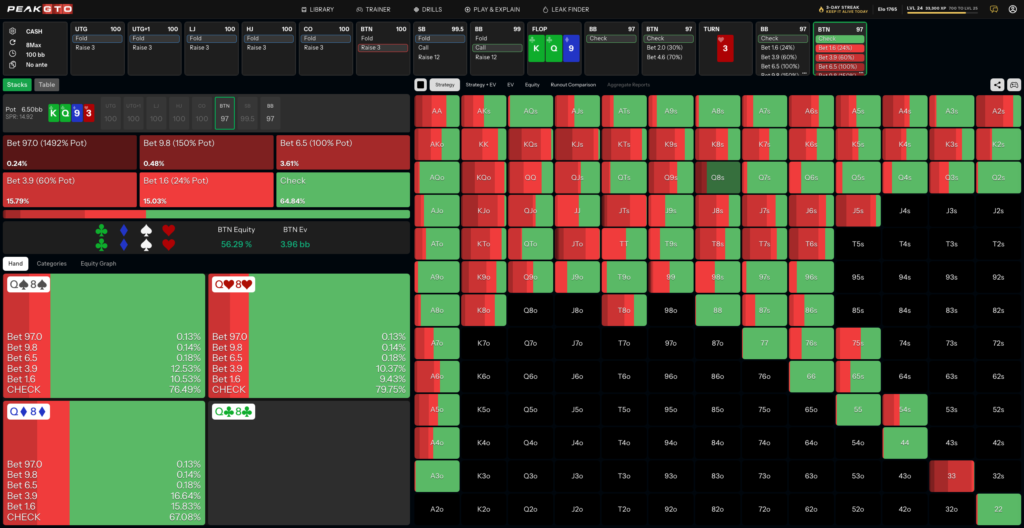
The 3♥ is a blank and the big blind checks again. Here is the temptation that costs players money: “the opponent checked twice, I have the best hand, so I will bet.” It is a trap. Think about what Hero checked back on the flop, which includes a lot of king-x hands. Those king-x combinations are the top of the range and are the hands that get to bet the turn. Queen-x is not at the top of the range, so most of it, including Q8, should keep checking. PeakGTO checks Q8 more than 80% of the time.
The deeper reason to check is twofold. First, if Hero bets and the big blind raises, which it should do some of the time, Q8 is in terrible shape and has to fold its showdown value. Second, checking actively induces the out-of-position player to make a mistake. By showing weakness twice, Hero invites the big blind to value bet too thinly or to bluff anything that cannot win, which is exactly the kind of error a marginal made hand wants to harvest. There is an exploit layered on top: if the opponent never checks king-x on the turn, then Hero’s Q8 climbs in relative strength and a thin value bet becomes reasonable. Against a tricky player who traps with kings, betting is out of the question. Hero checks, and the turn goes check-check.
River: 4♠
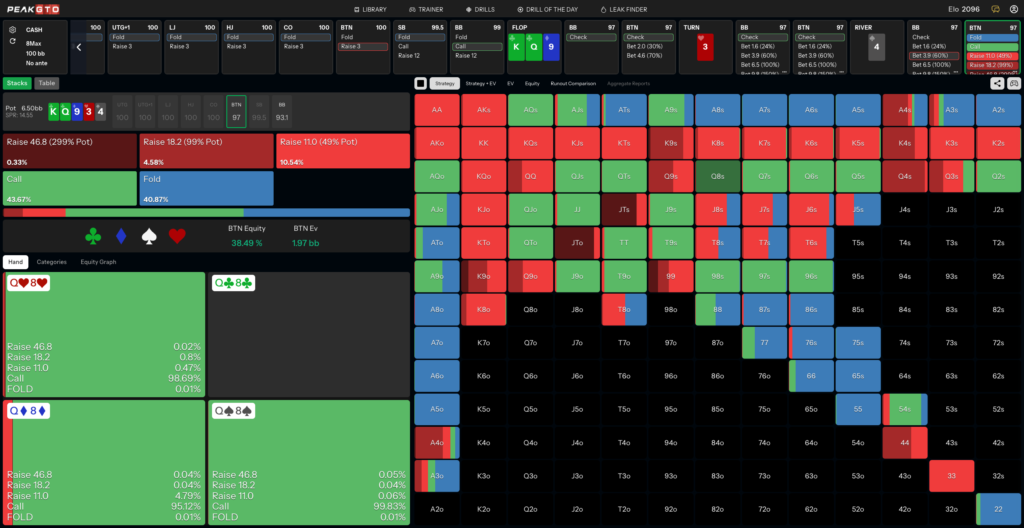
The 4♠ is a complete blank, and now the big blind leads for 3.9bb, about 60% of the pot. This is the decision the whole line was built around, and the answer is simple: call. When you check the flop with second pair, check the turn with second pair, and the opponent makes any reasonable bet on a river that did not change the board, you call. Q8 is so clearly a bluff-catcher here that it calls against essentially every size. Facing this 60% pot lead the solver calls Q8 about 99% of the time.
The logic is the heart of bluff-catching. By checking twice, Hero deliberately induced the big blind to bet a wide range that is heavy with bluffs and thin value, exactly the hands Q8 beats. Folding now would throw away all the value of that induction. Many players check it down and then, the moment the opponent finally fires a big river bet, panic and think “they must have me beat.” Sometimes they do, but a great many opponents will take ace-high and turn it into a bluff, or value bet TT or A9 far too thinly, without ever considering what Hero’s capped checking range looks like. The pot odds are good and the opponent’s range is wide, so this is a routine call. Hero calls and takes it to showdown.
It is worth noting what the GTO solution does with the stronger hands in Hero’s range, because it reinforces the point. Against a small or medium river lead, the very best hands, the king-x combinations, get to raise for value, and Q8 can occasionally mix in a tiny raise of its own. But Q8 is overwhelmingly a pure call, not a raise, because raising only gets value from the hands it already beats and folds out the bluffs it wants to keep in. The hand is a perfect bluff-catcher, and a bluff-catcher’s job is to call. Trying to get cute and raise a middle pair turns a clean, profitable call into a spot where you can only be called or raised by something better.
Key Takeaways
- Flop: On K♣Q♣9♦, middle pair with no kicker checks back about 74% of the time. Betting this marginal hand on a coordinated high board only folds out worse and gets action from better.
- Turn: The 3♥ tempts a value bet, but Q8 is not at the top of the range and checks over 80%. Checking avoids a check-raise and induces the opponent to barrel or over-value-bet.
- River: The 4♠ blanks and the big blind leads. Q8 calls nearly 100%, because checking twice induced a bluff-heavy range and folding the induced bluff defeats the line.
- Overall: A marginal made hand controls the pot by checking, which both protects the range and induces mistakes, then calls the river. When you check down to reach a reasonable showdown, do not let a scary-looking bet talk you into folding the bluff-catcher you planned to call. The plan was the showdown all along, and the river bet is the opponent walking into it rather than a reason to abandon it.