Try This Hand Yourself
Play this exact spot against the solver in PeakGTO before reading the analysis.
A 3-bet pot played in position is one of the most profitable situations in tournament poker, but only if you understand its mechanics. The pot is bloated, the stack-to-pot ratio is low, and every street pushes you toward big decisions faster than a single-raised pot would. That structure rewards two skills that feel like opposites: defending far wider than instinct suggests on early streets, and showing restraint with your draws when betting would only build a pot you do not want to play. Get both right and you arrive at the river with a disguised range that can apply enormous pressure.
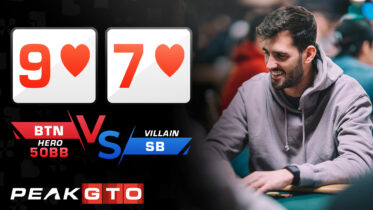
Today we will analyze a 50bb 8-handed tournament hand where the button calls a small blind 3-bet with 9♥7♥ and plays a 3-bet pot in position on 6♠4♥3♣. The hand moves through a wide flop defend, a disciplined turn check-back with a strong draw, and a river overbet jam once the draw bricks. Each decision is a piece of the same lesson: how the mechanics of a 3-bet pot let an in-position caller turn a missed hand into a credible bluff. The reasoning below includes why checking a flush draw plus a double gutshot can be more profitable than betting it.
Assumptions
- Stacks: 50bb effective
- Format: 8-handed MTT, 3-bet pot
- Positions: BTN (Hero, in position) vs SB (Villain, the 3-bettor)
- Action: BTN opens, SB 3-bets, BTN calls
- Flop: 6♠4♥3♣ rainbow (Pot: 19.6bb)
- Turn: T♥ (Pot: 29.4bb)
- River: J♠ (Pot: 29.4bb)
Preflop
The button opens, the small blind 3-bets, and the button calls with 9♥7♥. Calling a 3-bet in position with a suited connector is standard. The hand makes strong, disguised holdings and, just as importantly, the button keeps position for the rest of the hand. That positional edge is the engine behind everything that follows, because it lets the in-position player control the size of the pot and choose when to realize equity rather than being forced to act first.
It is also worth noting why a suited connector specifically, rather than an offsuit broadway, is the better flat here. Hands like 9♥7♥ flop a usable draw far more often, make hands the small blind cannot easily put you on, and never get coolered by dominating top pairs the way an offsuit ace-x can. That combination of disguise and low reverse-implied risk is exactly what you want when you flat a 3-bet and plan to play several streets out of the blinds’ line of sight.
Flop: 6♠4♥3♣
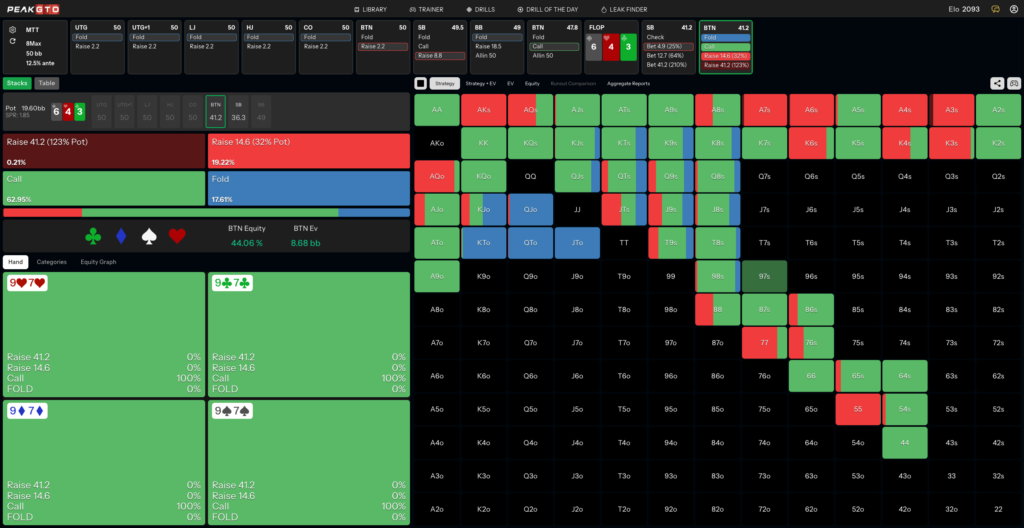
The small blind fires a small continuation bet of 4.9bb, about a quarter of the pot. On a low, disconnected board like this, the 3-bettor uses a small size to push its range edge cheaply. 9♥7♥ flops two overcards, a gutshot to the five, and a backdoor heart flush draw. This is a very clear continue, and the broader point is the one that surprises most players: how wide the button has to defend. You have to fight so hard in these spots, especially on these low-card boards, to the point of calling nearly the entire grid of suited hands that carry a backdoor draw.
The reason is a range mechanic. The button’s calling range is full of overcards that flop little but retain real equity through backdoor draws and the ability to make the best high card. Folding those hands to a cheap continuation bet would let the small blind print with its entire range. So 9♥7♥ calls, looking to draw toward a strong hand while keeping the door open to bluff later. Hero calls. Both players see the turn.
Turn: T♥
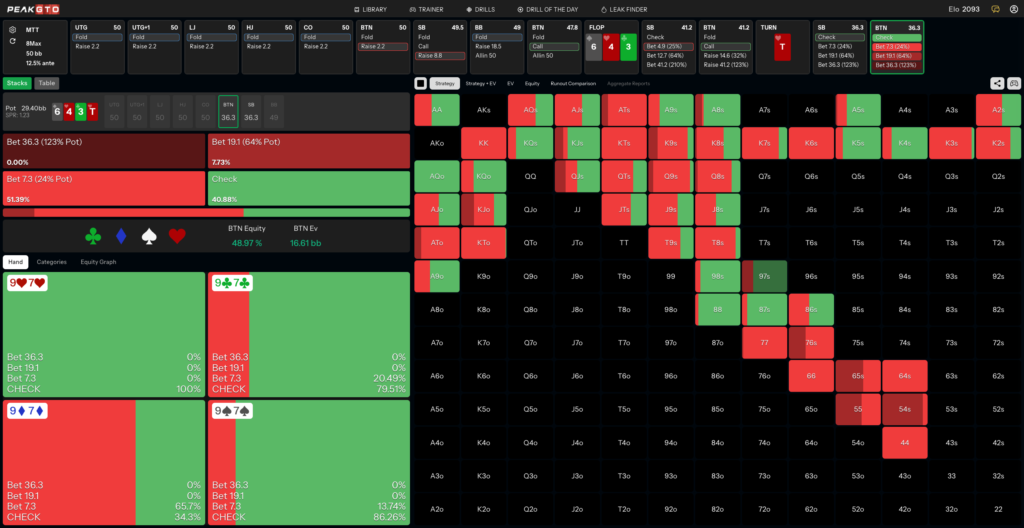
The T♥ is a huge card for the hand. It brings a heart flush draw to go with the existing gutshot, and it adds a second gutshot, so 9♥7♥ now draws to a flush plus either a five or an eight for a straight. The small blind checks. With this much equity, betting feels automatic, and that instinct is the trap. PeakGTO has the button checking back about 41% of the time, and 9♥7♥ is squarely a check-back.
This is one of the most important concepts in shallow-SPR play. When you are in position at somewhat shallow SPRs, you need to check this hand back and realize your equity. The danger of betting is the check-raise. If the small blind has a hand like jacks or better, or an over pair, and jams over the button’s turn bet, the button is stuck playing a huge pot with a draw that is suddenly in terrible shape. The test for which hands to bet is practical and worth stealing: bet the draws you can comfortably bet-call, and check back the draws that would hurt to bet-call. A flush draw with dominating high-card equity, or a hand that unblocks the opponent’s busted backdoors, can bet and call a jam. 9♥7♥ is not that hand, so it takes the free card. Checking back realizes the draw’s equity at zero risk and disguises the hand for the river. Both players check.
River: J♠
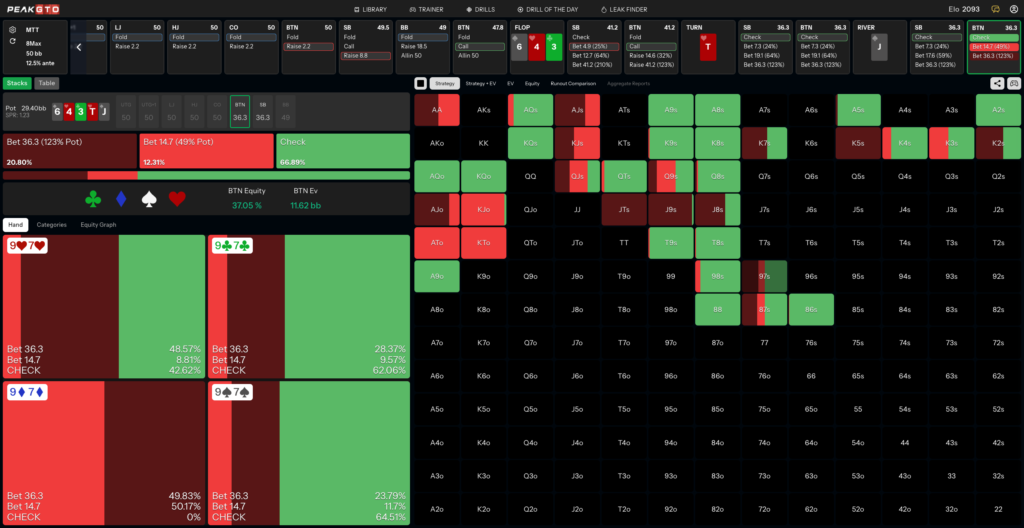
The J♠ bricks every draw. The board reads 6♠4♥3♣T♥J♠, and 9♥7♥ is nine-high with no showdown value. The small blind checks again. The button can bet a 14.7bb half-pot size or a 36.3bb overbet jam of roughly 123% of the pot. With a busted draw, the jam is the play, and the reason is entirely about how the line reads.
Think about how the button arrives here: call a 3-bet preflop, call the flop, check back the turn, and now face a river check. That sequence looks exactly like trapped value. The jam just looks like AJ, KJ, trapped 66, trapped fours or threes. The button has plenty of credible value to represent, which is the prerequisite for a believable bluff. Meanwhile, the button genuinely lacks natural bluffs in this spot. Hands like A2 and A5 would rather check and show down, and there are very few clean offsuit bluff candidates on a JT runout. The hand that bricked its draw is the one holding that has to do the bluffing.
The exploitative case is even stronger. At shallow SPR, the small blind’s check-back range here is heavy with ace-high, hands like AQ and AKo that played a medium-strength line and want to reach showdown. To call a 36.3bb jam, the small blind needs to defend exactly those hands, and in practice almost nobody calls off ace-high facing a river overbet. The solver already jams 9♥7♥ close to half the time here, about 49%, and checks it around 43%, so this exact combo is essentially a coin flip that slightly favors the jam. Against the very best players, mixing a jam with a check is the disciplined, balanced choice. The real-world adjustment is direct: against a typical field this is a perfect spot to go for a bluff every single time, and you are going to get a fold quite often. Against the field, the always-jam line beats the balanced one. This is the GTO baseline pointing the way, and a population read pushing the frequency higher.
Hero jams 36.3bb. The small blind folds. The pot is collected without the best hand, which is exactly what the mechanics of the 3-bet pot were building toward all along.
Key Takeaways
- Flop: In a 3-bet pot in position on a low board, defend extremely wide against a small continuation bet. 9♥7♥ calls with two overcards, a gutshot, and a backdoor flush, joining nearly every suited hand with a backdoor draw.
- Turn: Even after picking up a flush draw and a double gutshot, check back at shallow SPR. Betting invites a check-jam that turns the draw into a nightmare. Bet only the draws you can comfortably bet-call; check back the rest to realize equity for free.
- River: When the draw bricks, the check-back line reads as trapped value and the hand has few natural bluffs, so the busted draw jams. Choose the overbet (36.3bb) to maximize fold equity against a check-back range full of ace-high.
- Overall: The mechanics of a 3-bet pot reward wide early defense and disciplined turn play, which together build a credible river range. The solver already jams this combo about half the time as a near-coin-flip, slightly favoring the jam, but against opponents who fold too much, bluffing every time is the higher-EV exploit.