Try This Hand Yourself
Play this exact spot against the solver in PeakGTO before reading the analysis.
The best bluffs are decided long before the river. A profitable river bluff usually traces back to a quiet flop decision that most players get wrong: calling a bet with a hand that has almost no equity, simply because it will be perfectly positioned to apply pressure later. The skill is not finding the courage to fire on the end. It is recognizing on the flop which weak hands are worth keeping, because they unblock the hands you want to fold out and they leave your range with the bluffs it will need. This is how strong players gain EV in spots where everyone else gives up.
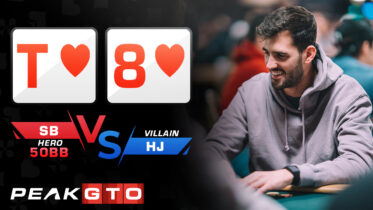
Today we will analyze a 50bb 8-handed tournament hand where the small blind defends T♥8♥ against a hijack open, calls a small continuation bet on A♠7♥2♣ with nothing but ten-high and two backdoor draws, and ends up firing a pot-sized river bluff after the board bricks out. The hand is a clinic in connecting flop and river decisions: why a 20% equity hand is a call, why the turn checks through, and why ten-high becomes the perfect hand to bluff with on the end. The logic is choosing hands for their future bluffing value rather than their current strength.
Assumptions
- Stacks: 50bb effective
- Format: 8-handed MTT
- Positions: SB (Hero) vs HJ (Villain)
- Action: HJ opens, SB calls
- Flop: A♠7♥2♣ rainbow (Pot: 6.4bb)
- Turn: 3♠ (Pot: 9.6bb)
- River: 2♦ (Pot: 9.6bb)
Preflop
The hijack opens and the small blind calls with T♥8♥. A suited ten is a fine defend, but the call commits the small blind to playing out of position with a hand that will usually flop a marginal holding. That positional disadvantage is the backdrop for the whole hand, and it is exactly why hand selection on later streets has to be deliberate rather than automatic.
Flop: A♠7♥2♣
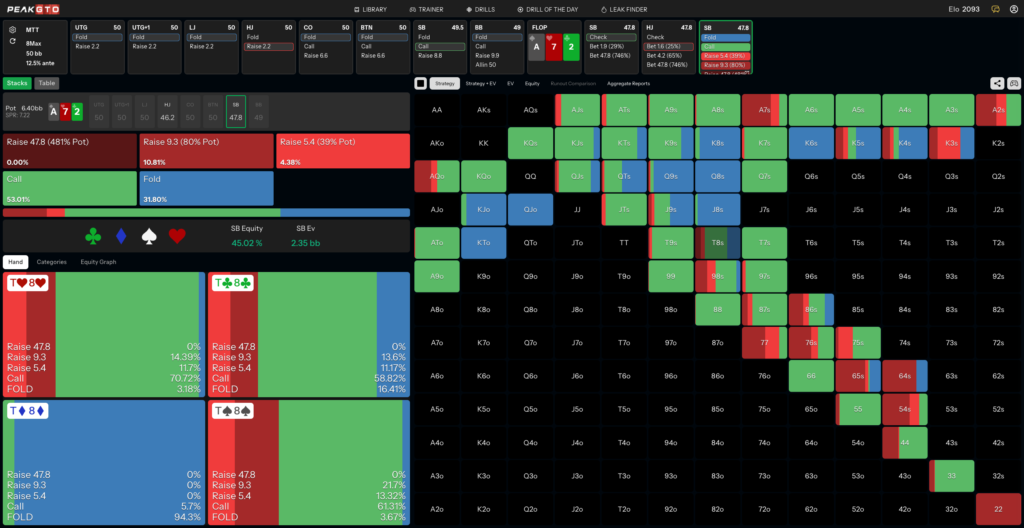
The small blind checks and the hijack fires a small 1.6bb continuation bet, about a quarter of the pot. The board is ace-high and dry, which favors the preflop raiser, and with T♥8♥ the small blind has only ten-high plus a backdoor straight draw and a backdoor flush draw. The instinct is to fold and move on. This is a spot people misplay by being too tight. You might be thinking, I have ten-high, I’m out of position, the board’s good for the opponent, but when you face this small bet you have to think about what your own range looks like.
Here is the part that breaks intuition. T♥8♥ has roughly 20% equity, while a hand like K6s has closer to 30%. Yet the solver calls the ten-high and folds the king-high. The reason is not raw equity, it is playability and blockers. Ten-high out of position has clean turns, where it either picks up real equity or gets an easy fold, and it crucially unblocks the opponent’s offsuit high cards like QJ, KQ, and KJ. That last point is the whole game. When the hand checks down, the small blind’s range is loaded with aces that want to get to showdown, so it needs bluffs to balance them. T♥8♥ is one of the few hands that can fill that role later, so the small blind calls now to set up a future bluff. Across the range, the solver calls this c-bet 53% of the time. Hero calls.
It is worth sitting with the K6s comparison, because it overturns a habit most players never question. The higher-equity hand can be the worse call. K6s makes a pair of kings or sixes that is often second-best and awkward to play, it blocks some of the very high cards you would want the opponent to hold and fold to, and it does not run out cleanly on later streets. Ten-high with backdoors has worse equity but better structure: it improves to genuinely strong hands or folds easily, and its blocker profile is built for bluffing rather than thin value. The lesson is to evaluate a flop call by what the hand can become, not by the equity it shows right now.
Turn: 3♠
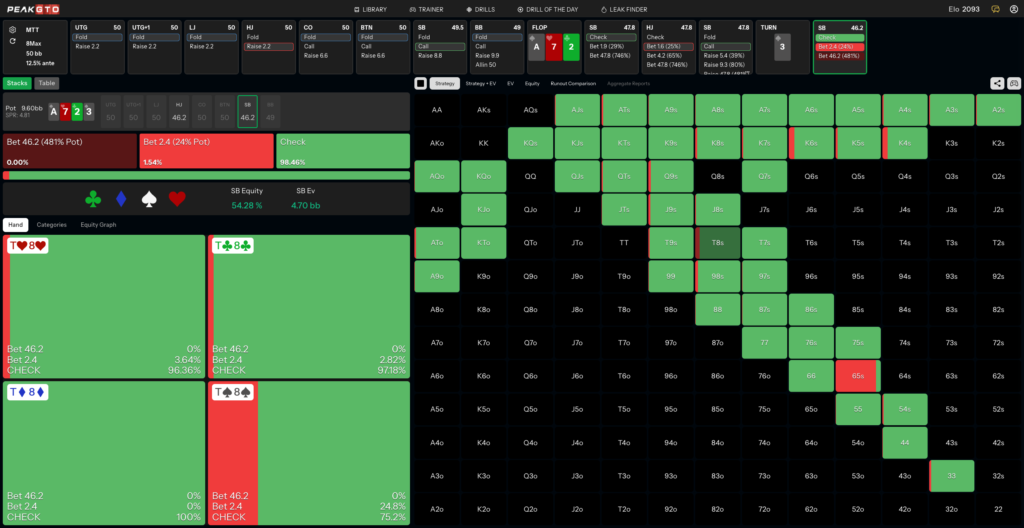
The 3♠ is a brick that changes nothing. PeakGTO has the small blind checking essentially its entire range here, about 98.5% of the time. With ten-high and no real improvement, there is no reason to bet: the small blind has no value to charge and no fold equity worth pursuing on a card that helps almost nobody. The plan is to keep the pot small, retain the option to bluff later, and see what the river brings. The small blind checks, and the hijack, holding a medium-strength hand like an underpair that is not strong enough to fire a second barrel, checks back. The turn goes check-check.
That check-back is information. When the in-position player declines to bet the turn, the strongest aces and most of the value have largely been removed from their range. By the river, the hijack is capped, holding a lot of medium pairs and missed high cards that want to see a showdown. That is precisely the range a well-chosen bluff can attack.
River: 2♦
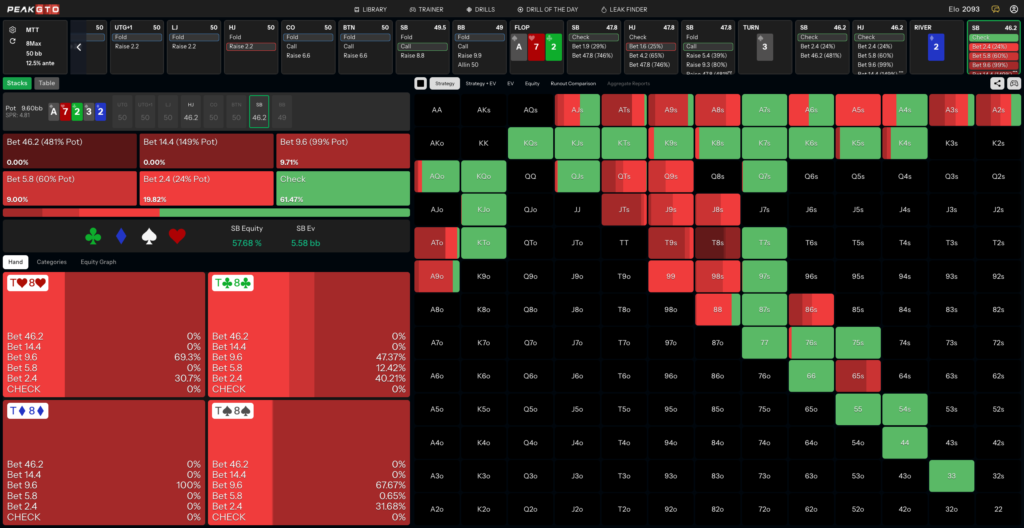
The 2♦ pairs the board and bricks every draw. The small blind has ten-high with no showdown value, and now the flop plan pays off. The reason to set up the bluff is that the small blind’s range is full of aces, so it can value bet thinly and therefore must bluff to stay balanced. The hands that bluff best are the ones that block the opponent’s calls and unblock the opponent’s folds. T♥8♥ fits perfectly: it unblocks the king-high and jack-high offsuit combinations the hijack will fold.
The sizing process starts from value. The small blind’s value bets here are its strong aces, and they want to bet big to target jacks through kings and the low suited aces that hero-call. Because T♥8♥ shares cards with the AT value hands and unblocks so many of the offsuit high-card combos the hijack folds, it belongs with that larger size rather than a small block bet. The solver’s pot-sized 9.6bb bet is the line T♥8♥ takes a large majority of the time. Unblocking those folds is the strongest reason to choose the bigger bet. The pot odds you offer with a pot-sized bet ask the opponent’s bluff-catchers a hard question, and a capped range rarely has the answer.
Hero bets 9.6bb, and the hijack folds an underpair. The pot is collected with ten-high, which is the entire point: the EV was created on the flop by calling a hand that could become a credible bluff, and realized on the river by following through. Most players never reach this node, because they fold the flop and never give themselves the chance. That is the GTO edge hiding in a hand that looks like a fold.
Key Takeaways
- Flop: Against a small c-bet on A72, T♥8♥ calls despite only ~20% equity, while a higher-equity hand like K6s folds. Playability and unblockers, not raw equity, decide which weak hands to keep.
- Turn: The 3♠ bricks, so the small blind checks nearly 100% of the time. The hijack’s check-back caps its range and sets up the river.
- River: With an ace-heavy range that value bets thinly, the small blind needs bluffs. T♥8♥ bets pot (9.6bb), unblocking the high-card hands the hijack folds and matching its value sizing.
- Overall: A river bluff is built on the flop. Calling with hands chosen for their blockers and playability, then following through when the board bricks, is how you gain EV in spots where most players have already folded.