Try This Hand Yourself
Play this exact spot against the solver in PeakGTO before reading the analysis.
One of the hardest sequences to play well is calling a raise on one street and then folding on the next. It feels inconsistent, even weak, but it is often exactly right. When you bet a thin value hand and get raised, the correct response depends entirely on how wide and how bluffy the raising range is, and the correct river response depends on a completely separate question: how often the opponent bluffs a big bet. A weak overpair can comfortably call a turn raise against a draw-heavy range and still be a clear fold to a river jam, because the two decisions are answering different questions. This hand shows how to keep those questions separate.
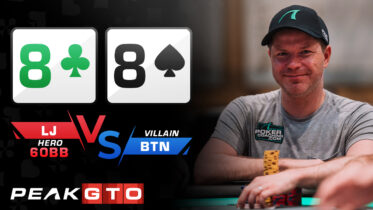
Today we will analyze a 60bb 8-handed tournament hand where the lojack opens 8♣8♠, checks a weak overpair on 6♠4♠3♥, bets small on the 2♣ turn, and gets raised. The overpair calls the raise rather than folding, the queen river is a check, and it then folds to a big jam. The lesson is that calling a turn raise does not commit you to the hand, and that both decisions are governed by your read on the opponent’s bluffing frequency.
Assumptions
- Stacks: 60bb effective
- Format: 8-handed MTT
- Positions: LJ (Hero, preflop raiser) vs BTN (Villain)
- Action: LJ opens, BTN calls; flop checks through
- Flop: 6♠4♠3♥ two-tone (Pot: 7.1bb)
- Turn: 2♣, Hero bets 1.8bb, BTN raises to 9.8bb (Pot: 7.1bb pre-bet)
- River: Q♥, BTN jams (Pot: 26.7bb)
Preflop and Flop
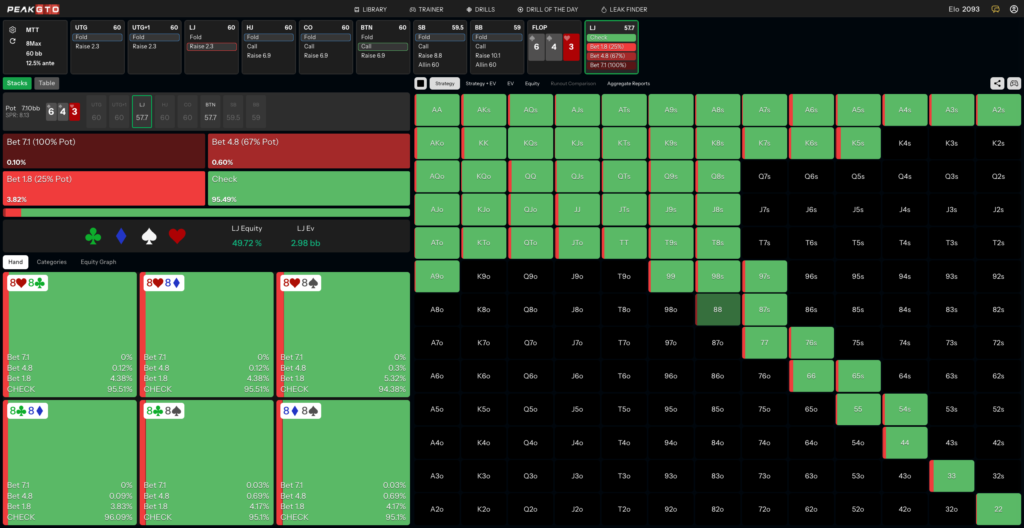
The lojack opens 8♣8♠ and the button calls. On the 6♠4♠3♥ flop, the weak overpair checks its entire range from out of position, because a low, connected, two-tone board favors the caller. The button checks back, which caps its range. The action then heats up on the turn, where the small bet gets raised.
Turn: 2♣, and the Raise
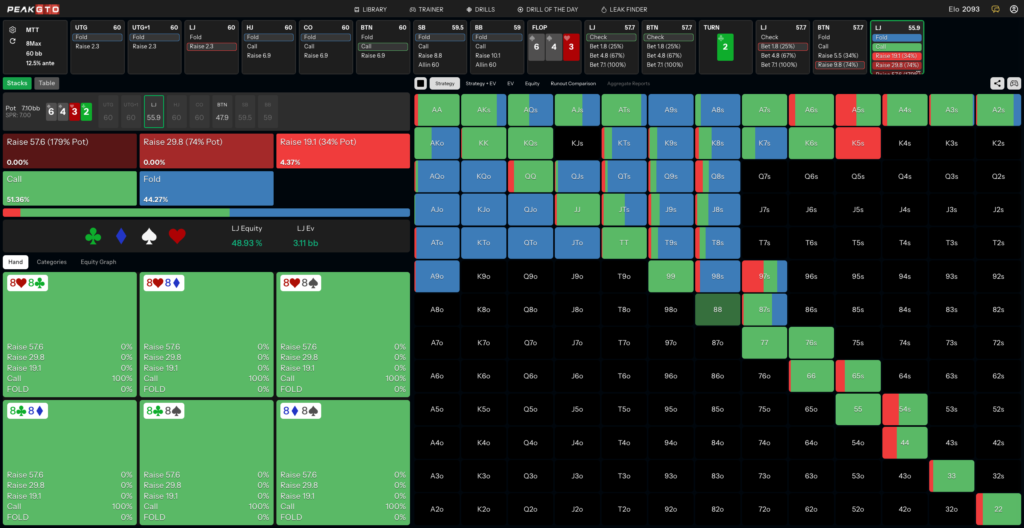
The 2♣ is a brick, and the lojack bets a small 1.8bb for thin value against the button’s capped range. The button raises to 9.8bb, and now the overpair has a decision. The instinct is to fear the raise and fold, but PeakGTO calls. The reason is the shape of the raising range. The hands that should raise here are remarkably junky: lots of holdings with a seven like T♣7♣, random eights like K♣8♣, and the spade flush draws. Because that range is so draw-heavy, the overpair has to continue a great deal, around 55%, and every pocket pair calls.
This is also where the read starts to matter. Most players do not bluff-raise the turn anywhere near often enough, so against a typical opponent you should overfold relative to the solver. Calling all of your overpairs may be a little bit too optimistic against weak, tight, straightforward people. But the default, against a properly constructed range, is to call, because folding would let a draw-heavy raising range run you over. Hero calls, and the pot grows heading to the river.
It helps to see why the call is well-justified by the math rather than a hero call. When a range is built mostly from draws and weak pairs, it contains far more combinations that you are ahead of than combinations that crush you, so even though the raise is sizable, the draw-heavy composition of the range means a modest made hand still has the equity to continue at a reasonable price. The mistake players make is pattern-matching “raise equals strength” and folding a hand that is actually well ahead of the bluffs and semi-bluffs doing the raising. The solver is not being brave by calling here; it is simply counting combinations and continuing the hands that beat the bulk of the raising range.
Flop Reference
It is worth restating why the flop check is what makes this whole line possible. By checking the entire range on the low, connected board, the lojack keeps its weak hands, its medium pairs, and its strong hands all bundled together, so the turn bet later is not transparent and the turn call does not stick out as obviously strong or obviously weak. A player who bets this flop and then bets the turn would arrive at the river with a far more readable, capped range, and would have a much harder time defending against a raise. The patient flop play is the foundation that lets the overpair both apply a little pressure on the turn and fold cleanly when the price gets too high.
River: Q♥
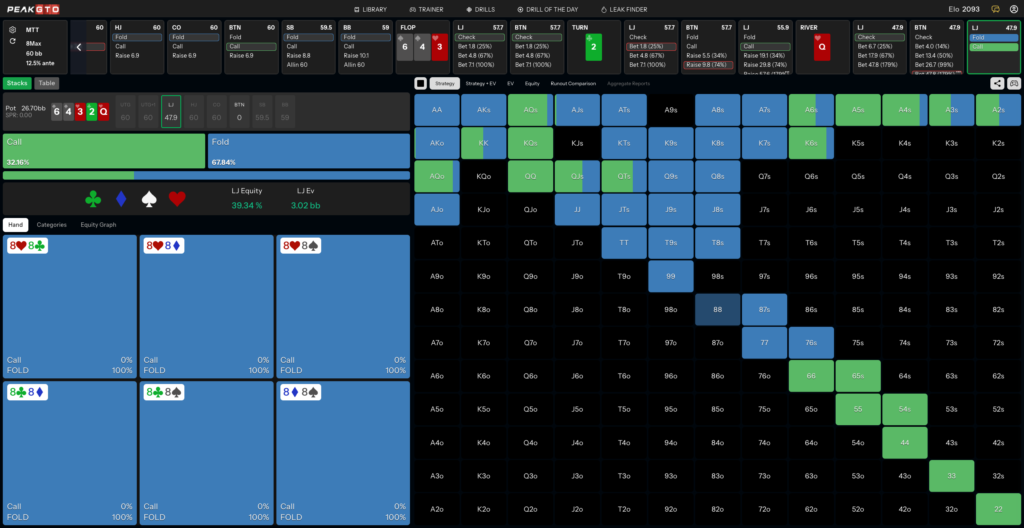
The Q♥ is an overcard, and the lojack checks essentially its whole range, including 8♣8♠. The button then jams a gigantic all-in, and the overpair folds 100% of the time. This is the crucial lesson: calling the turn raise did not commit the lojack to the hand. When the opponent both raises the turn and jams the river, their story is a straight (a five) or a set, with busted draws mixed in as bluffs, so the value-heavy jamming range simply beats a pair of eights too often.
It is worth being precise about which hands can actually continue, and 88 is not one of them. The bluff-catchers that call the jam are hands like AQ, which makes top pair and does not block the opponent’s bluffs, queens for a set, a few sets of sixes, completed straights such as A5, plus the low aces such as A4 and A3 that pair up and block the strong combinations. All the pocket pairs in the middle are folding, and that is exactly right: an eight is too weak to call a huge bet into a range that is mostly better. The disciplined turn call and the river fold are not contradictory; they are two correct answers to two different range questions.
As always, the read can override the baseline. If the opponent is the type to blast every river when you call their turn raise, putting you on an overpair and trying to barrel you off it, then they are bluffing far too often and you should become extremely call-happy. Against players who under-bluff, which is most of them, the GTO mix tips toward folding, and the pot odds of a giant jam are not enough to call without a real reason to think they are bluffing. Hero folds, having lost only a small-to-medium pot rather than stacking off with a weak overpair.
There is a reassuring counterpoint that makes the turn call easier to stomach. When the lojack checks this river, the button is supposed to check back a large share of the time, and the overpair beats almost all of that checking range. In other words, the opponent cannot profitably bet every river after raising the turn, so you are not signing up to face a jam every time you continue. You will reach plenty of rivers where you simply win at showdown or face a check. That is the quiet logic that justifies calling a turn raise you know you will sometimes have to abandon: most of the time you will not have to.
Key Takeaways
- Turn: Facing a turn raise, the weak overpair calls. The opponent’s raising range is junky and draw-heavy, so you must continue with all your pocket pairs rather than fold.
- River: Calling the turn raise is not a commitment. On an overcard river facing a jam, 8♣8♠ folds, because the jamming range is value-heavy and a middle pocket pair is no longer a viable bluff-catcher.
- Reads: Overfold the turn raise versus weak, tight players who never bluff-raise. Call wide on the river only versus opponents who will blast you off an overpair too often.
- Overall: The turn call and the river fold answer different questions, raise-range width versus river bluff frequency. Keeping them separate is what lets you continue without overcommitting a vulnerable hand.