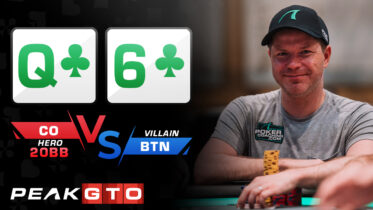
Try This Hand Yourself
Play this exact spot against the solver in PeakGTO before reading the analysis.
Some river cards are so good for your range that they turn even your weakest made hands into bluffs. When you have check-called twice with a marginal pair and the river brings a card that smashes your perceived range but misses your opponent’s, the right play is often to lead out and apply maximum pressure. A well-timed river bluff in this spot wins pots that a passive check would simply surrender. This tournament hand is a perfect example of a great river unlocking an aggressive jam from out of position.
Today we will analyze a 20bb 8-handed tournament hand where Hero opens Q♣6♣ from the cutoff, the button calls, and the board runs Q♥9♦5♣, K♠, A♥. Hero flops top pair, check-calls the flop and the king turn, and then leads all in on the ace river as a bluff. This hand shows why the ace is a great river for the cutoff, why Hero gets to lead out from out of position, and why a weak pair becomes one of the best hands to turn into a river bluff.
Assumptions
- Stacks: 20bb effective
- Format: 8-handed tournament (MTT)
- Positions: CO (Hero) vs BTN (Villain)
- Action: CO raises, BTN calls
- Flop: Q♥9♦5♣ (Pot: 6.5bb): CO checks, BTN bets 1.6bb, CO calls
- Turn: K♠ (Pot: 9.7bb): CO checks, BTN bets 5.8bb, CO calls
- River: A♥ (Pot: 21.3bb): CO bets 10.6bb all in, BTN folds
Preflop
At 20bb, Hero opens Q♣6♣ from the cutoff to 2bb and the button calls. This is a routine short-stacked open, and Hero will be out of position against a snug but strong caller. The preflop and flop play are identical to the other runouts of this hand; the entire story turns on the turn and river cards and what they do to each player’s range.
Flop: Q♥9♦5♣
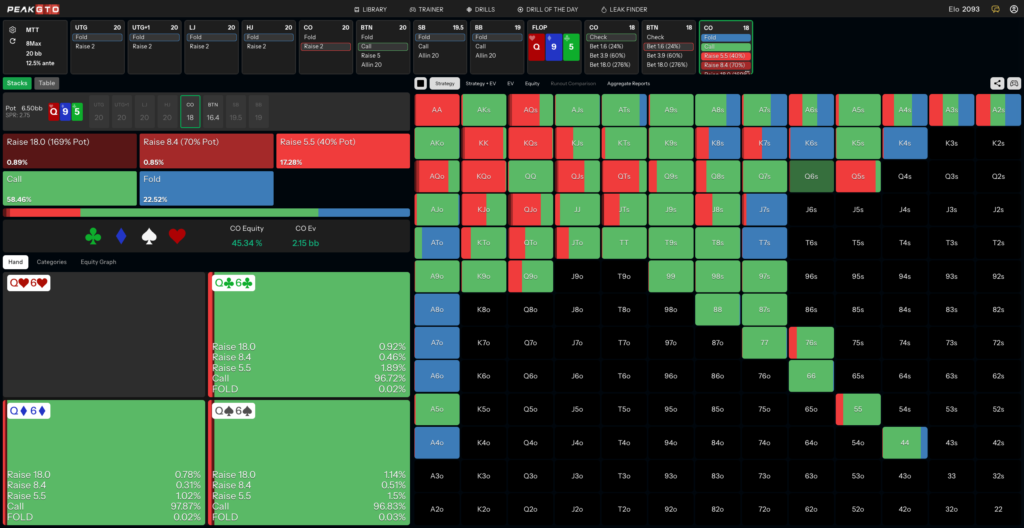
Hero flops top pair with a weak kicker. The correct play out of position with a marginal top pair is to check and check-call rather than fire a continuation bet, because Hero holds too many marginal hands and the button’s calling range is strong. The button bets a small 1.6bb, and Hero calls. Nothing here is unusual; the hand is being kept small and controlled with a pair that wants to reach showdown cheaply or pick up a better spot later.
This is the same flop line that works on every runout. The value of check-calling is precisely that it keeps every option open: Hero can call down on a brick, fold to overcards plus pressure, or, as happens here, flip a switch and become the aggressor when the board changes in its favor. A weak top pair does not have to commit to a single plan on the flop, and the cheap, controlled line is what gives Hero the flexibility to make the most of a great river two streets later. That optionality is worth far more than the small amount of value a flop bet would generate with this hand.
Turn: K♠
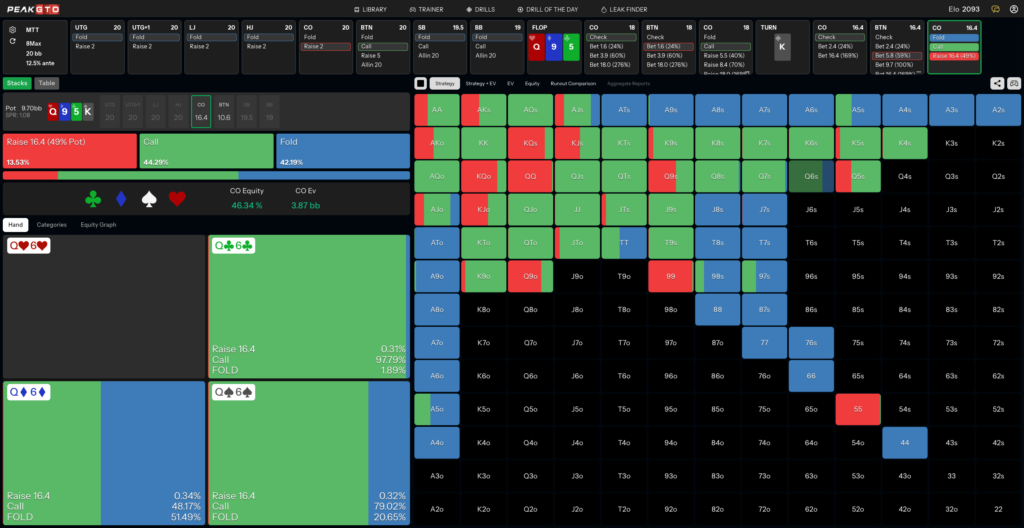
The K♠ is an overcard that makes Hero’s queens second pair, and the button fires a larger 5.8bb bet. Q6 continues comfortably here. What matters most for the river is what Hero’s check-calling range looks like at this point: it is actually fairly strong, containing AK, AQ, AJ, the Kx top pairs like KJ and KT, two pair with K9, and QT, alongside the weakest queens and nines that are mixing. Hero calls the 5.8bb, the pot reaches 21.3bb, and the stage is set for the river.
Holding that range in mind is the key to the next decision. Because Hero called twice rather than raising, the range arriving on the river is full of strong aces and kings plus a tail of weak pairs. The strong part wants to bet for value on the right card, and the weak tail is looking for a reason to either give up or turn into a bluff. The ace is about to give both halves exactly what they want, which is why thinking one street ahead about your own range, not just your hand, pays off so heavily here.
River: A♥
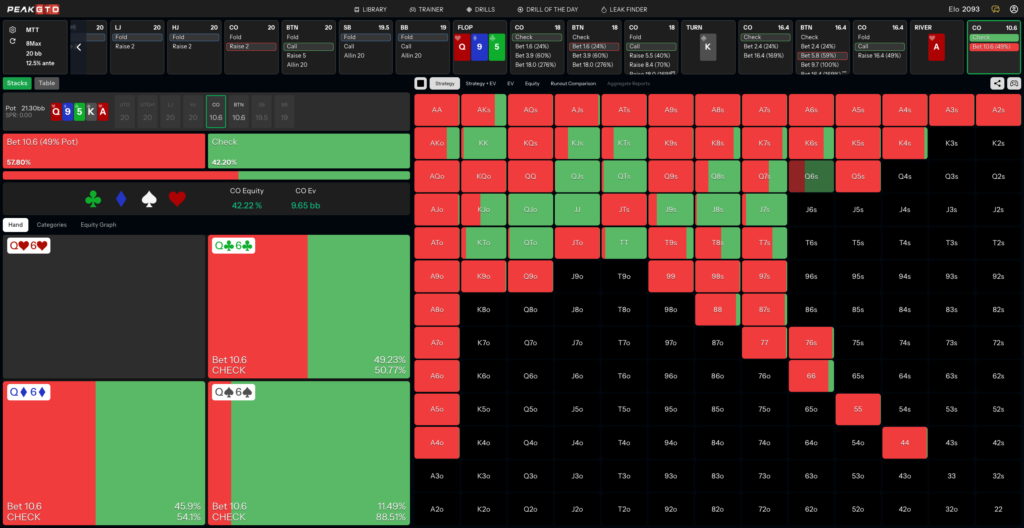
The A♥ is a really, really good river for the cutoff, and Hero gets to lead out a large share of the time. The reason is a range mismatch. When the button bets the turn, it does not have many aces, because hands like A2 would have bet the flop, checked back the king turn, and given up; so the button’s turn-betting range is short on exactly the card that just arrived. Hero, by contrast, can easily have aces. PeakGTO leads this river about 58% of the time, splitting between value and bluffs.
The value side jams KJ and better, all the Ax, and the JT straights, while the bluffs come from the weakest hands that do not want to check-call a bet and that block the button’s continuing range, including 98, 97, Q8, Q7, and Q6. Q6 is now third pair with essentially no showdown value against a betting range, so it mixes toward a jam rather than a pure check, jamming close to half the time. Most players make two mistakes here: they do not lead wide enough for value, and they do not bluff nearly enough. There is also a structural reason to bluff rather than check: because Hero leads its strong hands, its checking range becomes very weak, so if Hero checks and faces a jam it has to overfold dramatically, even letting go of KJ and KT in theory. Given that checking is a trap, Q6 should be willing to fire. Hero jams 10.6bb, the button folds its Kx and weak made hands, and the river bluff takes it down. This is the disciplined aggression that strong GTO play rewards: when the river is great for your range, lead your value and your worst hands, and let the bluffs print.
It is worth appreciating how unusual leading out of position into the player who held the betting lead actually is. For most of a hand, donking into the aggressor is a mistake, because the aggressor’s range is stronger and you give up the information of acting last. The ace river flips that completely: it is a card that hits the out-of-position raiser’s range far harder than the in-position caller’s, so the normal logic reverses and leading becomes correct. Recognizing these range-shifting rivers is what separates players who only ever check to the aggressor from those who know when to seize the initiative. Pairing that read with the willingness to fire your no-showdown hands, rather than only your premiums, is exactly what makes the play profitable, and it is the same skill that lets you find thin value leads on the cards that favor you and disciplined check-folds on the ones that do not.
Key Takeaways
- Flop: Weak top pair out of position checks and check-calls a small bet, keeping the pot small and the range wide for whatever the later streets bring.
- Turn: The king overcard makes the queens second pair, but Hero calls again. The key is that the check-calling range is strong, full of aces and kings plus a tail of weak pairs.
- River: The ace is a great card because the button’s turn-betting range lacks aces. Hero leads about 58% of the time, jamming value and turning the weakest hands like Q6 into bluffs.
- Overall: When a river card hits your range and misses your opponent’s, take the lead. A weak pair with no showdown value is a perfect candidate to become a river bluff, especially when checking would force a big overfold.