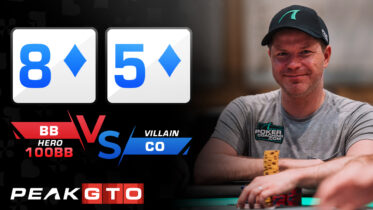
Try This Hand Yourself
Play this exact spot against the solver in PeakGTO before reading the analysis.
Few hands feel as uncomfortable to play as bottom pair from out of position. You are never sure whether you hold the best hand, you are first to act on every street, and a single barrel can leave you guessing. The instinct is usually to give up early, but that surrenders far too many pots, because bottom pair often comes with the extra equity that makes peeling correct. The real skill is knowing when that equity justifies a call and when a bricked river means it is time to fold. This hand walks through all three decisions in a 100bb cash game.
Today we will analyze a hand where Hero defends the big blind with 8♦5♦ against a cutoff open, flops bottom pair on 5♠7♦K♣, picks up a gutshot on the 9♠ turn, and faces a pot-sized barrel on the 2♦ river. This weak pair is a clear call rather than a raise, the turned gutshot is exactly what keeps the hand alive against a big bet, and the same hand becomes a fold once the draw bricks and the only thing left is a pair that beats no value.
Assumptions
- Format: 8-max cash game, 100bb effective stacks
- Positions: Hero is in the big blind (caller, out of position); Villain is in the cutoff (preflop raiser, in position)
- Hero’s hand: 8♦5♦
- Preflop: Cutoff raises to 3bb, Hero calls. Single-raised pot of 6.5bb.
- Flop: 5♠7♦K♣ (pot 6.5bb). Hero checks, cutoff bets 2bb, Hero calls.
- Turn: 9♠ (pot 10.5bb). Hero checks, cutoff bets pot, Hero calls.
- River: 2♦ (pot 31.5bb). Hero checks, cutoff bets pot, Hero folds.
Preflop
The cutoff raises to 3bb and Hero calls with 8♦5♦. This is close to the bottom of the defending range; against a 3bb raise with no ante, you do not want to call too wide, and a suited 85 is about as weak as you should get involved with. It does have the redeeming qualities of being suited and connected enough to flop pairs, straight draws, and the occasional disguised monster. Hero takes the flop heads up and out of position.
Flop: 5♠7♦K♣
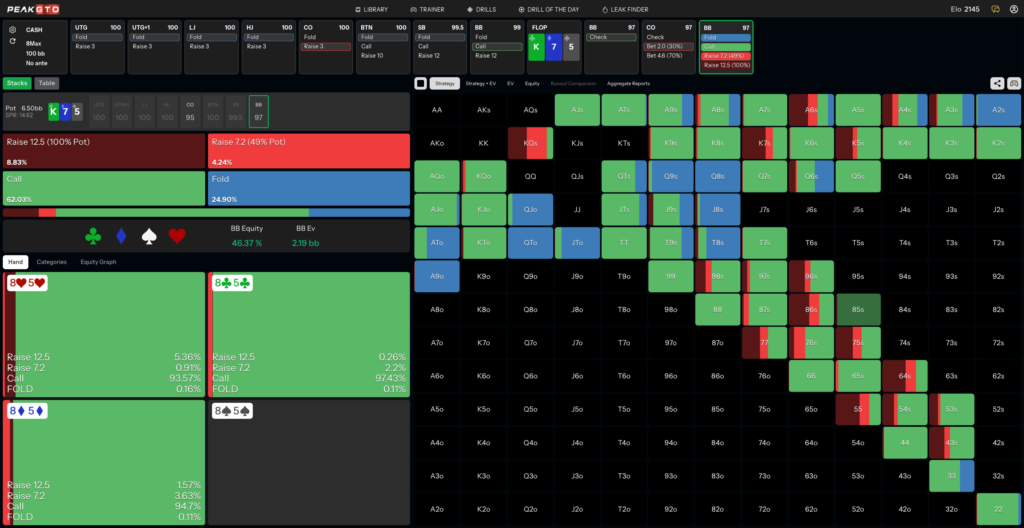
Hero flops bottom pair with a backdoor flush draw and a backdoor straight draw, and checks along with the entire range. The cutoff fires a tiny 2bb continuation bet, but it should not be betting this board very often, only about a third of the time and mixing the small size with a larger one near 4.6bb. The big blind connects reasonably well with all the medium cards here, so the cutoff has to check back plenty of hands like K4, QQ, ace-highs, and total air such as QT.
Against the small bet, 8♦5♦ is a straightforward call, and really the only option. It is tempting to think bottom pair with extra equity wants to raise, but the hands that raise here are the ones that are almost always good but vulnerable, plus the genuine draws. Interestingly, the solver does raise the weakest bottom-pair kickers like 53 and 54 a small amount, while better kickers such as 65, Q5, and A5 just call every time. 85s raises only about five percent of the time, which is effectively never. Hero checks and calls.
The price is a big part of why calling is so easy. Against a 2bb bet into a 6.5bb pot, Hero only needs to be good or to improve a small fraction of the time to continue, and bottom pair plus two backdoor draws clears that bar comfortably. Folding would surrender far too much equity to a bet that is often the cutoff giving up control of the pot rather than betting for value. Calling also keeps Hero’s range wide and connected, which matters on the many turns that improve these medium cards.
Turn: 9♠
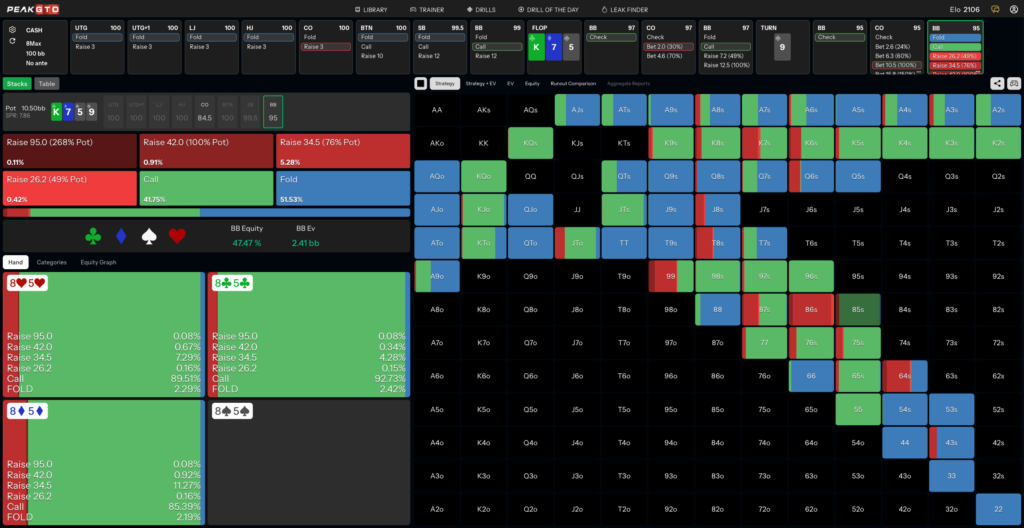
The 9♠ is a bigger card than it looks. Hero checks, the cutoff blasts a pot-sized 10.5bb, and many players look at bottom pair facing that kind of pressure and fold on the spot. That would be a mistake. The 9 gives Hero a gutshot, since any six now completes the 5-6-7-8-9 straight, and the pair adds outs of its own: a five makes trips that are almost always good, and an eight often improves to a winner as well. PeakGTO calls a healthy chunk of the time with this exact combination precisely because the gutshot is layered on top of the pair.
The gutshot is the whole difference. Add the straight draw and you are pretty much never folding a hand that holds an eight or a six, the lone exception being 66, which folds because they have fewer outs to improve. Raising is off the table against a bet this size; you raise only the very best made hands plus a few true draws like T8 and 87, and Hero does not have those here. So Hero does the uncomfortable thing and check-calls bottom pair and a gutshot out of position, which is very often exactly right.
It is worth noting how specific this is to having the draw. Strip the gutshot away and a bare bottom pair with no straight outs folds, because it has no way to improve and beats too little of the betting range. The lesson is not that bottom pair calls big bets, it is that bottom pair plus a live draw calls big bets. The pair provides a handful of showdown wins, the draw provides the outs, and together they clear the threshold that the pair alone never would.
River: 2♦
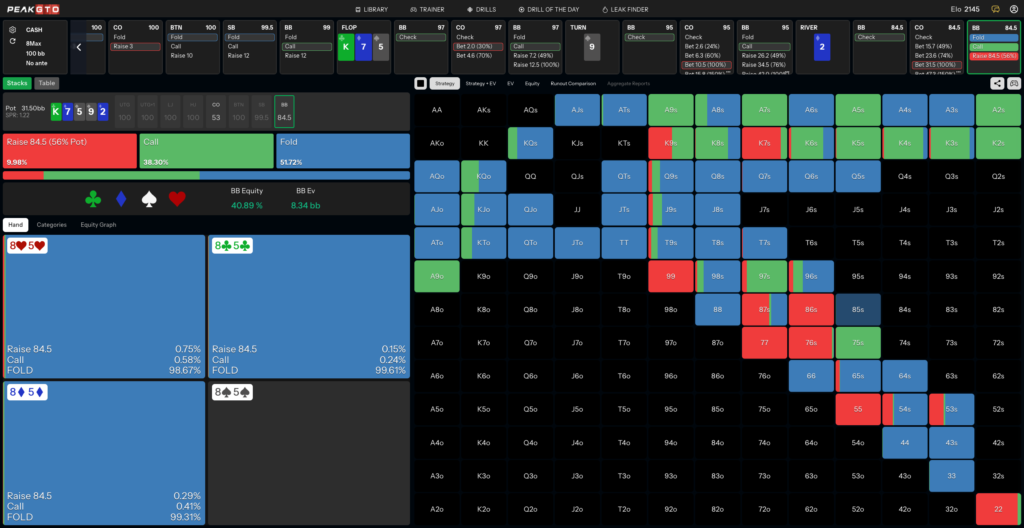
The 2♦ is a clean brick, the board reads 5♠7♦K♣9♠2♦, and the gutshot has missed. Hero checks and the cutoff bets a full pot, 31.5bb. The hand is now just bottom pair with no draw, and the decision comes down to whether that pair can profitably bluff catch. In GTO terms the solver mixes calling, folding, and even raising, but folding is preferred for a clear reason: bottom pair beats none of the cutoff’s value bets, so it can only ever win by catching a bluff.
That is where the blocker question decides it. When your hand beats no value, you want to ask whether your cards block the bluffs or unblock them. Here the eight is close to irrelevant, because the cutoff just does not show up with T8, Q8, or J8 very often, so holding the eight removes almost none of the bluffs you hope to catch. Combine that with the fact that the cutoff’s bet-small, blast, blast-pot line is extremely polarized and value-heavy, and the pot odds are not enough. Hero folds. The one adjustment worth remembering: against a live opponent who turns every busted QJ, QT, and 8x into a bluff, this exact hand swings back to an easy call, so calibrate to how often your opponent actually bluffs.
Key Takeaways
- Flop: Bottom pair with backdoor equity calls a small continuation bet and almost never raises. The solver raises only the weakest bottom-pair kickers; 85s simply checks and calls.
- Turn: When a card adds a gutshot to your bottom pair, it transforms the hand. The added straight outs make a check-call correct even against a pot-sized barrel, where the same pair with no draw would fold.
- River: Once the draw bricks, bottom pair beats no value and folding is preferred. The eight is a poor blocker because the opponent rarely holds the 8x bluffs, so there is little reason to call.
- Overall: Bottom pair from the big blind is about peeling when you have live equity and folding when you do not. Track your draws and your blockers, and adjust toward calling only when the opponent bluffs too much.