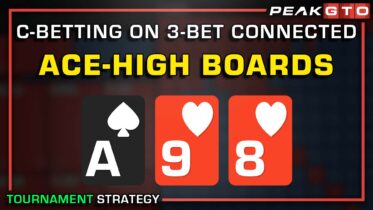

We already talked about c-betting on dry Ace-High boards in 3-bet pots, so today we will concentrate on covering strategy for connected flops.
We will examine wet board textures to identify strategy differences IP and OOP after 3-betting preflop and summarize key takeaways for each section.
C-Betting On Ace-High Boards In Position – As9h8h
We will start by analyzing an example of 3-betting from the button versus a cutoff open.
Key assumptions:
- The hand is played 40 bb deep with 12.5% ante
- Our opponent opens from the cutoff
- We 3-bet from the button
- CO calls to see the flop and checks to us
Let’s firstly look at a connected board of As9h8h to see our strategy in this situation.
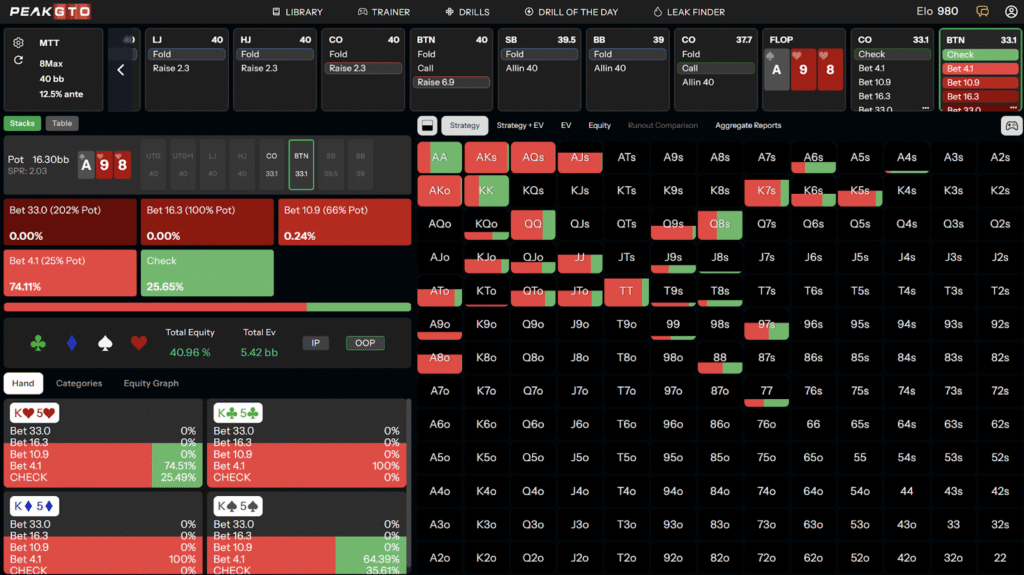
We have a huge range advantage in these situations, so we will bet very aggressively and use small sizing in all cases.
To be more precise, we will bet around 74% of our range and check 26% of the hands.
As you can see from the image above, we distribute our checks throughout the entire range. That said, we check back a lot of the time with a top set, and specifically KK that need less protection than other hands.
We are sticking to a 25% pot-size bet across all these cases, which allows us to remain aggressive with a wide range of hands.
When our stacks drop to 20bb, we do not have a 3-betting range in this situation, so we either call or move all-in if we decide to play the hand.
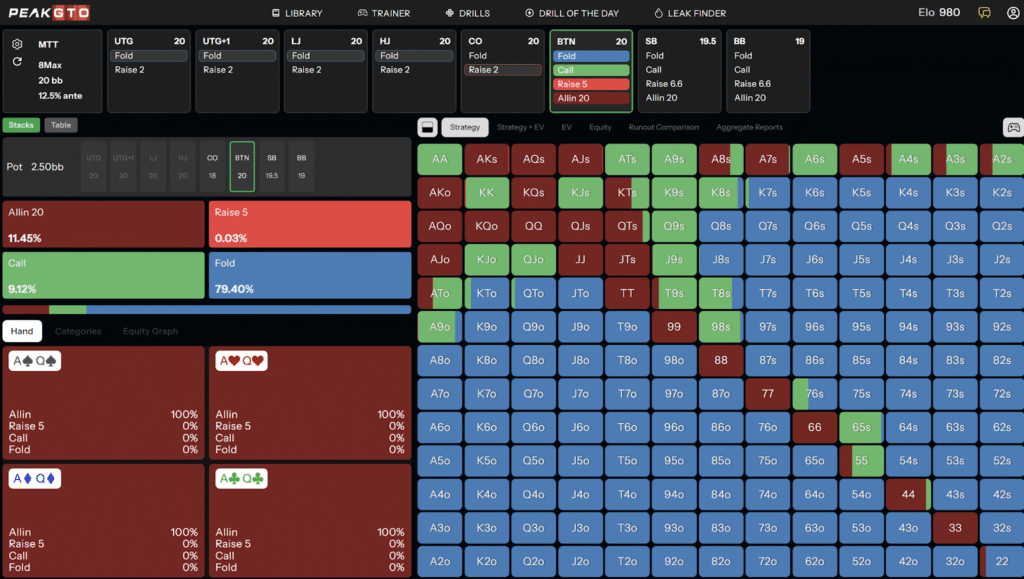
With shorter stacks, we move all-in with 11% of hands, call 9% and fold close to 80% of the range.
We play a very polarized strategy where we call our strongest hands like AA or KK, and then the weakest part of the range, while moving all-in with all of the hands in between.
Key takeaways
- C-bet very aggressively on connected boards with around 74% of hands
- Always pick a small bet sizing of 25% the pot when continuing
- Do not 3-bet with 20bb or less preflop and either fold, call, or move all-in
C-Betting On High-Card Boards OOP – As9h8h
Now, let’s look at the same hand, but when we are playing it out of position. In this case, we face an open from the BTN and we 3-bet from the BB.
Key assumptions:
- The hand is played 40bb deep with 12.5% ante
- Our opponent is opening from the button
- We 3-bet from the big blind
- The button calls
Let’s look at As9h8h to see how we should adjust here.
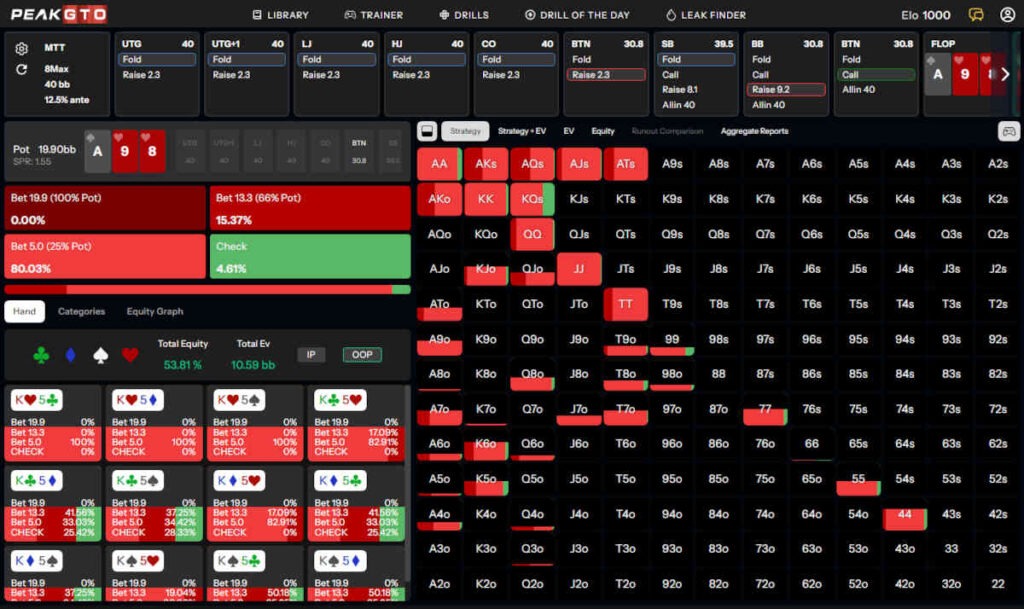
Our 3-betting range here hits the flop well, so the PeakGTO solver suggests c-betting 95% of the time.
Contrary to being in position, here we use both small and big sizing, but still stick to 25% pot size in the vast majority of cases. To be more precise, we are betting 25% of the pot with 80% of our hands, and using 66% sizing with 15% of holdings.
When the stacks drop to 20bb, we will move all-in with a big part of the hands we want to raise against an open.
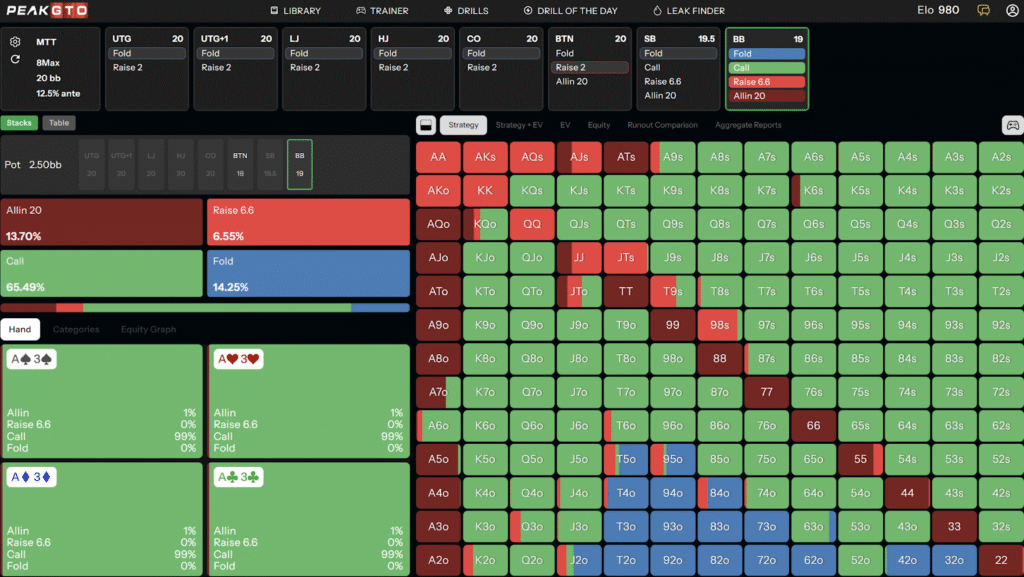
This includes poker hands like all pocket pairs up to JJ, most of our offsuit Ax hands, and a few suited combinations like AJs and ATs.
That being said, we still have a 3-bet range here and will do so with less than 7% of the hands while calling all other playable holdings.
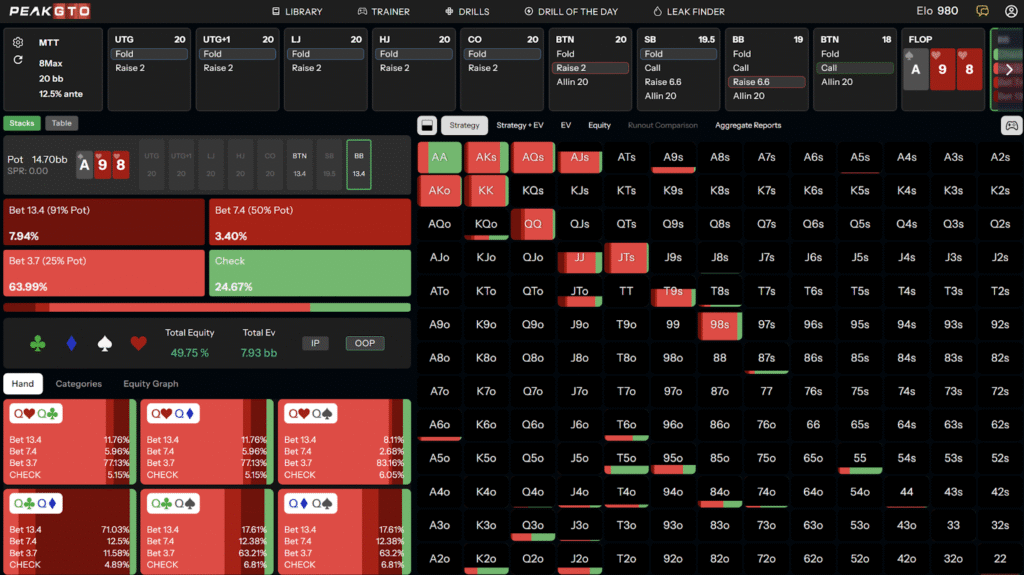
After 3-betting, we will fire a c-bet around 74% of the time and stick to a small size in most situations.
We will check some of the strongest hands together with very weak bluffs we chose to 3-bet before the flop that totally missed the board here.
Key takeaways
- C-bet almost your entire range on these connected board textures OOP
- Pick a small 25% pot size bet when c-betting
- When stacks drop to 20bb, shove most offsuit Ax hands and pocket pairs preflop
- After 3-betting preflop with 20bb, c-bet aggressively with a polarized range