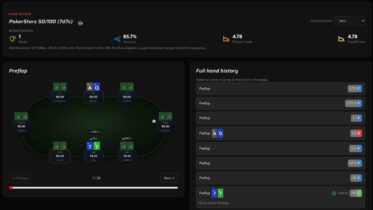
Flopping a set is one of the best feelings in poker, but it does not play itself. The instinct to slow play a monster and trap can be right or badly wrong depending on the board, and even when you bet, the question of how much, and on which streets separates a small pot from a stack. The most disciplined players read the texture, the turn card, and their opponent’s range, and they are willing to slam on the brakes on a bad card and then step on the gas again when the moment is right. This hand shows all three gears in action.
Today we will analyze a 100bb cash game hand where we call a lojack open with 55 in the big blind and flop bottom set on QT5. We check-raise big on the flop, slam on the brakes when the ace falls on the turn, and then fire a large bet on a blank river for value. We will walk through the flop check-raise, the disciplined turn check, and the river overbet, and explain the logic that makes each decision correct.
Assumptions
- Format: Cash game, 8-max, 100bb effective stacks
- Hero: 5♣5♦ in the big blind (BB)
- Villain: lojack (LJ), the preflop raiser
- Preflop: LJ opens to 2.5bb, folds to the BB who calls. Single-raised pot
- Flop: Q♣ T♦ 5♥. BB checks, LJ c-bets, BB check-raises big, LJ calls
- Turn: A♠. BB checks, LJ checks back
- River: 2♦. BB bets big
Preflop
The lojack opens and we call with 55 in the big blind, getting a great price to close the action against their opening range. Small pocket pairs are classic set-mining hands: most of the time we miss and give up cheaply, but when we flop a set we have a disguised monster that can win a huge pot. This time we hit the dream flop and connect with bottom set, so the entire hand becomes a question of how to extract the most value.
It is worth remembering why we are even in this pot with 55. We are not calling preflop because the hand is strong on its own. We are calling because of the implied odds: the rare times we flop a set, we can win far more than the small price we paid to see the flop. That is the whole bargain of set mining, and it only pays off if we actually maximize on the hands that hit. Misplaying a flopped set by trapping too passively or sizing too small is one of the most common ways players quietly leave money on the table, so getting these decisions right is where the real profit lives.
Flop: Q♣T♦5♥
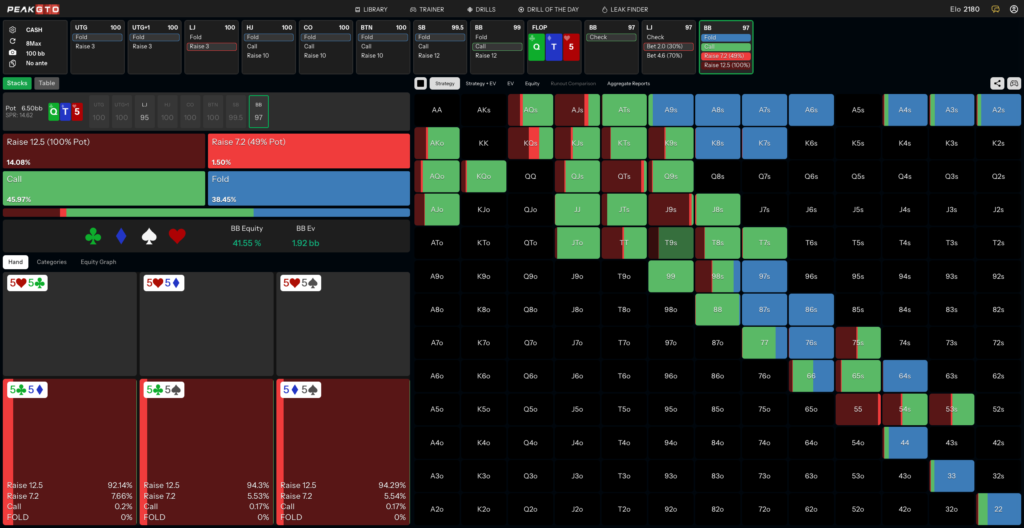
The flop comes Q♣ T♦ 5♥ and we have flopped a set of fives. We check, the lojack fires a continuation bet, and the correct play is a pure check-raise with the big size. When it does check-raise, the solver chooses the bigger of the two sizes about 90% of the time with our exact hand. There is no reason to slow play here, and there are two strong reasons to pile money in immediately.
First, this is a two-high-card board where equities shift dramatically on later streets. Any ace, queen, jack, or ten can change who is ahead in a hurry, so we want to get value now while our set is clearly best rather than letting a scary card kill the action. Second, our bottom set unblocks all of the hands our opponent wants to continue with: by holding the fives, we leave every AK, AJ, ten-x, and weak queen in their range, and a big check-raise puts all of those good-but-not-great hands in a tough spot. Playing out of position, building the pot now is exactly how we set up a stack-sized payoff. The lojack calls and we go to the turn.
Turn: A♠
The turn is the A♠, and it is pretty much the worst card in the deck for us. Our opponent has far more KJ, AQ, AK, and sets than we do, and on this ace their range gains a mountain of equity while ours plummets. The disciplined response is to check, and in fact we should be checking close to our entire range here. Our hand still loves to bet for value in a vacuum, but strategy is about the whole range, not one combination.
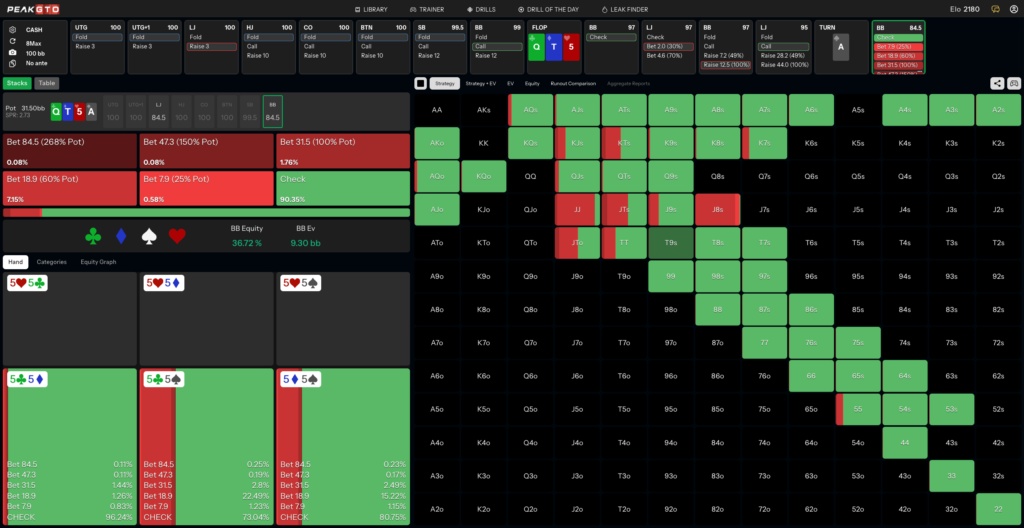
Here is the key idea. On a brutal turn card, if we only ever bet our best hands like sets and KJ, then our checking range becomes full of nothing but weak holdings, and we can never fight for the pot in our passive line. We would have no check-calls and no check-raises with any strength, leaving us dead whenever we check. To keep our checking range protected, we have to include some of our strongest hands in it, and a set is the perfect candidate because it is never in serious danger and benefits from letting our opponent keep betting or barreling into it. A solver such as PeakGTO confirms that even bottom set checks here about 96% of the time. So we check, our hand stays disguised, and the lojack checks back, which becomes the single most important piece of information for the river. Their check caps their range and tells us they do not have the nuts.
River: 2♦
The river is the 2♦, a complete blank, and our set of fives is still very strong. Because the lojack checked back the turn, their range is now capped and full of medium-strength hands they could not get value with: ace-x holdings, ace-highs, and weaker two pairs. We hold a polar range of strong hands and bluffs against that capped range, and the right way to attack a capped range is to bet big. Our set is pure value here, so it bets the river almost every time, leaning toward the larger sizes by mixing a pot-sized bet with an overbet around 150% of the pot. The range as a whole checks the river more than half the time, but the set is never a hand we want to park in that checking range.
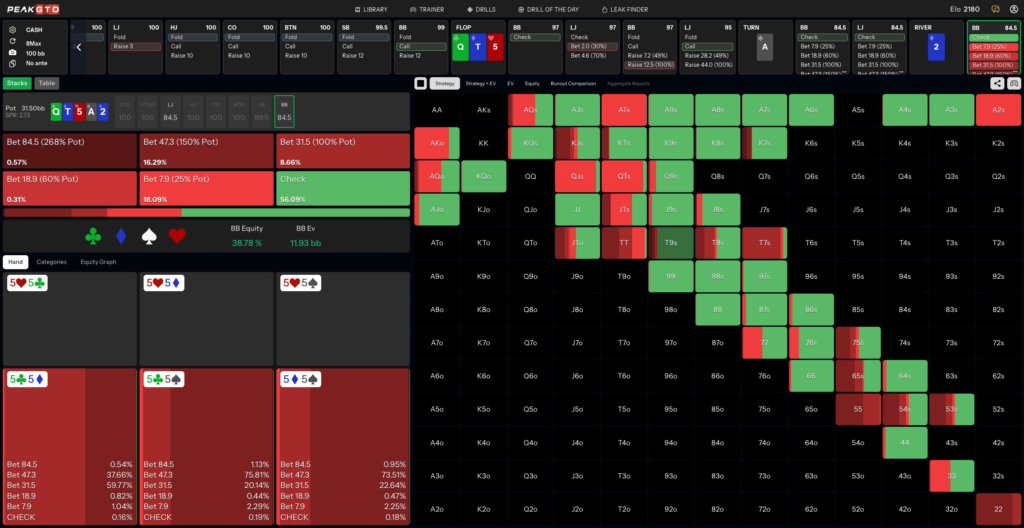
The thought process is refreshingly simple, and it is the one to start with: ask how much your hand is worth, then bet that amount. Against a capped range there is no need to get fancy with small blocking sizes or to worry about being raised, because the opponent simply does not have the hands to punish a big bet. We pick the large size to maximize value from the ace-x and weak two pair combinations that will look us up, and we pair that value with bluffs that take the same line, such as a weak made hand like 53s that check-raised the flop as a bluff and now has too little showdown value to check. Sound GTO play here is not a clever trap, it is putting a lot of money in ourselves with the best hand. The lojack calls with two pair, and our disguised set collects a big pot.
Key Takeaways
- Flop: On a two-high-card board, do not slow play bottom set. Check-raise big, because equities shift fast and your set unblocks all of the hands your opponent wants to continue with.
- Turn: The ace is the worst card in the deck, so check almost your entire range. Including sets in the checking range keeps your passive line strong enough to fight for the pot.
- River: When the opponent checks back the turn, their range is capped. The set is pure value and bets the river almost every time, favoring the larger sizes, pot to overbet, because a polar range crushes a capped one.
- Overall: Flopping a set is about gear changes. Build the pot when you are clearly ahead, slow down on cards that flip the equity, and then maximize value when your opponent caps themselves.