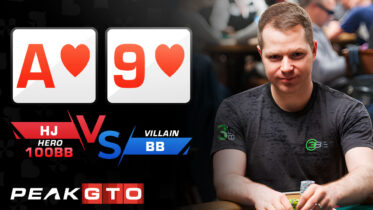
In cash games, defending the big blind against late position opens creates frequent decision points that test our ability to balance range protection with hand strength. These spots matter because they occur multiple times per session and determine whether we can defend profitably against aggressive opponents.
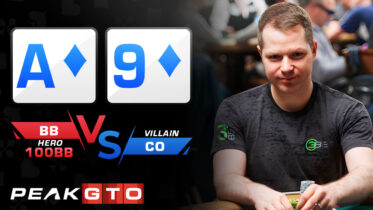
Today we will analyze a 100bb cash game poker hand where the big blind defends with A♦9♦ against a cutoff raise and improves to top two pair. This hand illustrates how solver strategy keeps strong hands in calling ranges to protect weaker holdings, and why raising often does more harm than good.
Assumptions
- Stacks: 100bb effective
- Positions: CO vs BB
- Action: CO raises to 3bb, BB calls
- Flop: Ac6d2s (Pot 6.5bb)
- Turn: 9s (Pot 10.5bb)
- River: Jd (Pot 23.1bb)
Flop: A♣6♦2♠
The solver checks 100.0% from the big blind on this A-high texture. The cutoff has both range and nut advantage, holding all of the strongest poker hands that the big blind would have three-bet preflop.
After the check, the cutoff uses a mixed strategy: bet 2.0bb (43.2%), bet 4.6bb (4.4%), or check (52.5%). The small bet dominates because the board is static and the cutoff wants to bet-fold protection with marginal aces while building pots with strong hands.
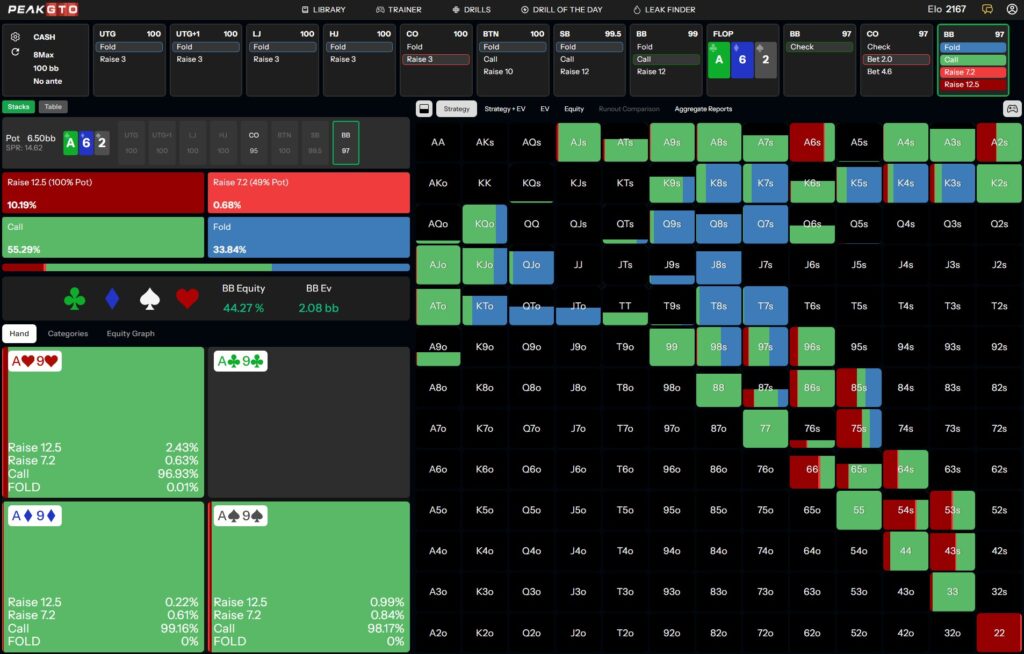
Facing the 2.0bb c-bet, Hero’s range raises only 11.1% of the time total (raise 7.2bb at 0.7% or raise 12.5bb at 10.2%). The raising range is polarized to two pair+ for value (A6s, A2s, 66, 22) and gutshots with backdoor equity for bluffs (54s, 53s, 43s, plus backdoor straight-flush draws like 85s, 76s, 75s).
A♦9♦ exclusively calls to protect the checking-calling range. This range includes pocket 7s, Q6 for third pair, KQ high cards, and weak aces that need strong top pairs mixed in for balance. Raising all your strong aces makes the calling range too weak and exploitable on later streets.
Turn: 9♠
The 9♠ improves A♦9♦ to top two pair. Many players assume this is an automatic raising spot, but the solver tells a different story.
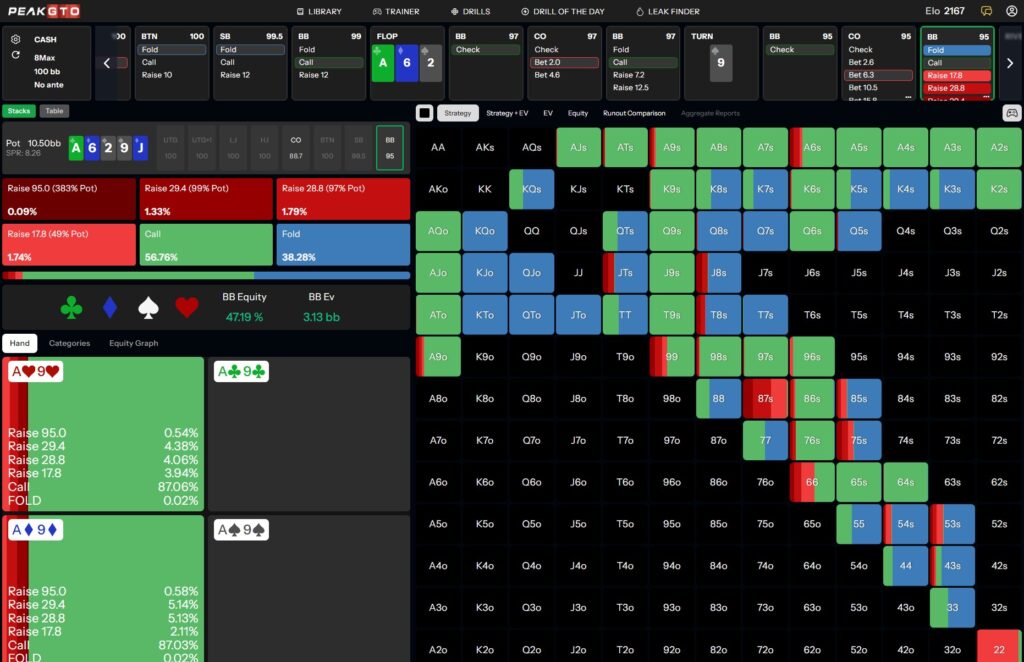
The big blind checks 100.0% again. The cutoff now uses multiple sizings: bet 2.6bb (18.9%), bet 6.3bb (27.5%), bet 10.5bb (4.9%), bet 15.8bb (1.1%), bet 95.0bb all-in (0.2%), or check (47.4%). The cutoff fires 6.3bb in our hand.
Facing this turn bet, the BB raises about 13% of the time combined across all raise sizes but calls 56.8%. Even with top two pair, calling is the primary action because the raising range stays polarized to sets (99, 66, and 22) for value and remaining gutshot straight draws and open ended straight draws for bluffs.
It’s important to realize the rest of your calling range is pretty marginal and GTO poker dictates the necessity to protect it. Hands like pocket 7s, Q6, and weak aces all need to continue occasionally. If you remove top two pair from the calling range, these marginal hands become too vulnerable to barrel pressure.
Against exploitable opponents who always have aces on the turn, raising becomes correct. But against balanced players who include bluffs, calling protects your overall strategy.
River: J♦
The J♦ is a brick. The board is now A♣6♦2♠9♠J♦ – no flush draws completed, no straights possible. After another check from the big blind, the cutoff fires a pot-sized bet of 23.1bb.
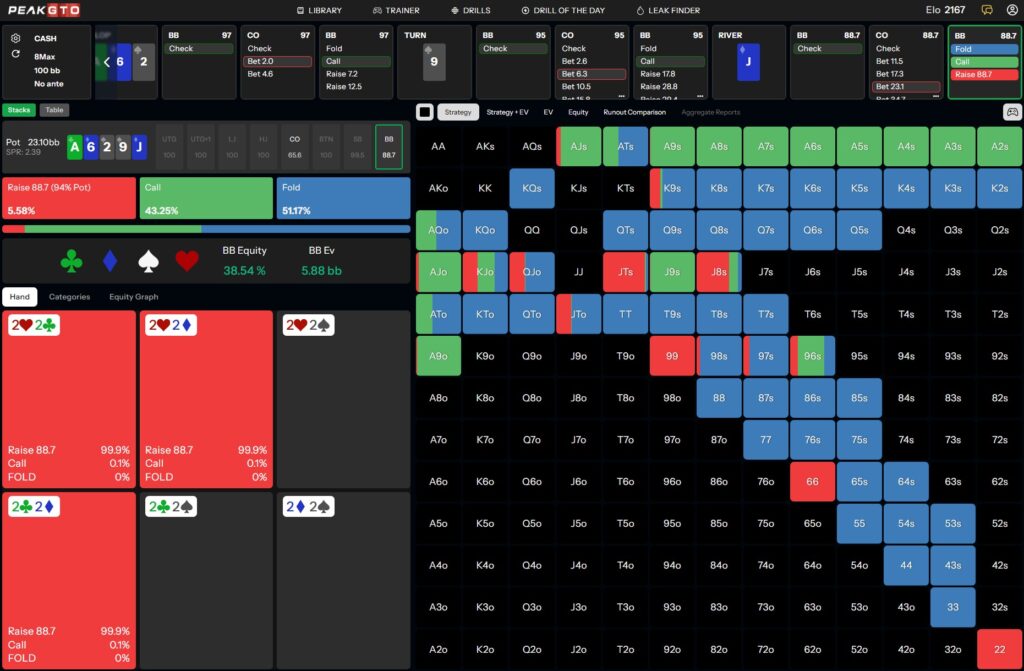
This aggressive bet-bet-pot line polarizes the cutoff’s range heavily. PeakGTO shows the cutoff uses multiple river sizings: bet 11.5bb (17.9%), bet 17.3bb (3.6%), bet 23.1bb (0.9%), bet 34.7bb (1.3%), bet 88.7bb all-in (12.4%), or check (63.9%).
Facing the pot bet, A♦9♦‘s strategy is clear: call 100% of the time, never raise.
The big blind’s overall response is raise 88.7bb all-in (5.6%), call (43.3%), or fold (51.2%). The raising range consists of sets (99, 66, 22) which beat all single aces decisively. Bluff raises use middle pairs with nine and Jack blockers (KJ, JT,J8,) that block 9x and Jx in the opponent’s calling range.
A♦9♦ stays in the calling range because if you raise, strong aces like AK should fold to the all-in. This would make A♦9♦ an over-bluff that turns showdown value into a bluff unnecessarily. The calling range needs all Ax hands for protection against the pot bet, while everything else (pairs below nines, missed draws) folds.
Key Takeaways
- Flop: Check entire range as BB on A-high boards. When facing small c-bet, raise only 11.1% with polarized range (two pair+ and specific bluffs). Ad9d calls to protect weaker holdings.
- Turn: A♦9♦ improves to top two but still only raises 13% of the time. Range protection matters more than hand strength. Sets and bluffs make up the raising range.
- River: Against pot-sized bet after check-check-call, check-bet-call action, A♦9♦ never raises. Only sets raise for value, with nine-blocker bluffs. All Ax calls for range protection.
- Overall: GTO prioritizes range balance over individual strength. Strong hands often call to prevent the calling range from becoming too weak and exploitable.