
A progressive knockout poker tournament, or PKO, is a format where half of each player’s buy-in funds a growing bounty on their head: when you eliminate a player, you pocket half their bounty in cash, and the other half is added to your own.
I have coached PKO strategy extensively, and the most common mistake I see is players treating bounties as bonus money rather than as pot equity that changes the correct calling range in real time. Understanding that distinction is what separates consistent PKO winners from the players giving away chips chasing paydays that the math cannot justify.
What Are Progressive Knockout Tournaments?

The first question we need to answer is what are progressive knockout tournaments, and how do they differ from other knockout formats?
I first started paying close attention to PKO mechanics a few years ago when the format exploded online, and the learning curve was steep. The bounty math changes the fundamental profitability of almost every all-in confrontation, and players who do not account for this are essentially playing a different game from the one they think they are playing.
Just like in a regular knockout event, half of the prize pool money is reserved for bounties, while the other half is distributed to the players who finish in the top 10 or 15% of the field.
Unlike a regular knockout tournament, however, a player busting another player does not receive exactly 50% of their buyin fee, but a variable amount depending on several factors.
At the start of the tournament, 50% of your buyin is added to the bounty prize pool, and the amount is displayed over every player’s avatar. Once a player is knocked out, one-half of that amount goes to the player who knocked them out, while the other half is added to this player’s bounty, making it more valuable.
For example, let us imagine you buy into a $22 PKO tournament on PokerStars. $2 of that amount is taken as tournament fees (rake), $10 goes into the prize pool, and $10 goes towards your bounty.
Everyone’s starting bounty is set at $10. Once you eliminate a player with this same bounty, $5 of that amount is added to your balance, while $5 is added to your bounty, increasing it to $15.
Of course, a player who happens to eliminate you at this point would receive $7.50 into their balance, while $7.50 would be added to the value of their bounty, etc.
This process continues throughout the tournament. As the blind levels go by and players get eliminated, the progressive bounties become bigger and bigger, eventually changing the dynamic of the entire tournament.
While PKO tournaments do have a prize pool to play for, the bounties matter more than the prizes, and there are many cases when you must adjust your tournament strategy to make profitable decisions in this tournament format.
How PKOs Differ from Other Tournament Types
In my experience reviewing hand histories from students who play PKOs, the players who adapt fastest are the ones who already understand standard tournament ICM. Those who struggle the most are deep-stack cash game players who have never had to think about tournament equity, because PKOs add a second equity layer on top of the ICM pressure that already makes tournaments different from cash games.
PKO tournaments have become incredibly popular as of late, as the added dynamic of constantly chasing more valuable bounties seems to have resonated quite well with the general poker audience.
The format is still relatively new, and many players who were quite used to playing tournament poker in general never fully adjusted to playing with progressive bounties.
For that reason, PKOs can be some of the most profitable tournaments around, as both recreational players and bad regulars make tons of trivial mistakes when playing this format.
However, you should also note that being good at PKOs does not come naturally either and that you will need some additional studying. That said, even just paying close attention to some basic dynamics and understanding how equities change with growing bounties should be enough to be better than a big chunk of the player field.
Yet, there are quite a few finesse that you should master before playing a significant number of PKOs, which will increase your overall ROI quite a bit. Let’s talk about some basic PKO tournament strategies and the adjustments you can make to win money in PKOs more often.
How PKO Strategy Changes at Each Stage
One of the biggest gaps I see in students’ PKO games is treating the format as a single, consistent strategy. PKO tournaments go through four distinct phases, each requiring different adjustments to bounty aggression, calling ranges, and stack management.
Early stage (deep stacks, small bounties)
In the early levels, bounties are still at or near their starting value and represent a small fraction of each player’s stack. Your strategy should stay close to standard tournament play. Calling light for a $10 bounty when it costs you 30 percent of your stack is a mistake that recreational players make constantly in the early levels. I recommend playing fundamentally tight-aggressive early and letting the bounties grow before adjusting your ranges.
Middle stage (bounties starting to grow)
As players get eliminated and surviving players accumulate portions of their bounties, individual bounties begin to diverge. This is when you start making bounty-influenced decisions: loosening your calling range against players with large bounties who cover you, and tightening when your own bounty grows and you become a target. The “cover rule” becomes important here: get involved with players you cover, and exercise caution against players who cover you.
Late stage (big bounties, ICM pressure combining)
In the late stages, bounties can be worth as much as or more than a pay ladder jump. This creates spots where calling a marginal all-in is correct not because of card equity but because the bounty adds enough to make the expected value positive. I calculate this by converting the bounty to its chip equivalent and adding it to the pot before determining my equity threshold.
Final table (bounty pool and prize pool both matter)
At the final table, surviving players have accumulated bounties that represent a significant portion of the remaining prize value. This is not the moment to abandon prize pool considerations entirely for bounty chasing. The key adjustment is continuing to isolate short stacks aggressively to play heads-up for their bounty, while keeping prize ladder ICM in mind for your largest decisions.
PKO Tournament Strategy Revealed
While a lot of the same tournament strategy applies in PKOs that applies in all other tournament formats, like freezeouts to rebuys, there are quite a few things that are unique to this format as well.
Most of these have to do with chip stack dynamics, as realizing how your stack compares to other stacks at your table and in the whole tournament can be quite important.
Paying close attention to chip stacks is also essential when trying to determine ranges with which certain players may have pushed all-in or made a call in front of you, as small stacks and big stacks will typically do so with wildly different ranges.
Finally, being able to calculate the equity needed to call a certain player’s all-in during the later stages and understanding what your equity may be against their shoving range will also be extremely important.
So, here are a few major things to look out for in PKO tournaments that will make your overall PKO strategy a lot better.
Look to Build a Stack
Stack size is the most underrated strategic factor in PKO tournaments, and I address it in almost every coaching session I run on the format. When you are the shortest stack at your table, you cannot win a bounty regardless of what happens, which means you are playing for a prize pool that is often worth less than the bounty pool you are locked out of.
Having a stack that covers at least some of the players at your table is extremely important in PKO tournaments, as it gives you the ability to play for bounties.
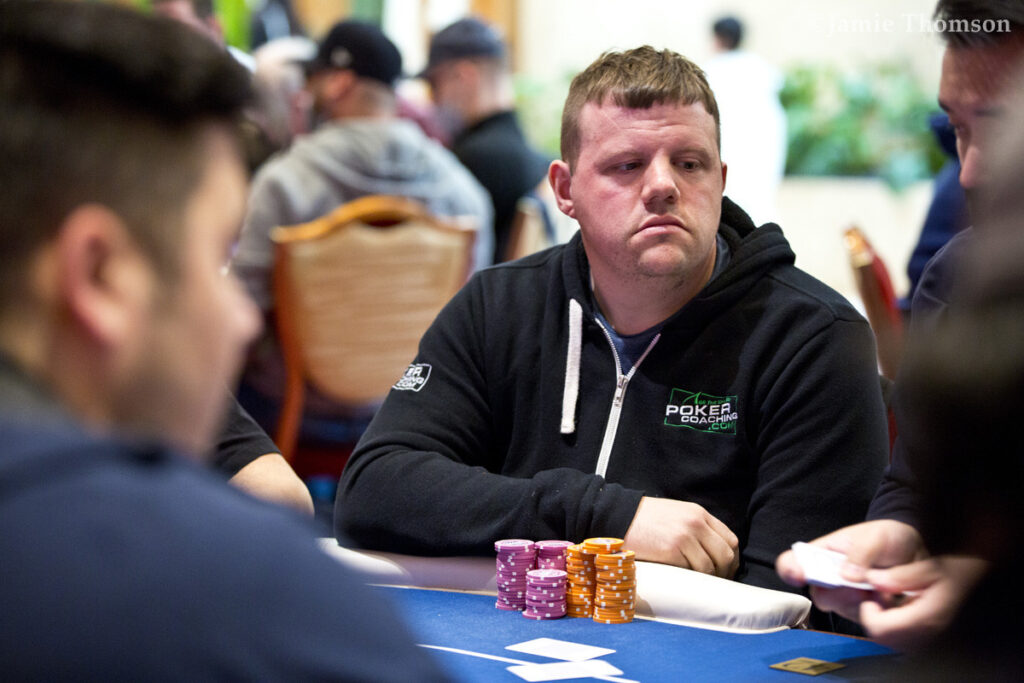
If you are the shortest stack at your table, you will not be able to win a bounty, no matter what happens. Even if you make a huge hand against the second smallest stack, you will only get to double up but never win a bounty.
Since so much of the overall prize pool in PKOs is in bounties, being able to play for them is critical, which makes sustaining a reasonable stack very important.
Of course, there will be times when the cards are simply not cooperating, and you are not able to grow your stack, but you should be looking to get involved and win some pots from the very start.
Also, note that this becomes progressively more important as the tournament goes into its later stages, as the PKOs become bigger and being able to play for them becomes more valuable.
Know the Value of Each Bounty
Bounty calculation is the single most important skill in PKO tournaments, and I spend more time on this in coaching sessions than on almost any other PKO concept. The key insight I drive home with every student is that you never use the full bounty value in your calculation: you use only the cash portion you would immediately receive, which is always half the displayed bounty.
The other half goes to your own head when you win, and you should not count that as guaranteed equity because most players never win the entire tournament. For running bounty equity calculations in specific spots against real solver ranges, I recommend PeakGTO, PokerCoaching’s native solver tool.
First of all, you should be aware that winning a bounty from another player at the table only awards you with half the value in cash, while the other half goes into your own bounty.
When money is added to your bounty, you can consider a small part of this as your equity, but considering you will only ever get to keep this money if you win the whole tournament, this won’t actually happen very often.
For this reason, you should only ever really be looking at the value of winning half of the player’s current bounty when you go into all-in confrontations.
As in all knockout tournaments, you can convert the value of the bounty into chips quite easily, and we will show you an example of how to do this.
Let’s assume you are playing a $55 PKO tournament with 10,000 chip starting stacks and a starting bounty of $25.
Eliminating a player with a $25 bounty will earn you $12.5 in cash, which is worth approximately 50% of the money that went into the prize pool from this player ($25). So, you should be adding 5,000 theoretical chips into the pot when calculating the equity you need to call their shove.
Now, if we assume that at a later point in the tournament, you face an all-in from a player who has a $100 bounty, you should remember that you stand to win $50 in cash if you win. This means that adding about 20,000 chips into the pot is the way you calculate your equity.
Typically speaking, the bigger a player’s bounty is, the less equity you will need to make a call and try to eliminate them to capture the bounty.
Beware of Your Bounty
Your own bounty growing is a double-edged advantage that many students overlook. I have reviewed PKO sessions where a player accumulated a large bounty through several early knockouts and then played too loose in the middle stages because they felt “in control,” only to get isolated by covered stacks specifically targeting their bounty.
A large bounty on your head is as much a liability as an asset if you do not adjust your own aggression downward to account for it.
Each player in a PKO has a bounty on their head, but the value of this bounty is not the same. You will do well to act in accordance with the value of the bounty being paid to other players to eliminate you.
What we mean by this is that you should be aware that players who cover you will be likely to call you quite light when you have a big bounty on your head.
Conversely, players will be less incentivized to try and eliminate you if you have a small bounty on your head or if they don’t have enough chips to eliminate you from the tournament.
These are all dynamics that you should be acutely aware of when playing PKO tournaments and should always be paying attention to.
Don’t Play Too Loose
Loose calling in PKO tournaments is one of the most expensive leaks I see in student hand histories, and the bounty pool is the reason most players justify it to themselves. The bounty does add equity to every all-in situation where you are at risk of winning a cash prize, but only in proportion to its actual chip-equivalent value.
Calling off 40 big blinds with a marginal hand because your opponent has a $30 bounty when the prize pool still contains thousands of dollars is a common and costly mistake.
Bounties in PKOs can be quite inviting, and they often lead players to make some extremely poor calls that the added equity of the bounty can’t justify.
Your goal in a PKO, like in any other tournament format, is to make decisions that are +EV for you. While bounties do add some equity to every call you make where you put others at risk, it is important to know exactly how much equity that is.
Being able to make good PKO calculations on the spot is extremely important, while just making very loose calls and hoping for the best is a great way to do very poorly in PKOs in general.
Don’t Level Yourself into Oblivion
Over-leveling is something I see constantly in PKO sessions from students who are strong standard tournament players. They assume that because the format is unusual, everyone is making large strategic adjustments, and they start second-guessing fundamental plays that would clearly be correct in a regular MTT.
The reality is that most players in a PKO are barely adjusting at all, which means your edge comes from applying the format’s math correctly, not from elaborate multi-level reads.
Many tournament players make the mistake of leveling themselves too much when playing PKOs and constantly thinking about what various decisions their opponents are making imply.
It is important to remember that most players are not playing a good PKO strategy at all and that many of the plays they make are mistakes.
Furthermore, deviating too much from the standard play will cause you to make some very bad decisions in spots where you normally would have made the right ones.
Instead, try to play a good fundamental tournament game and only make adjustments when you have very good reasons to or where the math clearly dictates you should, such as making a looser call against a very big bounty.
Be Ready for Chaos

Chaos is perhaps the defining characteristic of PKO fields, and I have found it to be one of the most reliable sources of edge for disciplined players.
When half the table is calling off stacks with marginal equity because they are chasing a bounty, the player who correctly identifies when a call is profitable and when it is not will pull away from the field over time.
While we recommend not playing too loose and chaotic yourself, there is absolutely nothing you can do about others, and you can expect to see quite a bit of chaos in PKO tournaments.
Recreational players, in particular, will play way too loose in most spots in a PKO, looking to take your scalp and increase their bounty for whatever that’s worth.
For this reason, you should always expect most players to play too loose, and you should adjust your ranges accordingly.
If everyone is playing too loose, that means you can’t get away with as much stealing, but you can get a lot more value when you have it. Make sure to keep this in mind, make more thin value bets, and bluff less as a general rule of thumb in PKO tournaments.
Common PKO Leaks That Cost Players the Most Money
After reviewing hundreds of PKO hand histories in coaching sessions, I have identified the leaks that appear most consistently across skill levels.
Treating the full bounty as instant cash: The most frequent calculation error I see is players counting the displayed bounty amount rather than the half they would actually receive. If a player has a $100 bounty on their head, you stand to gain $50 in cash and $50 added to your own head. Only the $50 cash portion should factor into your pot equity calculation, because the $50 added to your bounty is only realizable if you win the tournament outright.
Calling too loose in the early stages: Early-level PKO bounties are small relative to the prize pool and relative to starting stacks. Calling a 20 big blind shove in level 2 because your opponent has a $10 bounty when you have a 10,000-chip starting stack is a serious mistake. The bounty’s chip equivalent barely moves the equity threshold, and you are risking meaningful stack depth for minimal expected value.
Ignoring coverage when chasing bounties: Many players focus exclusively on the bounty and forget to consider whether they cover their opponent. If a short stack with a big bounty shoves and you cannot eliminate them because a third player has you covered and can win the side pot, you are calling for a bounty you might not get. Always confirm you are heads-up before treating a bounty as the primary driver of a call.
Playing too tight when you are the chip leader: The flip side of loose calling is playing too passively when your stack is large enough to cover everyone. When you cover the table, every short stack’s bounty is potentially yours, and failing to apply pressure to profitable shove spots is leaving money in the pot.
Enjoy Your First PKO
PKO tournaments reward players who can quickly convert bounty amounts into equity, think about stack coverage before entering pots, and stay disciplined when the rest of the table is chasing bounties with no math to back it up.
I find that the players who make the fastest progress in PKOs are the ones who already have a solid standard MTT foundation and then layer the bounty adjustments on top of it, rather than treating PKO as an entirely different game requiring entirely different instincts.
Start with smaller buy-in PKOs to practice your bounty calculations in real time, and review your hand histories specifically for spots where a bounty influenced a call you made.
Ask yourself whether the chip-equivalent value of the cash portion of that bounty actually changed the required equity threshold, and whether you had coverage. That review habit will accelerate your PKO development faster than any single strategic concept.