
RTA in poker, short for real-time assistance, refers to any tool or method that helps a player make decisions while a hand is actively in progress. This ranges from static preflop charts consulted during play to advanced solver software that generates optimal plays for every street of a Texas Hold’em hand in real time
All major online poker sites, including PokerStars and GGPoker, have banned RTA use outright. I have reviewed dozens of hand history reports flagged for RTA suspicion, and what is consistently striking is how detectable unusual patterns become at scale: plays that deviate slightly too often from exploitable human tendencies, with sizing and timing that align almost perfectly with solver outputs.
The result is an arms race between cheaters and operators, and in 2026, the operators have become significantly better at winning it.
What Is RTA in Poker?
Real-time assistance, or RTA, is an umbrella term used to describe a number of different tools and methods used by players to help them gain an unfair advantage over their opponents in real-time.
The simplest form of RTA out there is preflop charts, which players have used for many years to study the game and learn the optimal ways of playing their hands before the flop.
In the past, preflop charts were routinely used by players while playing, but more recently, such charts have been considered an unethical tool to use while playing poker.
On the other hand, more complex RTA tools, which use solver outputs to present optimal plays in real-time across all streets, are a much more serious threat and one that can make players using them unbeatable for all intents and purposes.
RTA tools give players a massive edge over an average poker player and a significant edge even against very good players, as none of us can really get close enough to solver outputs across the board to fight such tools.
For that reason, RTA tools are now banned industry-wide, and using them is considered grounds to get banned from major poker sites, but proving someone is using them remains the biggest issue of them all.
How Players Cheat with RTA
The most high-profile proven case of RTA use in online poker involved German player Fedor Kruse, who was banned by GGPoker in 2020 after an investigation found he had been using what was reportedly described as a “Dream Machine” setup, an automated system that scraped card and bet data during play and fed it through a solver in real time. GGPoker confiscated approximately $250,000 from his account.
High-stakes player Ali Imsirovic has also faced public accusations of RTA use and has been banned from several major live and online events. Cases like these illustrate why operators have invested heavily in detection infrastructure. It is no longer a fringe concern. RTA at high stakes is real, documented, and financially consequential
It is important to understand what constitutes RTA in the modern game before you play so that you can be sure you are not inadvertently using tools and software that are banned while playing.
For starters, there are static RTA tools, such as preflop charts and other types of written-down content, which directly dictate how you should play in a certain scenario.
Any chart instructing you how to play from different positions at different stack sizes, how often to c-bet on certain board textures, or how to play in any other situation is not allowed during gameplay, even though it can be used as a great learning tool away from the tables.
Charts and other static tools are considered RTA tools, but the rules against them are not as heavily enforced, especially as players can use them in printed form, and they don’t necessarily give the player a massive edge over his competition.
Manual input RTA tools, such as poker solvers, are a much bigger threat, as they provide players with exact plays for the exact situation while playing.
Such tools are absolutely 100% forbidden, and you can get banned if you try using them while playing poker. Running a “solve” for the situation you are currently in may cause you to get banned from your favorite poker site, even if it does help you win the hand.
Some players try to use such poker RTA tools when faced with tough decisions or deep in poker tournaments. This kind of behavior is considered blatant cheating, as simply playing in accordance with the solver’s instructions requires no skill and allows just about anyone to win at poker.
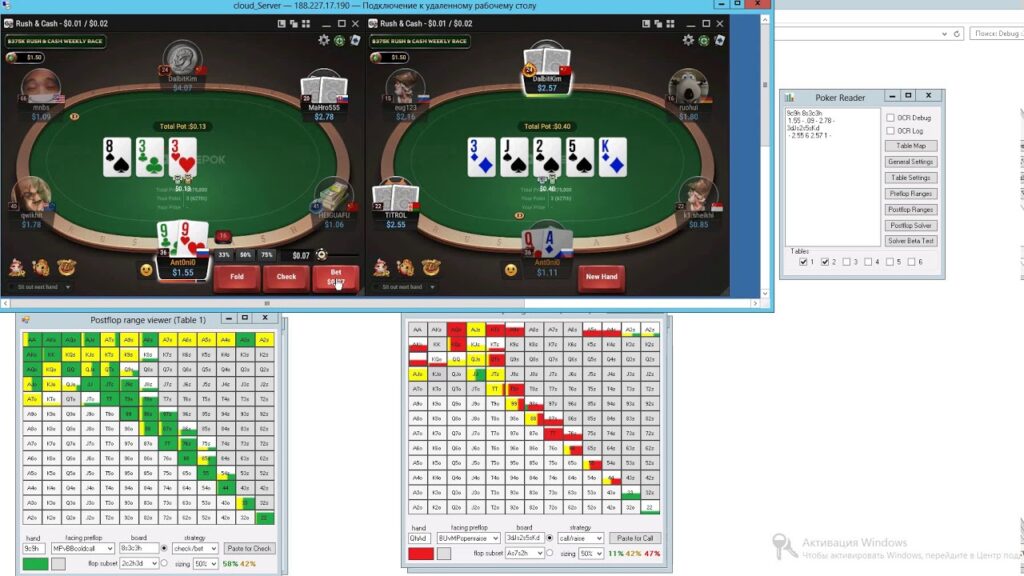
Finally, automatic input RTA tools are the worst of them all, as they are able to gain access to your hole cards, stack depths, and other necessary information and run solves in real time for every hand you play.
Such tools completely automatize the process of playing poker and are used to create poker bots, such as the ones that were recently at ACR Poker, according to the allegations made on Two Plus Two forums.
Automatic input RTA tools are considered the worst kind of RTA cheating and using them will lead to a ban more often than not, along with the confiscation of any funds you may have in your online poker account.
How Can RTA Be Detected
PokerStars has publicly stated that its proactive RTA detection rate exceeds 95%, meaning the majority of players using RTA tools are eventually identified before they are reported by other players. The platform employs a dedicated Game Integrity Development Team with decades of combined playing experience, using behavioral analysis, mouse interaction pattern recognition, and monitoring systems specifically designed to detect GTO solution signatures in real time.
Players flagged by these automated systems are then reviewed by a human team, sometimes asked to play on camera, and in confirmed cases, permanently banned with account balances confiscated. I find it encouraging that the gap between cheaters and detection is closing, but it has not closed entirely, which is why player reporting still matters.
The operators run tools that look for patterns in players’ games and try to identify those playing too close to solver outputs or those whose stats and results diverge from those of a typical winning player in the games.
Any player that is flagged by the tools is then audited by a team of poker players and security professionals who decide whether further inspections are in order.
If they are, players are typically contacted, asked questions about their game, sometimes asked to play with a camera running, and more.
While all of these practices prevent the use of RTA in poker from going rampant, it is pretty clear that there are players out there using RTA to some extent, even as you read this.
What Can I Do Against RTA?
My honest advice on this: play on regulated, well-resourced sites that invest in detection infrastructure. PokerStars and GGPoker both have dedicated integrity teams with publicly documented detection systems. Smaller, unregulated sites often lack these resources, and RTA use on such platforms is harder to detect and enforce.
If you suspect a player, report them with specifics. Vague reports get deprioritized. A report that includes usernames, session timing, stake levels, and a description of the patterns you observed is far more actionable for a security team.
A key thing you need to understand is that you won’t be able to beat players using RTA in the long run. Even if you think that no bot can beat you at poker because you are just so good, the numbers say differently.
There is no defeating the solvers, and even if you were good enough to come close to beating them, you would still rather play against real players who make tons of mistakes than solvers whose ranges are perfectly balanced across the board.
This means RTA in poker is a serious concern for everyone, and we should all be doing our best to eliminate the use of RTA from the game altogether.

The best thing you can do is make sure to stay vigilant and always report anyone you suspect may be using RTA in any way.
If you know for sure that a player or a group of players are using RTA tools, report them to the operator in question and give out their usernames. Let the security team take it from there, and if they really are using RTA, they will get banned.
If you just have suspicions, you should make sure to back them up with something. Major GTO solvers now allow you to see the exact time when a certain board was last solved for, and if you run such a check and find that someone ran the exact board you played in a big hand at the time you were playing it, it was likely your opponent.
This is one of the ways you can support your concerns over a player using RTA in poker, and this can be especially useful when playing in higher stakes games where the likelihood of someone using RTA increases significantly.
Is Poker RTA Illegal?
We have established that RTA in poker is a form of cheating, so you must be wondering whether it is legal and whether you could take someone to court for cheating you using RTA.
The answer to that question is no, RTA in poker is not illegal. For something to be illegal, it must first be defined by law, and poker RTA most certainly is not.
Even if you may find a court in some legal jurisdiction that would be willing to hear your case, proving RTA is hard in the first place, and proving it is an actual case of fraud would be even more difficult.
Instead of dreaming about taking your opponents to court, remember to play at regulated poker sites, report any suspected use of RTA tools, and avoid playing against players you believe may be doing anything shady.
Using RTA Tools to Study Poker
This distinction matters enormously, and it is one I emphasize constantly in my coaching: using solvers to study is not just legal, it is the fastest way to significantly improve your poker game. The issue is not the tool, it is when and how you use it. Running a solver after a session to review how you played a specific hand is entirely legitimate and highly educational.
Running that same solve in real time during the hand is cheating. PokerCoaching’s own solver, PeakGTO, is designed for exactly this kind of post-session study. You can input specific hands, review optimal play across all streets, and develop the strategic understanding that separates consistent winners from the field without ever crossing the line into real-time use.
Poker solvers are the best tools to use to run simulations of poker hands and learn how the computer likes to play a particular spot, as this will make you a better poker player.
If you can memorize all the outputs out there, you will become one of the best poker players in the world, and no one should be able to stop you.
However, avoiding the learning part altogether and using the tools while playing is the same as using computer simulations when playing online chess, which is widely recognized as cheating and will get you banned from any major chess platform.
Is RTA a Big Problem for Online Poker?
In my assessment, RTA is a more significant problem in cash games than in tournaments, for one specific reason: solving a poker tournament requires accounting for ICM, varying bounties in PKO events, and hand-by-hand stack depth dynamics across an entire field, which makes real-time solver outputs computationally impractical in most formats.
In cash games with consistent effective stack depths, static preflop charts and river decision trees can be solved in advance and consulted quickly during play. This does not make tournament poker immune from RTA, but the computational complexity creates a natural barrier that slightly limits its severity at the highest levels.
While claiming RTA is not a big problem for online poker and sweeping it under the rug may be the easiest approach, it is definitely not the right one. The truth is RTA is a major problem, and RTA automation to create working poker bots is an even bigger one that could potentially ruin the entire online poker economy.
By playing with real-time assistance tools or automating bots to use them, those doing so can gain a huge edge and essentially steal your money in plain sight by playing perfect strategy without any concern of being punished for it.
This is why poker players, operators, media, and everyone else involved with online poker must work together to confront RTA head-on and find new methods of fighting it.
While there will forever be those individuals out there looking for ways to cheat you out of your money, by working together to increase the security of online poker, we can ensure that the game remains safe to play for many years to come.