Risk premium is one of the most important concepts in tournament poker.
It describes the extra equity you need to call an all-in in poker tournaments because payout structures make losing chips more costly than gaining them.
This effect comes from ICM (Independent Chip Model) and explains why strong tournament players often fold hands that would be easy calls in cash games.
If you want to make better decisions near bubbles and final tables, understanding the risk premium is essential.

What Is Risk Premium?
Risk premium is the additional equity you need to justify calling an all-in in tournaments compared to a normal chip EV decision.
In a purely chip-based scenario, your decision is based only on pot odds. For example:
- If you must call 10 chips to win a pot of 20 chips
- You need 33% equity to break even.
However, tournaments involve payout implications. If you lose the hand, you might be eliminated or lose significant tournament equity.
Because of that, you need extra equity beyond the pot odds to justify the risk.
That extra required equity is called the risk premium.
The size of the risk premium depends on the tournament situation. Early in a tournament it is usually very small, because stacks are deep and payouts are far away. However, as the tournament progresses and players get closer to the money or large payout jumps, the risk premium increases significantly.
Put simply:
Risk Premium = Additional equity required due to tournament payout implications.
Why Chip EV Isn’t Enough in Tournaments
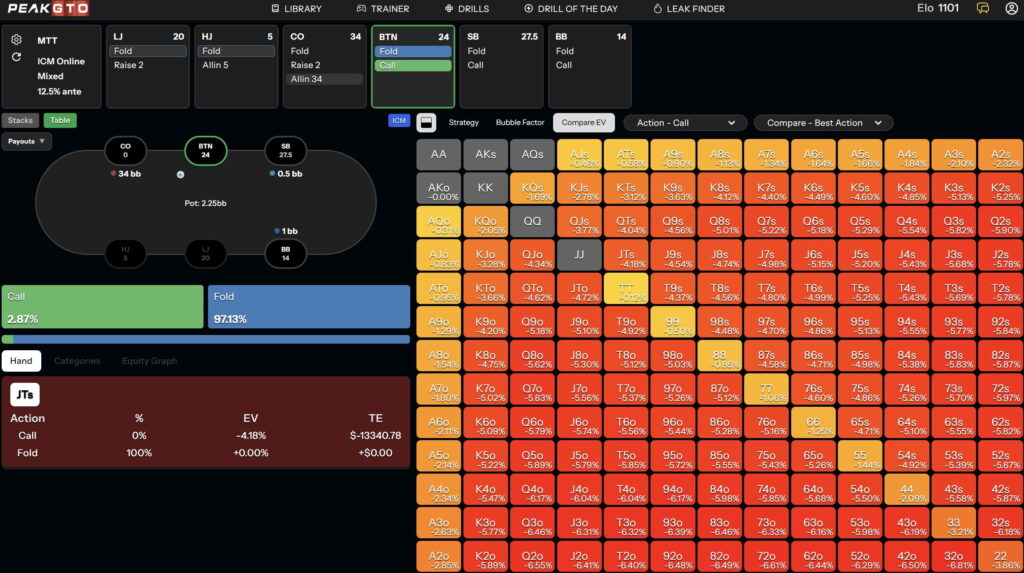
In cash games, chips equal money. If you double your stack, you double your money.
In tournaments, the value of chips changes constantly depending on stack sizes and payouts.
For example:
- Going from 20 big blinds to 40 big blinds is helpful, but it doesn’t double your prize equity.
- Going from 20 big blinds to 0 big blinds (busting) means losing all your future prize equity.
Because of this asymmetry, losing chips hurts more than gaining chips helps.
Risk Premium vs Chip EV Example
Imagine a situation where an opponent shoves, and you have pot odds requiring 40% equity to call.
From a poker EV perspective:
If your hand has 41% equity, the call is technically profitable.
But if losing the hand would eliminate you or significantly reduce your stack near an important payout stage, your risk premium might require 48–50% equity.
That means:
- 41% equity – profitable in chip EV
- 41% equity – losing in tournament EV
So the correct play becomes folding a hand that would be a call in cash games.
This is why tournament strategy often looks much tighter than cash game strategy, especially when players are deciding whether to call all-ins.
Bubble Factor and Risk Premium
The risk premium is closely related to another concept of the bubble factor.
The bubble factor measures how costly it is to lose chips relative to gaining them.
Risk premium increases when:
- You are near the money bubble
- You are near a final table
- There are large payout jumps
- You are involved in pots with players who cover your stack
During these stages, tournament survival becomes extremely valuable. As a result, calling ranges in tournaments become tighter.
Risk Premium Changes Against Different Opponents
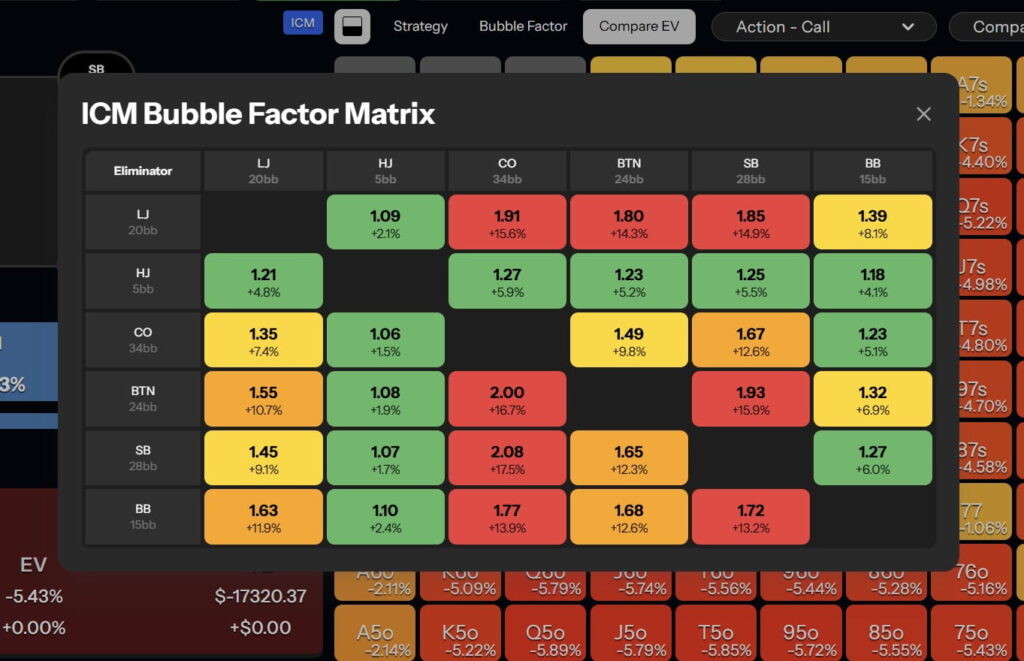
Risk premium is not the same for every player at the table, since it depends heavily on stack sizes.
The size of the risk premium changes depending on which opponent you are playing against. Stack sizes determine which risks are eliminated in the hand, which directly affects how cautious each player must be.
- Against a bigger stack. If they cover you, losing the hand eliminates you from the tournament, so your risk premium is high, and you must call tighter.
- Against a shorter stack. If you cover them, losing the pot doesn’t eliminate you. Your risk premium is lower, so you can call wider.
- Against similar stacks. If both players risk elimination, the risk premium can be extremely high. This is why medium stacks often avoid big confrontations near the bubble.
Tip 1. Tighten Your Calling Ranges Near Bubbles
Calling off stacks becomes much riskier when payouts are close.
Many profitable chip EV calls become folds.
As players approach the money bubble or significant payout jumps, the risk of elimination carries much more weight. Because of this, even hands that would normally have enough equity to call based on pot odds may need to be folded in order to protect your tournament life.
Many profitable chip EV calls become folds, especially in short-stack situations where players must rely on a correct push-fold strategy to make optimal all-in decisions.
Tip 2. Apply Pressure as the Big Stack
When you cover opponents, their risk premium increases.
This allows you to shove or raise more aggressively.
Players who risk elimination against you must be much more cautious when deciding whether to call all-ins. Because of this, big stacks can apply pressure by opening more pots, shoving wider, and forcing shorter stacks into difficult decisions where they cannot call without very strong hands.
This leverage is one of the biggest strategic advantages of building a large stack late in a tournament.
Tip 3. Avoid Marginal All-In Calls Against Covering Stacks
If someone can eliminate you, you need significantly more equity to call.
This is one of the most common mistakes recreational players make.
Many players focus only on their hand strength or pot odds, but ignore the tournament implications of busting. When an opponent covers your stack, the risk premium increases significantly, meaning hands that look strong enough to call can still be losing decisions in tournament EV.
Tip 4. Be Careful as a Medium Stack
Medium stacks often face the highest risk premium because they can bust, but also don’t benefit much from doubling. This is why they frequently play tighter near bubbles.
Short stacks often have to take risks to survive, while big stacks can apply pressure without risking elimination. Medium stacks sit in the middle, where losing a big pot can knock them out of the tournament, but doubling up does not dramatically improve their payout equity. Because of this, medium stacks must often avoid marginal confrontations and pick their spots carefully.
Final Thoughts
Risk premium is one of the key concepts separating strong tournament players from players who rely only on chip EV.
It explains why:
- Players fold surprisingly strong hands
- Big stacks can apply extreme pressure
- Bubble play looks dramatically different from early tournament strategy.
You don’t need to calculate exact numbers during a hand.
But understanding why a risk premium exists will help you make far better decisions in the most important stages of a tournament.