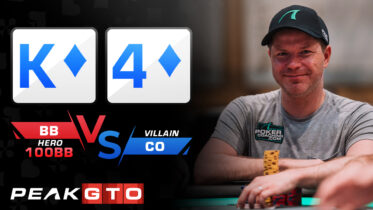
Try This Hand Yourself
Play this exact spot against the solver in PeakGTO before reading the analysis.
Strong draws do their best work when they are willing to bet rather than just call. A semi-bluff check-raise takes a hand with almost no showdown value but real equity and turns it into pressure, winning the pot now while keeping the option to improve later. The hard part is selection, because not every backdoor combo belongs in a raising range, and the small details that separate a continue from a fold are easy to get wrong. This hand shows how a single gutshot tips the balance on the flop, and how that same draw, once it bricks, becomes the perfect river bluff.
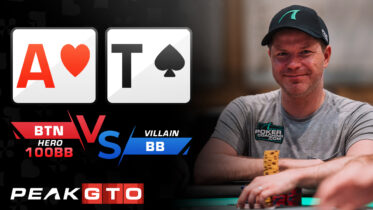
Today we will analyze a 100bb 8-handed cash game hand where Hero defends K♦4♦ in the big blind against a cutoff open, check-raises the 3♦6♣7♣ flop with a gutshot and a backdoor flush draw, fires a pot-sized barrel on the 7♠ turn, and jams the T♠ river after every draw has missed. This breakdown covers which draws qualify for the flop raise, why the turn bet is correct even at a low frequency, and the blocker rule that decides whether a busted draw should pull the trigger on the river.
Assumptions
- Format: 8-max cash game, 100bb effective stacks
- Positions: Hero is in the big blind (caller, out of position); Villain is in the cutoff (preflop raiser, in position)
- Hero’s hand: K♦4♦
- Preflop: Cutoff raises to 3bb, Hero defends the big blind. Single-raised pot of 6.5bb.
- Flop: 3♦6♣7♣ (pot 6.5bb). Hero checks, Villain bets 4.6bb, Hero check-raises to 12.4bb, Villain calls.
- Turn: 7♠ (pot 31.3bb). Hero bets pot, Villain calls.
- River: T♠ (pot 93.9bb). Hero jams all in, Villain folds.
Preflop
The cutoff opens to 3bb and the action folds to the big blind. K♦4♦ is a routine call. Hero is already invested for one blind and only has to add two more to close the action with a suited hand that flops draws, backdoors, and the occasional dominating top pair. A 3-bet is unnecessary. K4s plays well as a caller because it makes enough equity to defend and carries enough disguise to win big pots when it connects. Calling also keeps the cutoff’s entire opening range in the pot, including all the weaker holdings that K4 can outflop and stack.
Flop: 3♦6♣7♣
Hero checks, as the big blind does with almost its entire range on this low, connected board. K♦4♦ has a little of everything: a backdoor diamond flush draw, a gutshot to the five that would complete 3-4-5-6-7, and a king overcard. None of that amounts to much on its own, but together it is a stack of small edges that add up to a real reason to keep playing.
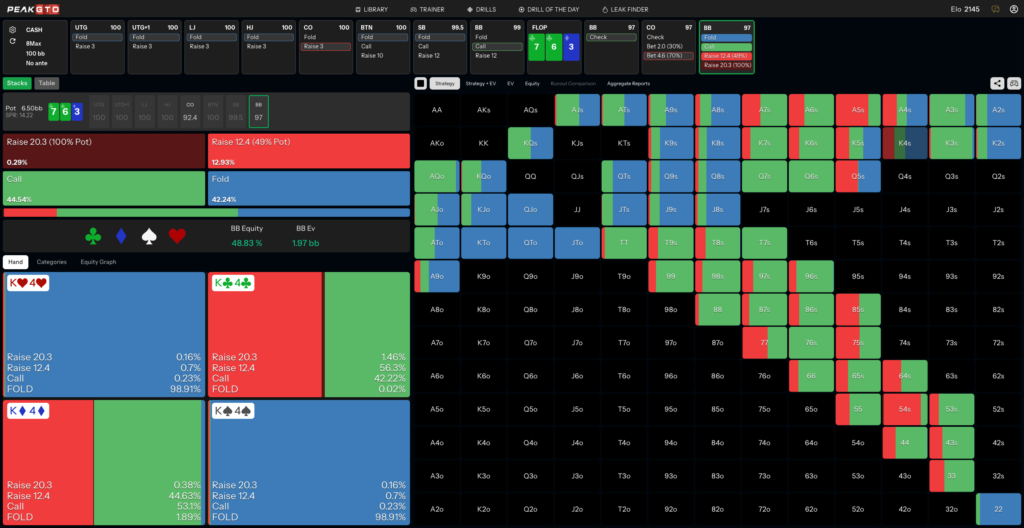
The cutoff fires a continuation bet on this texture in a polarized way: only about 27 percent of the time, but at a larger 4.6bb size, roughly 71 percent of the pot. That sizing drives the decision. Against a large bet you do not get to continue with every backdoor draw. K♦9♦, which has the same backdoor flush draw and the same king overcard but no straight equity, simply folds. The gutshot is the deciding factor, because once the hand can make a straight it has a reason to fight back rather than surrender.
So the real question is call or raise. PeakGTO shows the big blind check-raising about 13 percent overall, calling 44.5 percent, and folding 42.2 percent. Hands like K♣5♣ and K♣4♣ with a front-door flush draw raise about half the time, and the backdoor-flush-plus-gutshot combos raise at a similar clip. Many players just call every time here, afraid of getting blown off the hand by a re-raise. That fear is misplaced. When an opponent bets large and then faces a raise, they rarely hold the range to re-raise, so the check-raise lets Hero see a turn while applying real pressure. Hero check-raises to 12.4bb and the cutoff calls, continuing with a nut flush draw and two overcards.
Turn: 7♠
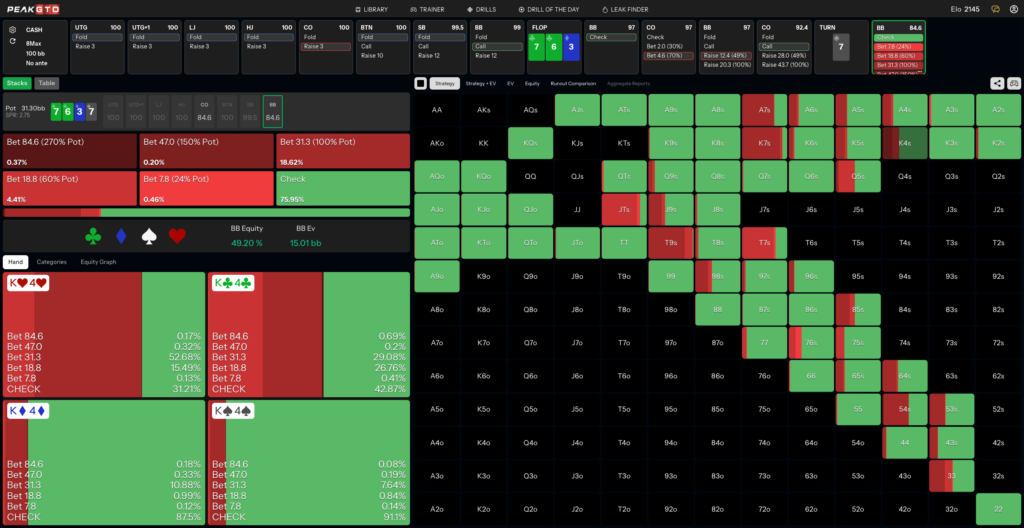
The 7♠ is a nasty card. It pairs the board, and while the big blind does hold a fair number of sevens after check-raising, the rest of that range is now full of trash that just bricked. With the exact K♦4♦, the solver bets the pot, 31.3bb, only about 11 percent of the time and checks the rest. This is a low-frequency bet, not a default. The board pairing helps the perceived range, but the actual hand is mostly a gutshot with no pair, running straight into a calling range stuffed with sevens and overpairs that will never fold.
Across the whole range, the big blind checks the turn about 76 percent of the time and bets pot 18.6 percent, with the other sizes appearing rarely. The hands that want to bet large here are the genuine value bets and the strongest draws: K7 for trips, 85 for an open-ended straight draw, 54 for the made straight, and 33 for the boat. In GTO terms, K♦4♦ sneaks into the betting mix as a low-frequency bluff because the range needs a handful of extra bluffs to balance all of that value. Hero chooses aggression and fires the pot-sized 31.3bb. The cutoff calls again, still holding the nut flush draw.
River: T♠
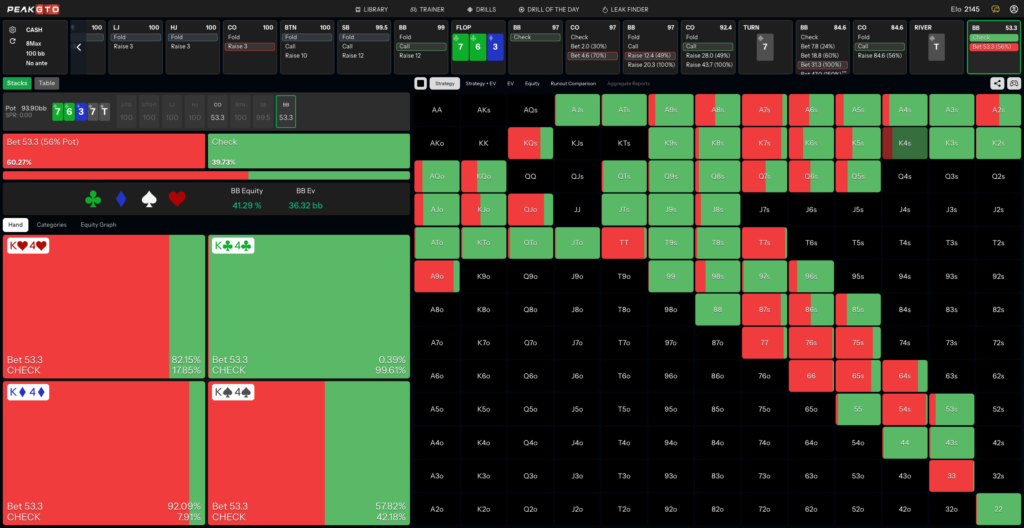
The T♠ misses everything. The gutshot never filled, the backdoor diamond draw died on the turn, and the final board reads 3♦6♣7♣7♠T♠. Hero has king-high with no pair, no draw, and no showdown value. This is exactly the kind of hand that wants to fire the last barrel. The solver jams about 60 percent of the time across its whole betting range, but our exact K♦4♦, with no club to block the opponent’s busted draws, is close to a pure jam.
The blocker rule decides it. When you bluff this river, you want your hand to hold no club. The flush draw bricked, so the cutoff’s busted club draws are exactly the hands most likely to fold. If you hold a club yourself, you remove some of those folding combos from the opponent’s range and your bluff works less often. For that reason almost no club hands fire here. K♦4♦ is the ideal candidate: it holds two diamonds and no club, so it lets the opponent keep every one of those busted flush draws that have to fold to a shove. A busted gutshot with no club and no way to win at showdown should blast it.
Hero jams roughly 53bb all in into the 93.9bb pot. The cutoff is getting about 2.76-to-1 on the call, needing only around 27 percent equity, the kind of price that should make folding feel painful, but the line tells a consistent story of strength: a flop check-raise, a pot-sized turn barrel, and an all-in river. Against that pressure a weak pair with only marginal showdown value cannot continue, and the pot odds are not enough to overcome how rarely the bettor shows up bluffing with a club-free range. The cutoff folds, and Hero takes it down without the best hand.
Key Takeaways
- Flop: Facing a polarized 71 percent pot continuation bet, the big blind check-raises about 13 percent, calls 44.5 percent, and folds 42.2 percent. K♦4♦ earns the semi-bluff raise because the gutshot is layered on top of the backdoor flush draw and overcard. The same hand without that straight equity, like K♦9♦, has to fold.
- Turn: The 7♠ pairs the board and the big blind checks about 76 percent of the time. The pot-sized bet is correct only around 11 percent with this exact hand, a low-frequency bluff that keeps the range balanced against value bets like K7, 54, and 33.
- River: The T♠ bricks every draw, leaving king-high with no showdown value. The range jams about 60 percent, but a club-free hand like K♦4♦ jams close to always, and the deciding factor is blockers: a club-free hand like K♦4♦ lets the opponent hold the busted club draws that fold to the shove.
- Overall: A draw earns the right to raise when it has layered equity, and the same hand earns the right to bluff the river when it brings the right blockers and no showdown value. Choosing the gutshot for the flop check-raise and the club-free busted draw for the river jam is what turns a marginal holding into a profitable check-raise plus two barrels.