
Tournament poker keeps evolving, and so should your strategy. That’s why Jonathan Little and the team have rebuilt the flagship MTT course from the ground up to create Tournament Masterclass 2.0.
The new course is designed to help serious players master every stage of tournament play.
From advanced postflop decision-making to ICM and final table strategy, short-stack adjustments, and the mental game, the new Masterclass delivers a structured path to long-term success in today’s competitive MTT landscape.

Over the next few weeks, we’ll be giving you exclusive sneak peeks into the key sections of the TMC 2.0. We will start where it all begins, covering preflop foundations.
If you’ve ever watched elite tournament players go through tough preflop spots with total confidence, it’s not luck but rather a structured approach they are taking.
They’ve built their game on rock-solid fundamentals that make every postflop decision easier, more profitable, and more predictable.
Jonathan Little opens Tournament Masterclass 2.0 by covering MTT preflop principles, one of the most essential yet often misunderstood sections. Whether you’re a seasoned grinder or still building your first tournament resume, mastering preflop play is what separates players who “guess” from those who know.
Lesson 1: The Importance of Position & Stack Depth

If poker had a golden rule, mastering positional play might just be it. In this first video, Jonathan explains why your seat at the table shapes so much of your decision-making, and most importantly, how to adjust to different stack sizes.
When you’re in position, you get more information, more control over pot size, and a greater ability to realize your equity. When you’re out of position, every pot becomes a battle uphill.
At deep stacks (80bb+), he emphasizes playing cautiously from early position. When you open under the gun, you’ll often have to play large pots out of position against multiple callers. In these spots, speculative hands like suited connectors or small pairs lose a lot of value because you often won’t realize your equity. Instead, focus on strong, connected, and high-card hands that perform well across many runouts.
In contrast, as you move later in position, such as cutoff and button, your ranges should widen dramatically. The deeper stacked you are, the more leverage your position gives you. You can open suited aces, suited connectors, and one-gappers profitably because acting last allows you to control the pot and extract value when you hit.
At medium stacks (30–50bb), position still matters, but the dynamics shift a bit. Shorter stacks create smaller postflop SPRs (stack-to-pot ratios), meaning hands like offsuit broadways and small pairs lose some of their implied odds value. On the button, you can still open these liberally, but in early position, trimming your range keeps you out of tricky postflop spots.
Once stacks fall below 20bb, position matters the least, and the game becomes more math-driven. Push-fold decisions dominate, and you can’t rely on postflop maneuvering. Even here, Jonathan points out that players in later positions retain an edge because they can see who’s yet to act and steal more effectively.
“The deeper the stacks, the more position matters. When you’re short, position shrinks in importance — but it never disappears entirely.” – Jonathan Little
Lesson 2: Understanding Different Preflop Ranges
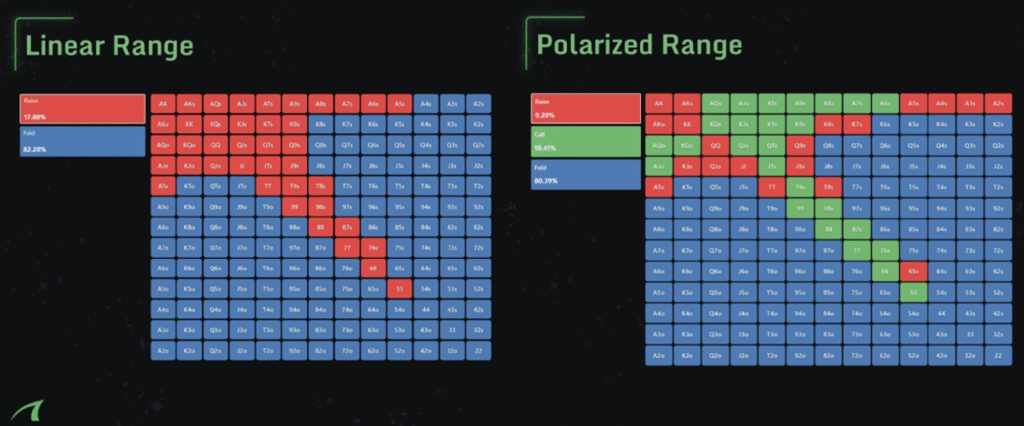
In the second preflop lesson, Jonathan takes players deeper into how professionals think about ranges. Terms like “linear” or “polarized” aren’t just jargon – they describe the architecture of your preflop strategy.
Before you can play well preflop, you must learn to recognize the shape of your and your opponent’s range.
Here’s how Jonathan defines the five most important range types and when to use them:
- Linear Ranges – These are made up of your strongest hands in descending order. When you 3-bet linearly, you’re building a range of pure value hands like AQ+, TT+, and suited broadways. Jonathan explains that linear ranges are ideal when you expect your opponent to call 3-bets often, since you want to push your equity edge with hands that perform well postflop.
- Polarized Ranges – These combine your very best hands (AA, KK, AKs) with hands that are just a bit too weak to call (like A5s or K9s). Polarization is most effective when your opponent’s opening range is wide and you expect folds frequently. You’re balancing premium value hands with well-chosen bluffs that block strong holdings.
- Capped Ranges – These are passive ranges that lack the strongest hands. For example, if the big blind just calls against a small blind open, their range is capped since they don’t have AA or KK nearly as often. Recognizing a capped opponent allows you to apply pressure postflop with aggression and bigger sizings.
- Uncapped Ranges – The opposite of capped since these ranges can include the nuts. Any time you take an aggressive action (open-raise, 3-bet, or 4-bet), your range remains uncapped, and opponents must tread carefully.
- Condensed Ranges – These consist of mostly medium-strength hands without the weakest holdings but not premiums. A common example is a button calling range versus an early-position open, filled with hands like AJs, 99, and KQs.
Jonathan provides practical examples throughout:
- When you 3-bet from the small blind against a button open, your range should be polarized with strong hands and bluffs.
- When you 3-bet from the big blind versus an early-position raise, go more linear since you’ll often get called, so focus on hands with solid equity realization.
He stresses that learning to identify these shapes doesn’t just help you build better ranges, it also helps you read opponents in real time. When a tight player flats your UTG open from the button, their range is likely condensed. When an aggressive reg 3-bets from the cutoff, expect polarization. These mental models let you anticipate their next move before the flop even comes.
“Understanding ranges is like speaking the language of poker. Once you’re fluent, every decision becomes clearer.” – Jonathan Little
Lesson 3: The Ultimate Guide to Preflop Bet Sizing

In this advanced lesson, Jonathan shows exactly how professionals size their raises, 3-bets, and even shoves across different effective stack depths.
Jonathan lays out a structured sizing framework based on stack depth and position, helping players avoid one of the most common leaks with inconsistent sizing. Raising smaller with weak hands or larger with strong ones may feel intuitive, but it exposes you to exploitation by observant opponents.
Instead, stick to a clear system:
- 80bb+ – Open to around 2.5bb. When facing a raise, 3-bet to about 3.5x in position and 4.5x out of position. Facing a 3-bet, re-raise to 2.5x in position or 3x out of position. Deep stacks mean larger SPRs, so postflop skill matters most.
- 60–80bb – Trim slightly: open to 2.3bb, 3-bet to 3–3.2x in position and 4.2x out of position. Your fold equity remains high, but you reduce risk against 4-bets.
- 30–50bb – The middle zone where 3-bet shoves begin to appear. Jonathan advises mixing in non-all-in 3-bets with strong value and polar bluffs while staying aware of shorter stacks behind you.
- 20–25bb – This is where the strategy pivots. You’ll often see polarized 3-bet shoves and smaller open sizes around 2bb. Jonathan explains that at this depth, you can’t 3-bet small and fold since your fold equity and stack preservation depend on decisive action.
- 10–19bb – Most 3-bets become all-ins, but you can still be calling with various hands, especially from the button or big blind, when pot odds and position justify it.
He also highlights a common mistake: not adjusting against limpers. Against one or more limpers, Jonathan recommends using a pot-sized raise, which is roughly three times the last limp plus one big blind for each limper. This sizing denies equity to speculative hands and punishes passive players who limp too wide.
For example, if two players limp and blinds are 500/1000, a pot-sized raise would be around 6.5bb, which is big enough to isolate while keeping your range consistent.
This approach creates a data-driven, repeatable system you can apply immediately, no matter the table or stack configuration.
Bringing It All Together
These first three preflop lessons lay the foundation for what’s to come in Tournament Masterclass 2.0. They bridge theory and practice, showing not only what to do but also why it works.
This is just the first step in your preflop journey, and by the time you’ve completed the full Preflop section, you’ll understand:
- How to build and recognize different range structures
- How stack depth impacts every raise, call, and shove decision
- Why consistent sizing and positional awareness drive long-term profitability
- How to build the perfect strategy against different opponents and varying stack sizes