Try This Hand Yourself
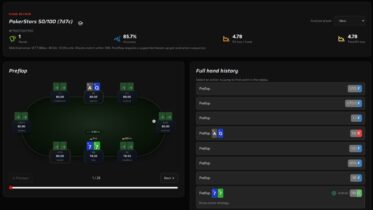
Play this exact spot against the solver in PeakGTO before reading the analysis.
Top pair is one of those hands that lives or dies by the turn card. When an overcard arrives it can quietly demote your hand and force you to slow down, but when the turn bricks off and leaves your pair clearly ahead, the right response is the opposite: step on the gas. Knowing the difference between a turn that shrinks your hand and a turn that frees it to attack is one of the highest-leverage reads in a cash game. This hand is the friendly version of that spot, where a blank turn keeps the lead and lets a strong top pair build a huge pot.
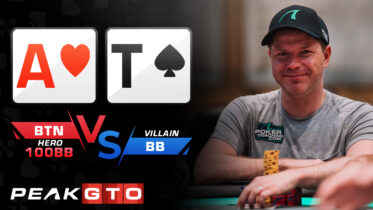
Today we will analyze a 100bb 6-handed hand where Hero opens A♥T♠ on the button, the big blind calls, and the board runs T♣6♦2♥, 3♠, 2♠. Hero flops top pair with the ace kicker, pots the flop, overbets the brick turn at 150% of the pot, and then shoves the paired river. This hand shows why top pair top kicker is a clear big bet on the flop, why a card that changes nothing turns into a green light to overbet, and why AT is the weakest hand that can still value shove the river here.
Assumptions
- Stacks: 100bb effective
- Format: 6-handed cash game
- Positions: BTN (Hero) vs BB (Villain)
- Action: BTN raises, BB calls
- Flop: T♣6♦2♥ (Pot: 5.5bb): BB checks, BTN bets 5.5bb, BB calls
- Turn: 3♠ (Pot: 16.5bb): BB checks, BTN bets 24.7bb, BB calls
- River: 2♠ (Pot: 65.9bb): BB checks, BTN shoves all in
Preflop
Hero opens A♥T♠ to 2.5bb on the button and the big blind calls. ATo is a routine button open, and Hero takes the betting lead in position. The big blind defends a wide, capped range, mostly the suited and connected hands that prefer to flat rather than three-bet, which means Hero will usually be ahead whenever this hand pairs the top card. That positional and range advantage is what makes the aggressive line that follows so profitable.
Flop: T♣6♦2♥
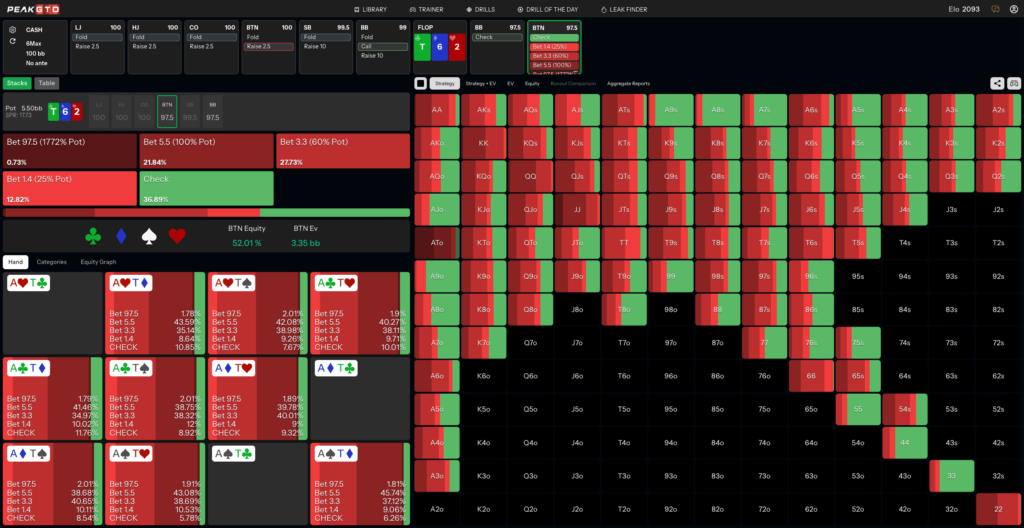
Hero flops top pair with the best kicker. The big blind checks, and top pair top kicker wants to bet very often here, usually with a medium or big size. It gets called by every worse top pair and by a long list of draws, so there is no reason to give a free card. This is a textbook continuation bet spot, and the strongest hands in the betting range all prefer to use a larger size.
The betting range is polarized, pairing strong made hands with the right bluffs. The overcard-and-backdoor hands around the ten, like KQ, KJ, QJ, Q9s, Q8s, J9s, and J8s, are excellent betting candidates that many players fail to fire. The backdoor-draw bluffs are also underused: an ace, king, queen, or jack alongside a five or a four (plus A3s) can pot the flop roughly a third of the time, especially with a backdoor flush draw attached. Top pair top kicker and the overpairs sit at the top of this range, and when they bet they bet big. Hero pots it for 5.5bb and the big blind calls.
Turn: 3♠
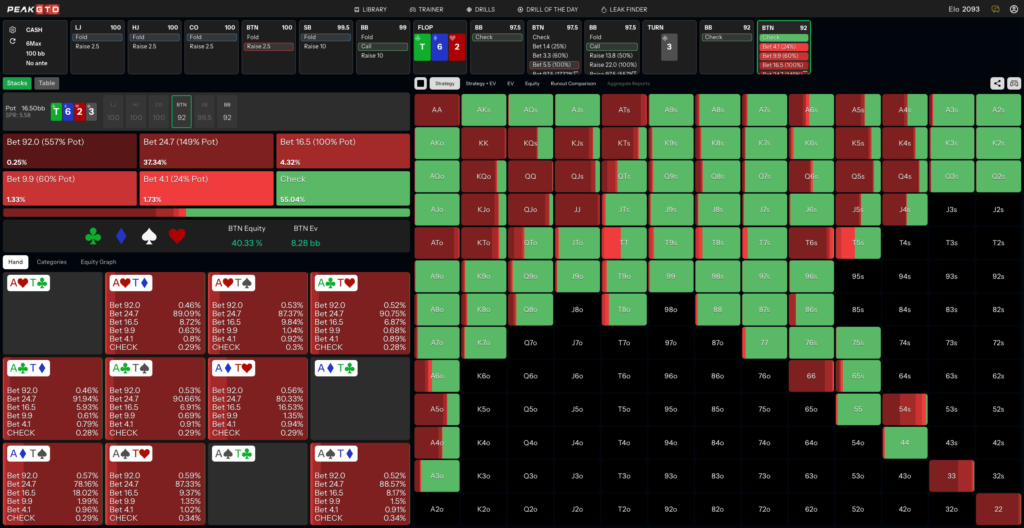
The 3♠ is the card that names this hand a “good” turn, even though at first glance it looks scary. A few players freeze here, worried about 54s that just made a straight, or about 63s that just made two pair, and while those combos exist, they are a tiny sliver of the big blind’s range. Far more often the opponent holds a ten, a six, a two, or a draw, all of which the three did nothing for. When the card you are afraid of is one your opponent almost never has, the correct reaction is to attack, not retreat.
So Hero does not just continue, Hero overbets. The right move is to blast this turn at around 150% of the pot with KT and better, and that is exactly what AT does here, betting 24.7bb into the 16.5bb pot. The logic is that the turn betting range is polarized and fairly tight, only about 45% of hands, made up of genuine value and real draws. Almost every hand the big blind holds, the tens and sixes that are now medium-strength, the deuces, and the assorted draws that all have live outs, is very likely behind, which means a huge bet folds out a mountain of medium-strength equity. Even the medium hands like a pair of sixes and 99 are supposed to fold to the overbet in a solver world, though that is the GTO baseline, and against an opponent who refuses to let go of those underpairs you would bluff this turn less. PeakGTO backs this up, and the overbet works precisely because Hero’s strongest hands crush the few strong hands the big blind can still have.
The bluffs that join the overbet are the draws that improved, mainly the gutshots: A5, A4, K5, K4, Q5, Q4, J5, and J4 all love to barrel. The hands that bet the flop on a pure backdoor and then bricked, like K8 or K7s, prefer to check now, because the range already has plenty of real draws doing the betting. This is the heart of the spot. A brick turn that leaves your top pair clearly ahead is not a reason to slow down, it is a reason to size up. The big blind calls, and the pot balloons to 65.9bb.
River: 2♠
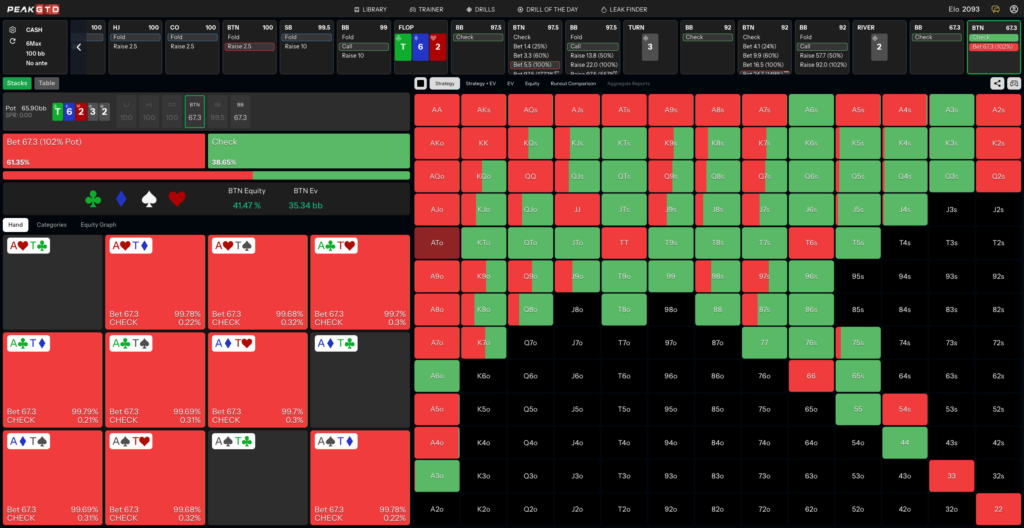
The 2♠ pairs the board, and it is one of the best cards in the deck for Hero. The opponent had very few twos to start with and folded most of them on the turn, so this river is effectively a brick that hands the big blind almost no new nutted hands. When the river is a genuine brick and your opponent can barely have a river-nut combo, the default is to keep betting. Because the remaining stacks are about the size of the pot, the choice collapses to a clean one: check, or jam all in.
AT is good enough to value shove, but only just. It is the single weakest hand that can still profitably jam all in here, which is a useful calibration point. The pure bluffs that come along are the missed hands with no showdown value, like KQ, KJ, and Q9, while A5 and A4 bet a lot because they block the straight and remove the opponent’s ace-x combos, the hands most likely to call the shove. The cards that let AT shove are narrow: an ace, a ten, a seven, and this two. On almost every other river, AT is supposed to check it back, which can feel nitty until you understand why.
The reason ties directly back to the turn. By overbetting 150% of the pot, Hero folded out most of the big blind’s medium-strength hands, so the calling range that arrives on the river is stronger and tighter than it would be after a smaller bet. This caution is worth internalizing: if you had bet a normal size on the turn instead of overpotting, you could fire a third value bet on a much wider set of rivers, but after the big overbet you have to be selective. Many players autopilot here, reasoning “I bet the flop, I bet the turn, I have top pair, of course I shove,” without asking who is left to call. On this exact two, though, the math works, and AT can take the rare green light to get it all in. This is the disciplined flip side of the same skill that, on a bad turn, would have you checking back from GTO instead.
Key Takeaways
- Flop: Top pair top kicker on T♣6♦2♥ bets very often and prefers a big size, getting called by every worse top pair while the overcard-and-backdoor combos make up the bluffs.
- Turn: The 3♠ is a brick that leaves the tens clearly ahead, so AT overbets to 150% pot. The betting range is polarized and tight, and the huge size folds out the opponent’s many medium-strength hands that all have live outs.
- River: The 2♠ is a brick that gives the big blind almost no nut hands, so Hero shoves. AT is the weakest value shove here, and it can only do so because the two is one of the few good cards after the turn overbet thinned the calling range.
- Overall: A good turn is the mirror image of a bad one. When the card changes nothing and your top pair stays ahead, size up and apply maximum pressure, but stay aware that overbetting earlier narrows who can call you later.