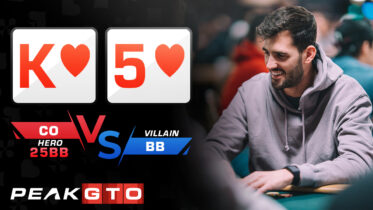
Try This Hand Yourself
Play this exact spot against the solver in PeakGTO before reading the analysis.
When you completely miss, you have two jobs: realize whatever equity you have cheaply, and find the right moment to turn your nothing into a bluff. Most players do neither. They either bet too early and get raised off their hand, or they give up entirely and never collect the pots that a well-timed river bluff would win. Turning king-high into a bluff at exactly the right time is one of the highest-leverage skills in no-limit, and it usually means checking twice before you ever put a chip in.
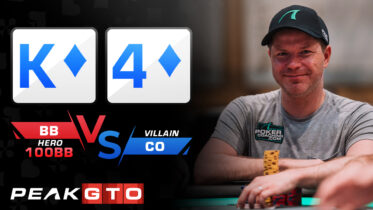
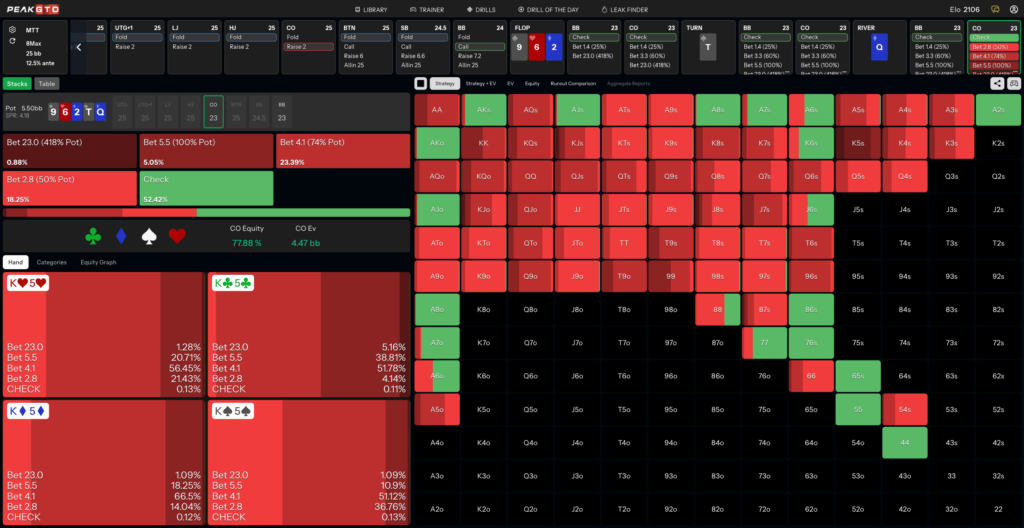
Today we will analyze a 25 big blind tournament hand where Hero opens K5s from the cutoff, gets called by the big blind, and flops only king-high and backdoors on 9♠ 6♥ 2♦. Hero checks back the flop, checks back the T♠ turn, and then comes alive on the Q♦ river, firing a bet with king-high air that folds out the better hands in the opponent’s give-up range. It is a clinic on how to play when you have nothing.
Assumptions
- Stacks: 25 big blinds effective
- Format: 8-handed MTT
- Positions: Hero in the cutoff (the preflop raiser, in position), Villain in the big blind (the caller, out of position)
- Preflop action: Hero opens, Villain defends the big blind
- Flop (pot ~5.5bb): 9♠ 6♥ 2♦, rainbow. Villain checks, Hero checks back
- Turn: T♠. Villain checks, Hero checks back
- River: Q♦. Villain checks, Hero bets around 75% pot, Villain folds
- Hero: K♥5♥ | Villain: A♣7♠
Preflop
Hero opens K♥5♥ from the cutoff and the big blind defends. Nothing unusual, but as the preflop raiser in position, Hero gets to control the size and tempo of the pot on every street. That positional edge is exactly what makes the check-check-bet line possible later, because you always get to see what the big blind does before deciding whether your air should give up or attack.
Flop: 9♠6♥2♦
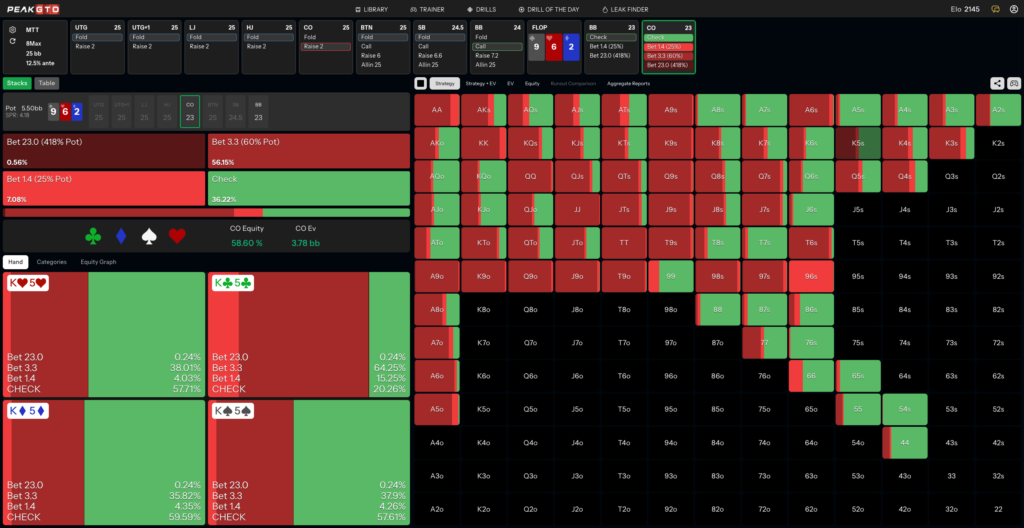
The flop is 9♠ 6♥ 2♦, and K5s has king-high with a backdoor flush draw and an overcard. As the raiser you hold a big range and nut advantage on these low, disconnected boards, with more overpairs and strong nines than the big blind and far less air, so a chunk of your range fires a big continuation bet while another chunk checks. K5s itself is a genuine mix.
There is a useful GTO mechanic for deciding which way to lean. When a hand cannot continue against a small check-raise, you prefer to bet the version without the backdoor flush draw, because it is less painful to fire and then fold. The K5 with no flush draw bets more often, while the K♥5♥ here holds real backdoor equity that stings to fold, so it checks back at a higher frequency to realize that equity. The easiest pure checks are your underpairs that need little protection and your good king-highs like KQo. Hero’s K5s lands in that same checking bucket. Hero checks back, planning to realize equity now and look for a bluff later.
Turn: T♠
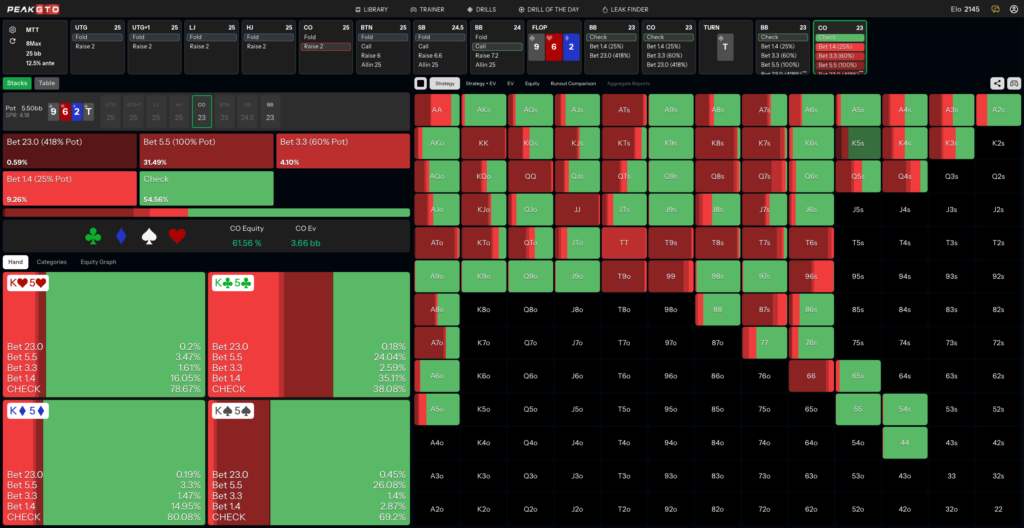
The turn is the T♠, an overcard that brings the spade flush draw live and gives the big blind new top pairs, so a good opponent checks again at a high frequency. Because the flop went check-check, the big blind never had to fold their air, so their range is still loaded with weak holdings, and Hero keeps an equity advantage. The temptation is to barrel that advantage, but K5 is a poor candidate to do it with.
The reason is blockers. When you bet this turn you are targeting the opponent’s offsuit king-highs and weak air. K5 has no spade, so it does not block the opponent’s flush draws, the hands you most want to fold out, and the king it does hold actually blocks some of the offsuit king-highs you are trying to fold out. Weak ace-highs with a spade do a better job, like A7 or A8 with a spade, because the spade blocks those flush-draw folds while the ace-high itself folds out stronger ace-highs and clears a lot of equity, which is why the solver bets them. The PeakGTO solutions show the solver betting around 45% of its range here while parking marginal hands like K5 into a check. So Hero checks back a second time, staying disciplined and keeping the pot small with a hand that is not ready to fire.
River: Q♦
The river is the Q♦, a brick, the big blind checks a third time, and now king-high becomes a bet. This is the payoff of the check-check line, and it is a spot most players are not comfortable in: you hold king-high and you want to put money in the pot. The reason it works is that after checking twice, you can credibly show up with strong hands, and your opponent simply does not have many bluffs of their own, so they are checking a weak, give-up-heavy range that folds far too often.
The blockers finally line up too. The K♥ blocks the big trap of KJ, one of the few strong made hands the opponent could be slow-playing, while the 5 blocks nothing they want to fold. Betting a medium size around 75% pot, Hero targets ace-highs, king-highs that beat you, like an unpaired K7 or K8, and hands that paired the board, like a deuce or a six, all of which fold at a high rate. In practice, opponents do not fight back hard enough on this runout. They do not check-raise their thin value enough after checking twice, and they fold their weak made hands rather than turn them into a check-raise bluff.
That is why this line prints. Had Hero bet the flop or the turn, the opponent gets to continue with sticky hands and even check-raise, forcing Hero to either fire a huge bluff or fold out the very equity that made the hand playable. By checking twice and then firing the river, Hero realizes equity along the way and still gets to attack the hands he was trying to fold out on earlier streets. It is a textbook example of how GTO patience and blocker awareness combine to make you very tough to play against. Villain folds A♣7♠, and Hero takes it down with king-high.
The wider lesson is how to think about a hand that has no showdown value by the river. King-high will essentially never win at showdown against a range that checked three times and is happy to show down, because that range still contains all the small pairs and weak made hands that beat you. That means checking back the river captures almost nothing, while betting captures the entire pot every time the opponent folds a hand that beats king-high. When your hand cannot win by checking and your opponent is capped and folding too much, betting is not a gamble, it is the clearly higher-EV choice. The discipline on the earlier streets is what earns you that profitable river, because it is the checks that give your eventual bet its credibility.
Key Takeaways
- Flop: King-high with backdoors is a mix. Prefer checking the version that holds the backdoor flush draw, since it has real equity to realize and stings to fold against a check-raise.
- Turn: Do not barrel just because you have an equity advantage. K5 lacks a spade, so it does not block the flush draws you want folded, while weak ace-highs with a spade make better turn bluffs, so it checks back a second time.
- River: After checking twice you can credibly bet, and the K blocker fights KJ while the opponent’s checking range is full of folds. Fire a medium size and fold out ace-highs, better king-highs, and the hands that paired the board.
- Overall: Turning king-high into a bluff is about patience and timing. Check to realize equity, keep the pot small with poor bluff candidates, and attack the river when blockers and ranges line up.