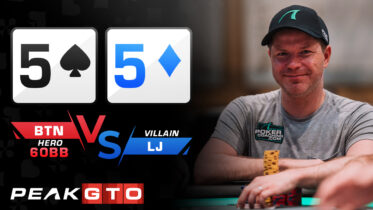
Flopping a monster is the easy part. Value betting the nuts for the maximum is what separates winning players from the rest, and it almost never means betting big on every street. The right line is counterintuitive: sometimes you flat a strong hand instead of raising, sometimes you bet tiny when nothing in their range can stand up to you, and sometimes you blast an overbet that looks like it must be folding everything out. Each sizing has a job, and choosing the wrong one quietly leaves chips on the table. This hand shows how a set, and then a full house, extracts every chip it can in a 60bb tournament.
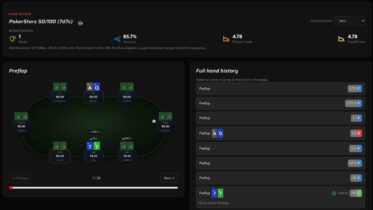
Today we will analyze a hand where Hero calls a lojack open on the button with 5♠5♦, flops a set on 6♠5♥2♦, improves to a full house on the 2♠ turn, and then jams the 8♥ river. Even a set just calls against a polarized pot-sized bet, the full house bets small rather than big on the turn, and the river is a maximum-value overbet shove rather than a careful size designed to get called. The range the opponent shows up with on each street is what dictates the sizing.
Assumptions
- Format: 8-max MTT, 60bb effective stacks
- Positions: Hero is on the button (caller, in position); Villain is in the lojack (preflop raiser, out of position)
- Hero’s hand: 5♠5♦
- Preflop: Lojack raises, button calls. Single-raised pot of 7.1bb.
- Flop: 6♠5♥2♦ (pot 7.1bb). Lojack bets pot, Hero calls.
- Turn: 2♠ (pot 21.3bb). Lojack checks, Hero bets 5.3bb, lojack calls.
- River: 8♥ (pot 31.9bb). Lojack checks, Hero jams all in, lojack folds.
Preflop
The lojack raises, it folds to Hero on the button, and calling with 55 is a clean, standard play. A small pair like this plays beautifully as a flat: it has clear set-mining value with position in hand, and when it does flop a set it is disguised and ready to win a big pot. Hero calls and takes a heads-up flop in position.
Flop: 6♠5♥2♦
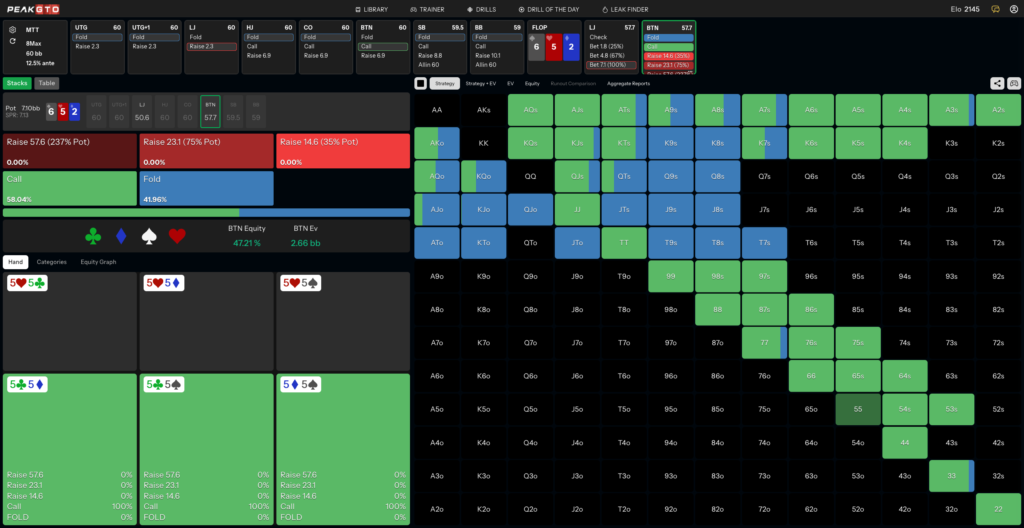
Hero flops a set of fives, about as good as it gets on this board. As stacks get deeper the lojack should be checking a lot here, but in practice many players auto-fire their whole range, and the more they do that, the more you should be calling and raising in response. This time the opponent bets pot, which is a fine play at a low frequency, around 18 percent. The reason the continuation bet should be rare and polarized is the texture: the board is draw-heavy, and even though a 43 already completes a straight, it is essentially impossible for the preflop raiser to hold it.
Here is the first counterintuitive decision. Facing a big, polarized bet, Hero does not raise the set; Hero just calls. When an opponent bets infrequently and large, your response is to continue with everything that continues and keep your raising range nonexistent, because raising only folds out the bluffs you want to keep in and isolates you against the value. Had the lojack bet small, say 1.5bb, the set would raise a healthy chunk. Against the pot-sized bet, even a set cannot do anything but call. Hero calls and takes the turn.
There is a second benefit to flatting beyond pot geometry. By calling, Hero keeps the lojack’s entire polarized range in the pot, including all the busted draws and overcards that will keep barreling or give up on later streets. A set is not in any danger here, so there is no reason to charge a draw and risk blowing the opponent off their bluffs. Slowplaying the flop also disguises Hero’s hand completely, which is exactly what lets the small turn bet and the river overbet collect chips that a flop raise would have chased away.
Turn: 2♠
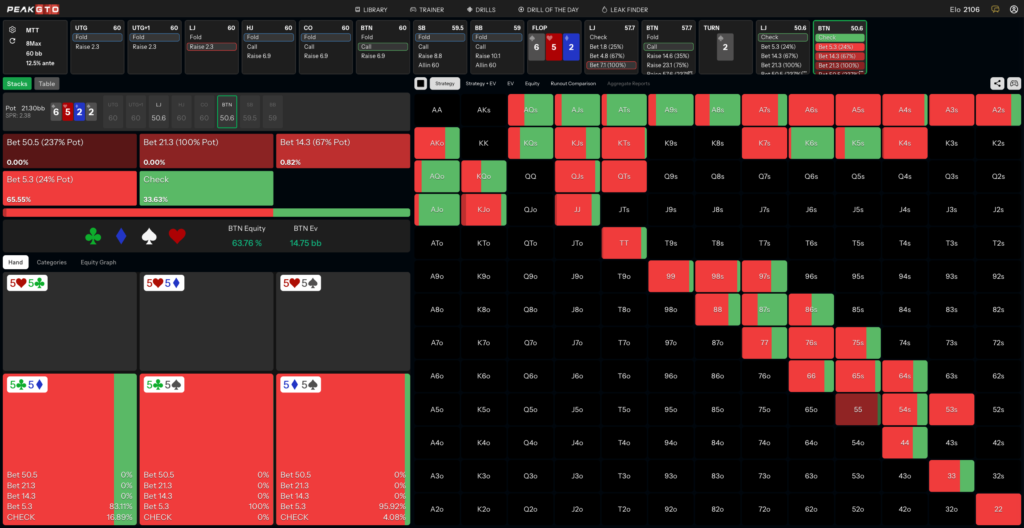
The 2♠ pairs the board and improves Hero to fives full of deuces, the effective nuts. The lojack checks, and that check is loaded with information. After potting the flop with a polarized range, an opponent who then checks the turn is usually very weak, which hands Hero both a range advantage and, with all the sets in the range, a nut advantage. PeakGTO responds by betting about two thirds of the time, and crucially it bets small. Hero bets a tiny 5.3bb, about a quarter of the pot.
The small size surprises people on a hand this strong, but the logic is airtight. Because the opponent’s range is mostly garbage after potting and checking, they have to fold about half the time even to a quarter-pot bet, far below the minimum defense frequency. That is the power of the small bet: it prints with the medium and junky hands in Hero’s betting range while still charging the worse made hands a fee. The full house does not need a big bet to extract here; it is almost always best, so it happily uses the same small size as the bluffs and lets the next street do the heavy lifting. The lojack calls.
It is worth noting which hands prefer to check this turn instead, because it sharpens the picture. Ace-high floats and a hand like K6 that is good but hates getting raised would rather check, as would an open-ended straight draw with two overcards that cannot win at showdown, since betting it and facing a raise is a disaster. A set has none of those problems. It welcomes a raise, it is never folding, and it gains value on almost every river, so it bets the small size at a high clip while the awkward holdings take the free card.
River: 8♥
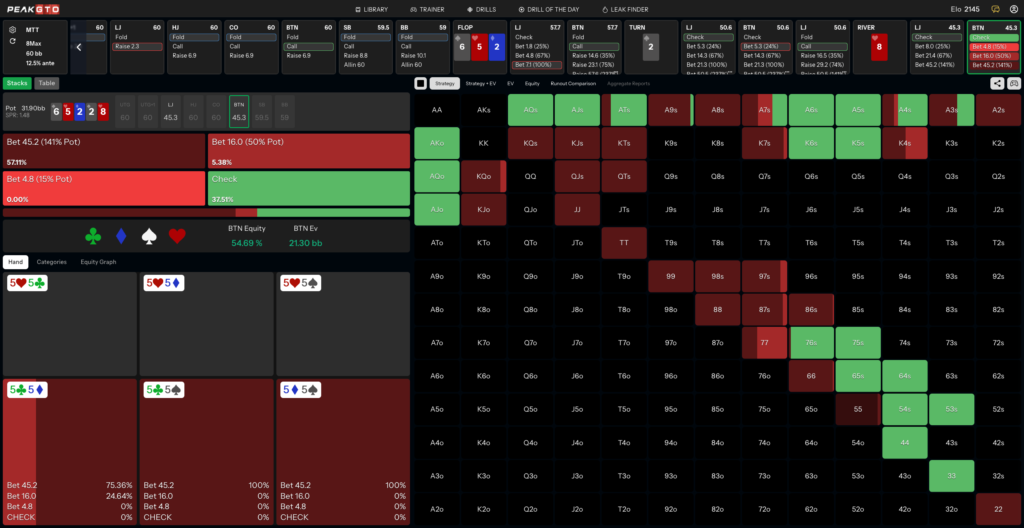
The 8♥ completes the board at 6♠5♥2♦2♠8♥, the lojack checks, and the pot is about 32bb with roughly 45bb left in Hero’s stack. This is where the sizing finally goes big. With about 1.5 times the pot behind, the river bet is essentially all in, and it should be a polarized range of the best value hands and a handful of bluffs. The value side is any eight or better, and a full house is the top of that range with nothing to think about.
The key idea, and the one that defines maximum value, is that you do not size down to coax a call. In GTO terms, a river bet in position wants to be roughly half pot or larger, and here the small half-pot size is used only about five percent of the time. Trying to bet about 16bb of a 45bb stack just to get called invites a check-raise shove that puts Hero in a miserable spot, so the clean play is to rip it all in. With the nuts you are not hoping to get called; you are betting the size that maximizes value across the opponent’s entire calling range, and you fill out that overbet with bluffs like the busted king-highs and floats that have no showdown value. Hero shoves, and although the lojack folds a hand like two pair this time, the overbet is exactly how you extract the most when you do get paid. You take the pot and move on.
Key Takeaways
- Flop: Against a polarized pot-sized continuation bet, even a flopped set just calls. Raising folds out the bluffs you beat and isolates you against value, so you keep your whole continuing range intact.
- Turn: When the opponent pots the flop and then checks, their range is usually weak. A full house bets small, the same quarter-pot size as the bluffs, because that size makes them fold far too often.
- River: With about 1.5 pots behind, the value bet is an all-in overbet. You do not size down to get called; you choose the size that maximizes value against the whole calling range.
- Overall: Value betting the nuts is a sizing puzzle, not a strength contest. Flat when raising only helps the opponent, bet small when their range is capped, and overbet for the maximum when you finally want to get it all in.