
Since we already covered c-betting on low-card boards in single raised pots, today we will dive deeper into the strategy for 3-bet pots.
We will examine IP and OOP strategy after 3-betting preflop and summarize key takeaways for each section.
C-Betting On Low-Card Boards In Position – 8d6h2s
Key assumptions:
- The hand is played 40 bb deep with 12.5% ante
- Our opponent opens from the cutoff
- We 3-bet from the button
- CO calls to see the flop and checks to us
Let’s start by looking at an example on a dry board of 8d6h2s.
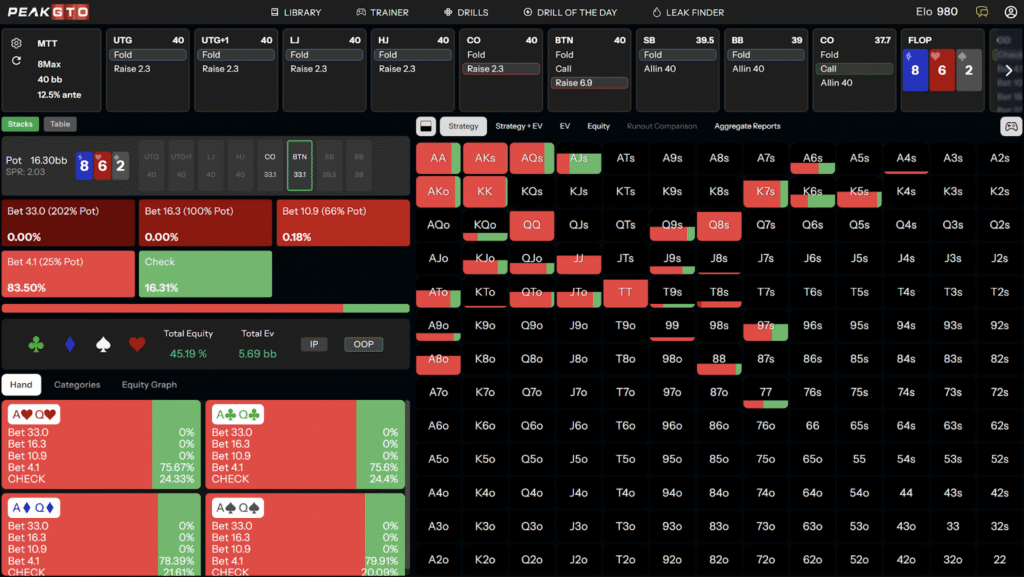
In this spot, we are c-betting with 84% of our range and sticking to a small bet sizing of 25% of the pot in all cases.
Since we have a range advantage, we can easily put the pressure on our opponent. They will have a hard time defending OOP, and small sizing lets us continue with a wide range.
We only check back a few ace-high combinations, as well as some broadways and runner-runner draws.
When the stacks drop to 20, we no longer have a 3-betting range, and we either reshove all-in when facing an open, call, or fold.
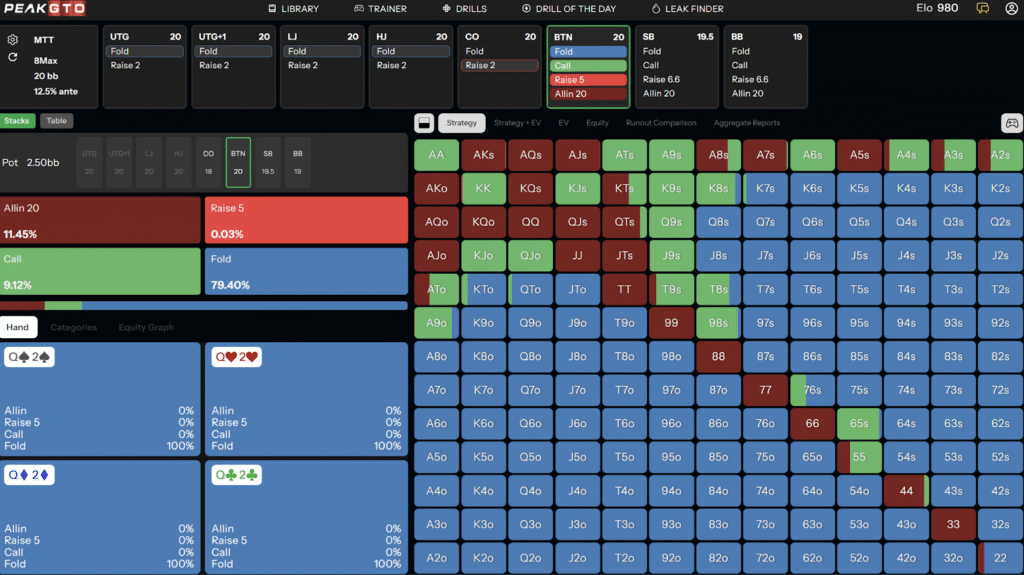
Our range becomes polarized, so we call with the strongest poker hands and the bottom part of our range, and move all-in with everything in between. In this scenario, we are shoving all pocket pairs up to QQ, some broadways, and Ax combinations.
Key takeaways
- C-bet very aggressively on dry boards with around 84% of hands
- Always pick a small bet sizing of one-fourth the pot when continuing
- Mostly shove, call, or fold preflop when stacks move down to 20bb
C-Betting On Low-Card Boards OOP – 8d6h2s
Now, let’s look at the same hand out of position. In this case, we face an open from the BTN and we 3-bet from the BB.
Key assumptions:
- The hand is played 40bb deep with 12.5% ante
- Our opponent is opening from the button
- We 3-bet from the big blind
- The button calls
Let’s look at 8d6h2s to see how we should adjust here after 3-betting.
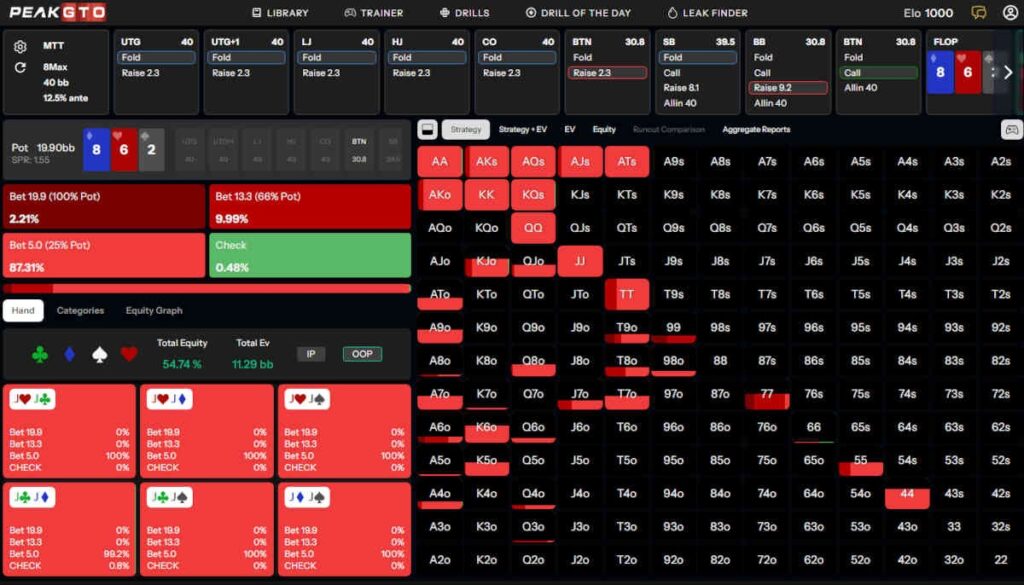
Once again, we will continue betting aggressively and picking small sizing in most situations since we have a range advantage. To be more precise, we will be betting with all of our hands.
As for the sizing, the default bet is 25% of the pot with 88% of the hands, and we should choose larger bets around 12% of the time.
Big bets are mostly reserved for specific hands that need protection, like 99,77, some top-pair and second-pair holdings, and a few combinations of overcards.
When the stacks get down to 20bb, our strategy changes significantly.
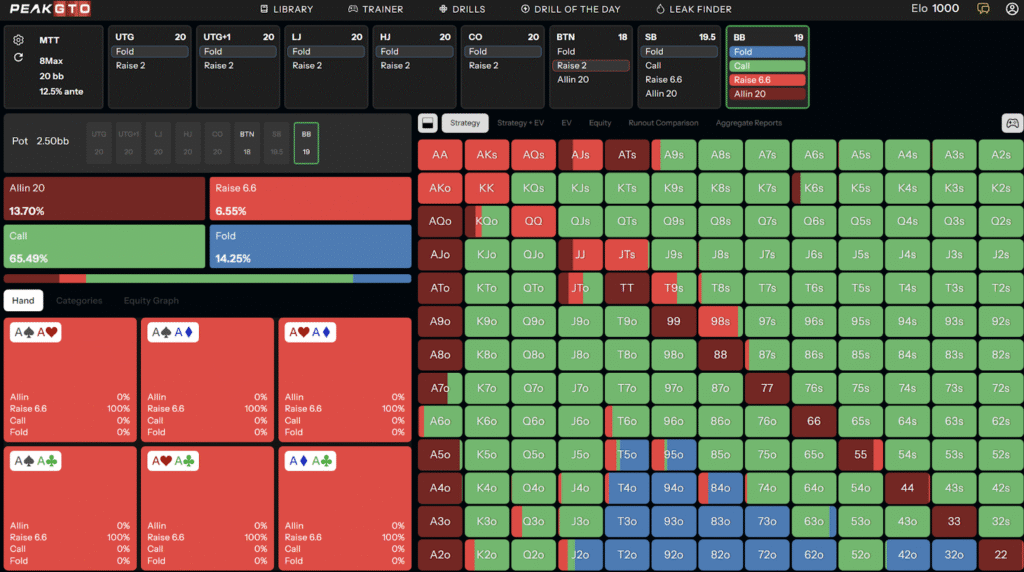
In this spot, we will be calling with 65% of the hands preflop, moving all-in with 14% holdings, and 3-betting just with 6.5% of the range.
When we do 3-bet, we will continue with a very wide c-bet again on 8d6h2s.
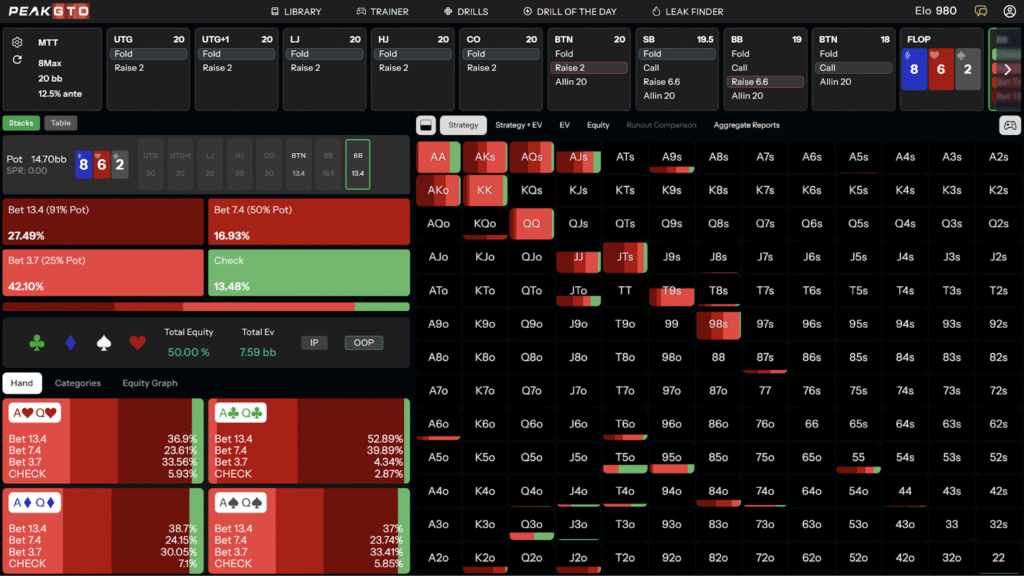
We are betting 86% of the time, but varying our bet sizing quite a bit. While we still pick small 25% pot-size bets around half the time, we also use bigger sizing. This is how are bets are distributed:
- 25 pot size bet – 42% of the time
- 50% pot size bet – 17% of the time
- All-in – 28% of the time
As you can see from the example above, we are not only using small or bigger sizing for a c-bet but also moving all-in with a significant part of our range. This includes a few overpairs, one-pair hands, the strongest Ax type holdings, and even some overcards.
Key takeaways
- C-bet your entire range on dry low-card boards when out of position
- Stick to a small sizing of 25% of the pot with almost your entire range, and mix in bigger bets around 12% of the time
- When stacks drop to 20bb, we mostly call or move all-in preflop, leaving a small 3-bet range of around 7%
- If you 3-bet with 20bb stacks, c-bet aggressively and use a mix of both small and big bet sizings