
In Texas Hold’em, few decisions matter more than how you respond when facing a bet. Every bet your opponent makes forces you to make an immediate judgment about the strength of ranges, incentives, and the profitability of future actions.
The long-term winners are not the players who guess correctly more often. They are the players who make structurally sound decisions rooted in good range construction.
This article expands on the core principles for playing when facing a bet and analyzes concrete examples so you can apply these concepts directly to real hands.
Tip #1. Think in Ranges, Not Hands
One of the biggest leaps in poker understanding comes when you stop asking “Is my hand good?” and instead begin asking “Which hands in my range continue here?”
Strong players make decisions based on how their range performs against the opponent’s betting range. Your specific holding is just one piece of a much larger structure.
The right response depends on how that hand functions within your range. Whether it’s a strong value hand, a profitable semi-bluff candidate, a reasonable bluff-catcher, or an easy fold.
Consider this example. You call from the big blind. Flop comes K♦ 7♣ 4♣. Villain bets 30% pot. You hold 8♠7♠.
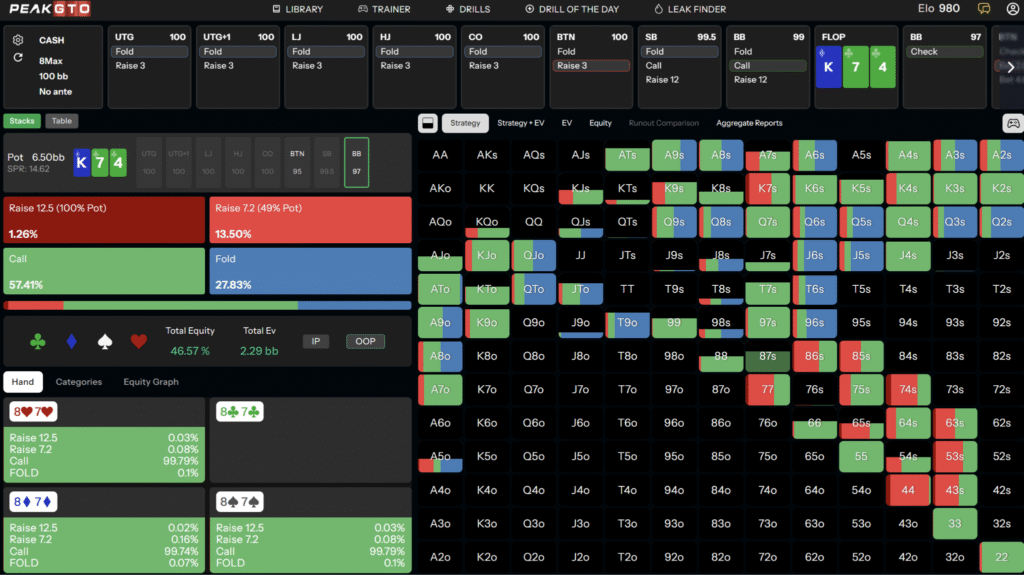
If you just think emotionally that you have a middle pair and have to call, you will miss the big picture. Instead, you need to consider where the hand belongs in your entire range.
- The middle pair here is a medium-strength capable of winning at the showdown
- It is not strong enough to include in your check/raising range
- The hand beats all bluffs but loses to most value hands
- It has decent but not great playability
All of this indicates that this is a medium-strength hand that is optimally played as a call and should go into your calling range, but not just because you have a second pair.
Tip #2. Adjust Tp Different Bet Sizes
Every bet your opponent makes comes with mathematical implications. A half-pot bet requires you to defend more often than a pot-sized bet because you are being offered a better price.
This doesn’t mean you should robotically adhere to minimum defense frequency (MDF), but understanding how bet size shapes the required continuing range gives you an essential baseline.
The larger the bet, the fewer hands you must continue with. The smaller the bet, the more hands you must keep in the pot. This is a good illustration of the ranges you need to defend versus different bet sizes:
| Bet Size | % of Hands You Defend |
| 1.5 Pot | 40% |
| Full Pot | 50% |
| ¾ Pot | 57% |
| 2/3 Pot | 60% |
| ½ Pot | 67% |
| 1/3 Pot | 75% |
For example, if you face a bet of two-thirds of the pot, you will have to continue with 60% of your range to avoid being exploited.
This dynamic creates natural shifts in your calling and raising tendencies. Folding too much on small bets or too little on large bets are among the most common leaks in poker.
Tip #3. Construct a Balanced Continuing Range
Your range when facing a bet splits into three components: folds, calls, and raises. Players often overcall and under-raise, leading to an imbalance that strong opponents exploit.
A well-constructed raising range is polarized, meaning it contains your strongest poker hands and your best semi-bluffs.
Raising with medium-strength hands accomplishes little since they fold out worse hands but get called by better ones, so these hands usually belong in your calling range.
Your call range should consist of hands with decent equity or hands that can profitably realize their equity on future streets.
Let’s look at an example. BTN opens, you call BB with A♣ 6♣. Flop J♣ 9♦ 2♠. Villain c-bets 30%.
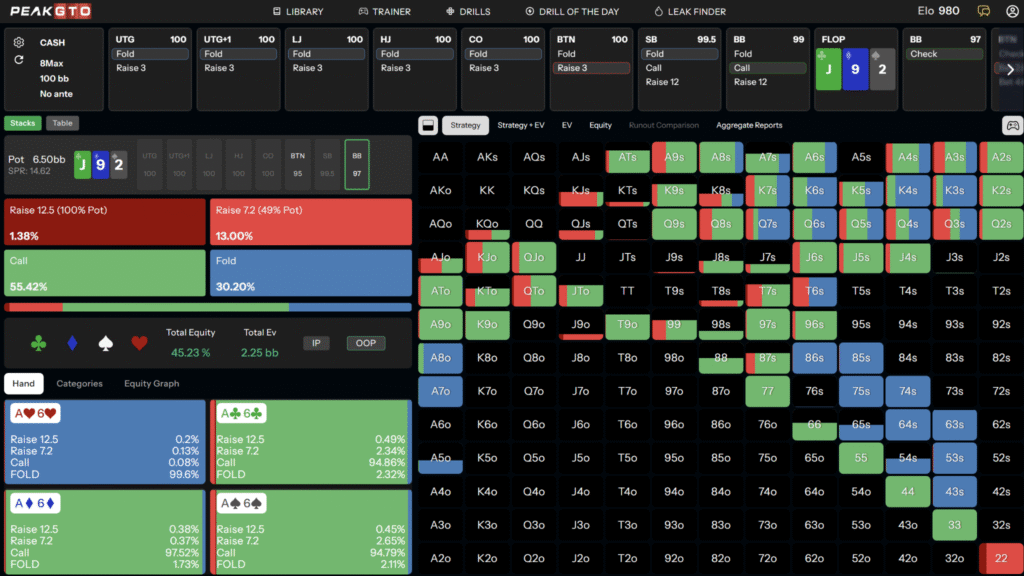
In this case:
- Your raising range is polarized and includes the strongest hands like sets, two-pairs, and top pair combinations, as well as semi-fluffs like flush draws, and other hands with runner-runner potential.
- You call most medium-strength hands with showdown value and decent equity, including most one-pair combinations and even some ace-high hands.
- You fold the bottom part of your range with hands that have a small showdown value and little chances to improve.
This lets you play a very balanced GTO poker strategy than no opponent will be able to exploit.
Tip #4. Evaluate Board Texture and Range Advantage
Board texture profoundly shapes how often you should continue. Dynamic, draw-heavy flops allow you to defend more liberally because more of your range has equity. Dry, static boards compress your range and reward tighter play.
Wet boards (for example, J♠ T♠ 8♦)
- Many draws
- Equity is fluid
- Raising wide becomes normal
- Floating is common
- Defense frequency is high
Dry boards (for example, A♦ 7♣ 2♠)
- Very few draws
- Value is static
- Raising is rare
- Fold frequency increases
An equally important concept is the nut advantage, which evaluates which player holds more combinations of the strongest hands. When you possess the nut advantage on a given board, you gain the ability to raise more aggressively.
Conversely, when your opponent has the nut advantage, your range becomes more cautious, and calls become more selective.
These are two things you always need to consider when facing a bet, and if you properly evaluate who has the range and nut advantage on a specific board texture, the decisions become so much easier.
Tip #5. Stay Disciplined on Later Streets When Ranges Narrow
As the hand progresses to the turn and river, the incentives shift. Your opponent’s betting range tends to become stronger, their bluffs decrease, and the pot grows. Because of this, you should be folding more often on later streets, not out of fear, but because the math and range interactions naturally demand it.
- Ranges are already defined by flop action.
- Big bet sizes drastically change the incentives.
Let’s look at another example. You call preflop from the BB and again call a c-bet on J♣ 7♠ 5♦ from the button. Turn is an A♦, and your opponent bets again for 100% of the pot.
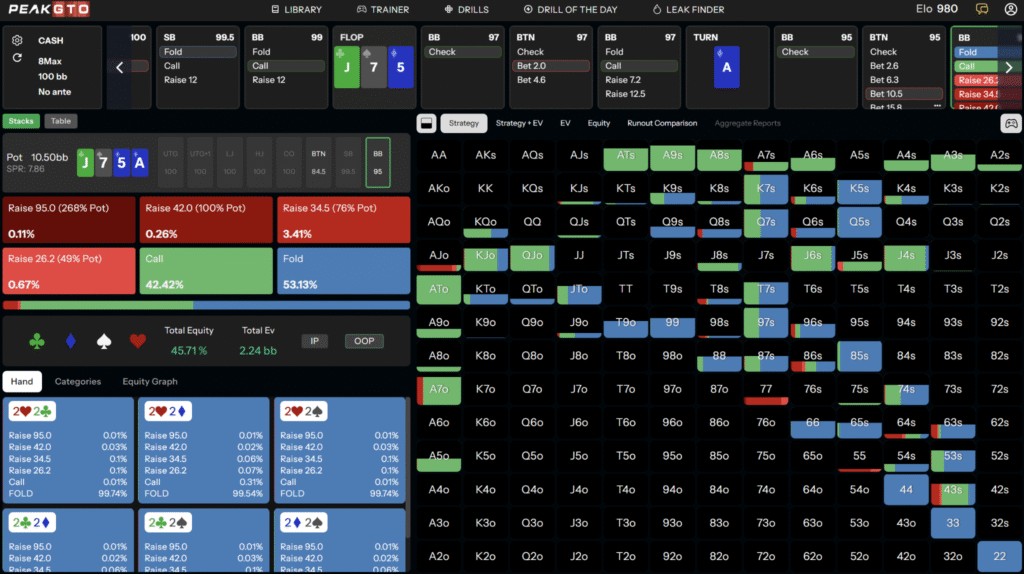
In this case, your weak floats and bluffcatchers lose a lot of value, and you should be folding over 50% of the hands. Most of your 3rd and even 2nd-pair hands from the flop have to fold now.
Speculative hands also lose value as fewer cards remain, so you need to keep your discipline and not be afraid to fold just because you had something on the flop.
Final Thoughts
Responding correctly to bets isn’t about guessing whether your opponent has it. It’s about understanding how your range interacts with theirs, interpreting bet sizes, recognizing when you have a nut advantage, and appreciating the true value of your hand across future streets.
When you learn to defend the right hands and fold the wrong ones, you create a sturdy framework that continues to print EV across every format.