
Many players spend countless hours studying solver outputs, memorizing balanced ranges, and worrying about being “exploitable,” only to sit down in games where opponents fold too much, call too wide, and rarely apply pressure correctly. In these environments, strict GTO play often leaves money on the table.
The most profitable players at low stakes don’t try to play theoretically perfect poker. Instead, they make simple, intentional preflop adjustments designed to exploit how the population actually behaves.
This article covers five of the most important preflop adjustments you can make to immediately improve your win rate in small-stakes cash games, especially online micro-stakes and live low-limit poker.

Tip 1. Open Wider in Late Position
Position is the foundation of profitable poker, yet it remains one of the most underutilized edges at small stakes. When you are on the Button or in the Cutoff, you act last on every postflop street. That advantage alone dramatically increases the profitability of marginal hands.
In theory, blind players should defend aggressively against late-position opens. In practice, they do not. Most small-stakes players fold their blinds far too often, particularly against Button raises. Even when they do call, they tend to play passively and predictably after the flop.
Because of this, opening wider than preflop charts suggest in a late position is one of the easiest ways to increase your win rate. You are not opening weaker hands because they are strong in isolation, but because position and fold equity make them profitable.
Key benefits:
- Wins the blinds more often without contest
- Creates profitable postflop situations with position
- Increases overall volume of small, low-risk wins
Tip 2. 3-Bet Much Less Against Tight Early-Position Opens
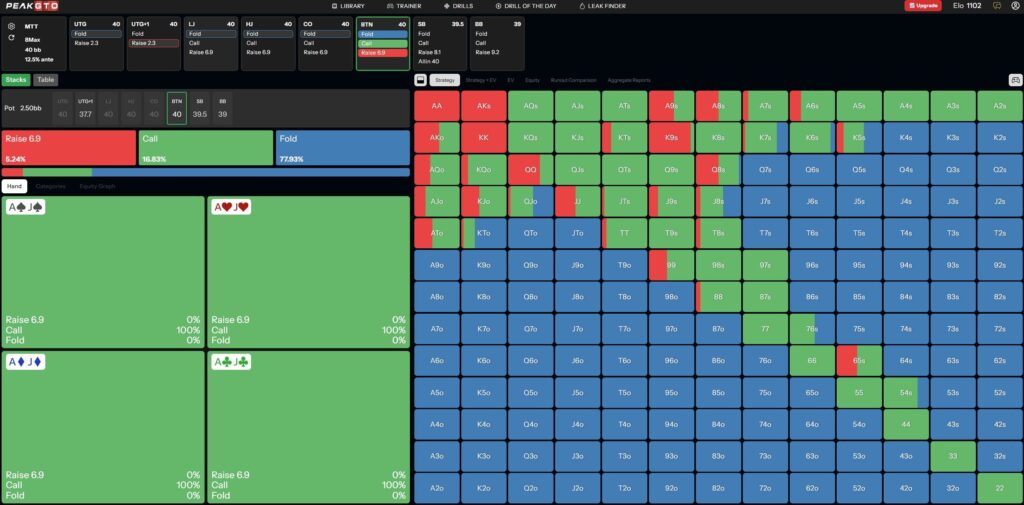
Aggression is often praised in modern poker strategy, but aggression without context can be expensive. One of the most common mistakes small-stakes players make is 3-betting too often against early-position opens.
At low stakes, early-position ranges are typically much tighter than theory suggests. Many players simply do not open weak hands from under the gun or middle position. When these players face a 3-bet, they also tend to continue only with strong holdings and rarely 4-bet bluff.
The correct adjustment is to significantly reduce your 3-bet frequency in these spots. Strong but non-premium hands often perform better as calls, while marginal hands are best folded. This keeps pots manageable and avoids bloated situations against strong ranges.
Key benefits:
- Avoids building big pots against very strong ranges
- Keeps dominated hands in when you flat-call
- Reduces costly preflop and postflop mistakes
Tip 3. Over-Fold to 3-Bets, Especially Out of Position
Calling 3-bets is one of the most misunderstood areas of small-stakes poker. While theory suggests defending a wide range, in practice most low-stakes players do not bluff enough with their 3-bets to justify loose calls.
This is particularly true when you are out of position. Calling a 3-bet without position often leads to difficult postflop decisions, dominated top pairs, and forced folds on later streets.
A highly profitable strategy is simply folding more often than GTO recommends. This disciplined approach protects your stack and allows you to invest chips only when you have a clearer edge.
Key benefits:
- Avoids dominated hands and awkward postflop spots
- Preserves chips for higher-EV situations
- Simplifies decision-making under pressure
Tip 4. Open Larger Preflop, Especially in Live Games
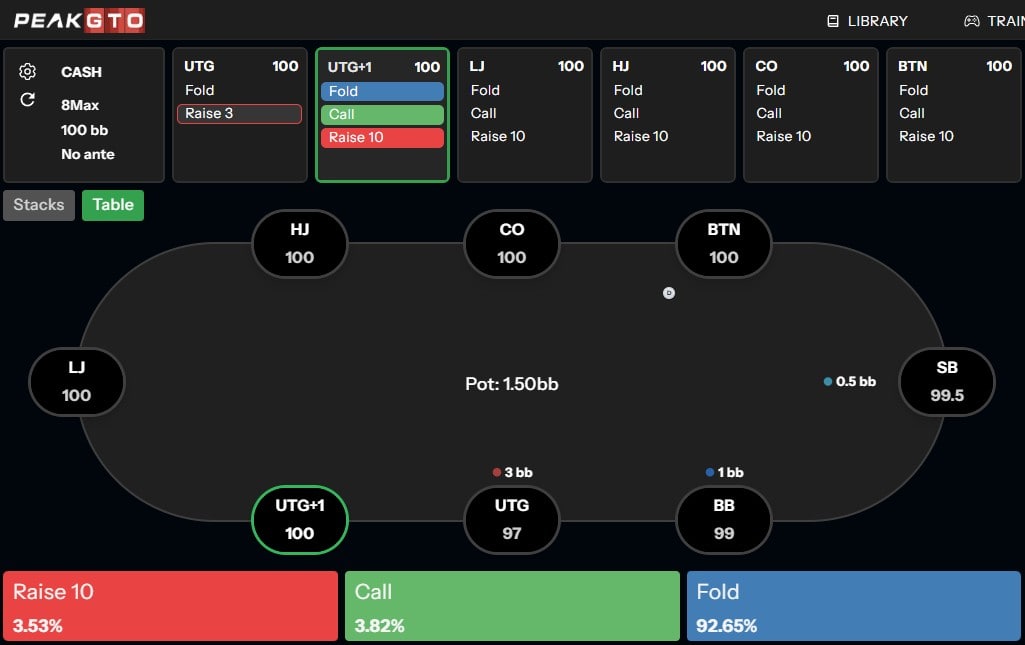
One of the biggest differences between theoretical poker and real-world low-stakes games is how opponents respond to bet sizing. In live games, especially, many players call preflop raises regardless of size if their poker hand looks playable.
This creates a clear opportunity to open for larger sizes. Bigger raises build larger pots with strong hands, discourage excessive multiway action, and punish players who insist on calling too wide.
By opening larger, you simplify the game and shift more money into situations where hand strength and decision-making matter most.
Key benefits:
- Extracts more value from loose callers
- Reduces multiway pots and chaos
- Creates clearer postflop stack-to-pot ratios
Tip 5. Iso-Raise Recreational Players Aggressively
If there is one situation in poker where balance matters the least, it is against weak recreational players who limp or call too frequently. These players represent the largest source of profit in small-stakes games.
When a recreational player limps, they are usually entering the pot with a weak and poorly constructed range. By iso-raising aggressively, you gain the initiative, often secure a position, and isolate the weakest player at the table.
Iso-raising is not about fancy bluffs or complex strategies. It is about creating simple, profitable situations where your opponent is likely to make mistakes.
Key benefits:
- Isolates weaker players in heads-up pots
- Maximizes value against poor ranges
- Creates straightforward, high-EV situations
Conclusion: Simplicity Wins at Small Stakes
Small-stakes Texas Hold’em is not beaten by perfection. It is beaten by clear, repeatable decisions that exploit common mistakes.
Opening wider, respecting early-position strength, folding more often to 3-bets, increasing preflop sizing, and aggressively isolating recreational players are not flashy concepts. They are practical, disciplined, and consistently profitable.