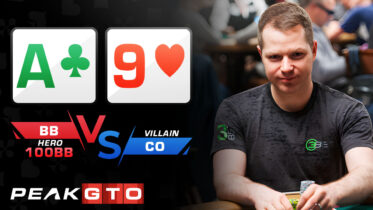
Deep-stacked cash game poker hands when out of position often hinge on how well we construct aggressive ranges without overextending them. This hand illustrates a common but nuanced spot where the big blind check-raises the flop, then must exercise discipline on later streets as equities and range advantage shift. Holding A♣9♥, Hero follows a solver-driven line that highlights when to apply pressure and, just as importantly, when to slow down.
Assumptions
- Stacks: 100bb effective
- Positions: CO (Villain) vs BB (Hero)
- Action: CO raises, BB calls with A♣9♥
- Flop: T♦7♣4♣ (Pot 6.5bb)
- Turn: 2♠ (Pot 31.3bb)
- River: 8♠ (Pot 31.3bb)
Flop: T♦7♣4♣
This is a dynamic, low-to-mid board that interacts well with the big blind’s defending range. Solver output has BB checking range, allowing the cutoff to act first. CO responds with a mixed strategy, betting 4.6bb at its highest frequency (41.4%), using a smaller 2.0bb bet less often, and checking 37% of the time.
Facing the 4.6bb bet, solver gives the out of position BB an aggressive response. The check-raise to 12.4bb appears 14.1% of the time and is a core part of the strategy on this texture. A♣9♥ fits naturally into this raising range. It has middling equity, blocks some strong top-pair continues, and helps balance value hands like sets and strong two pairs. The raise pressures overcards and forces CO to continue with a more condensed range. CO calls nearly half the time and folds 40.5%, with raises remaining relatively rare.

Turn: 2♠
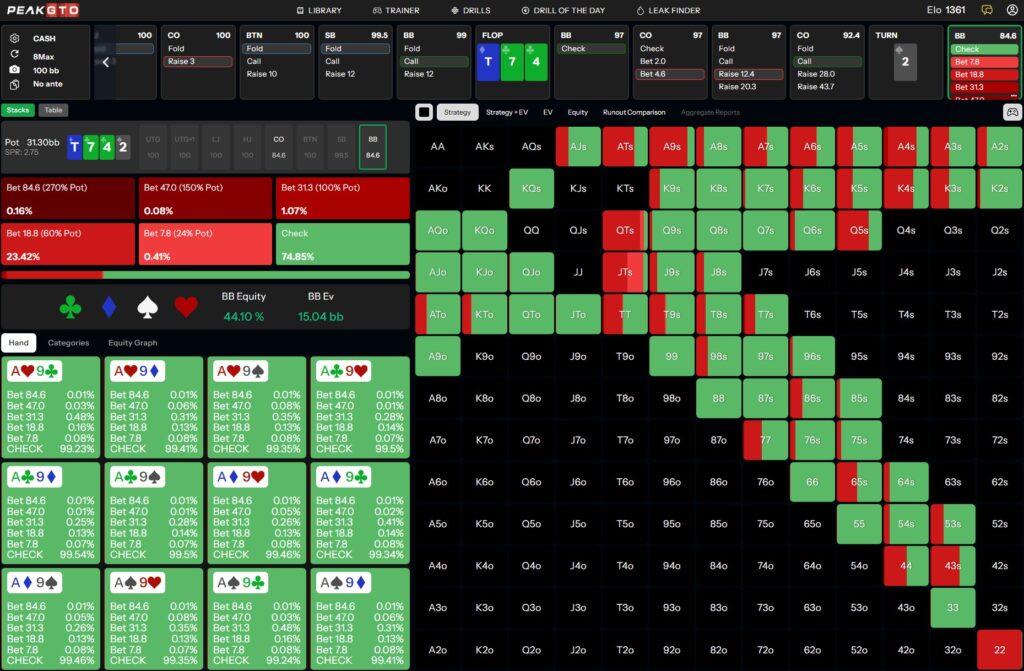
The turn is a pure brick that does not meaningfully improve BB’s range. Solver output reflects this by shifting BB into a very check-heavy strategy, checking 74.9% of the time and betting only selectively. This slowdown is critical: after the flop check-raise, BB’s range contains many draws and medium-strength hands that did not improve on this card.
Hero checks with A♣9♥, which aligns precisely with solver logic. Betting here would overextend a range whose overall equity has dropped. CO also checks back at a high frequency (44.3%), confirming that both players recognize the reduced incentive to inflate the pot on this turn.
River: 8♠
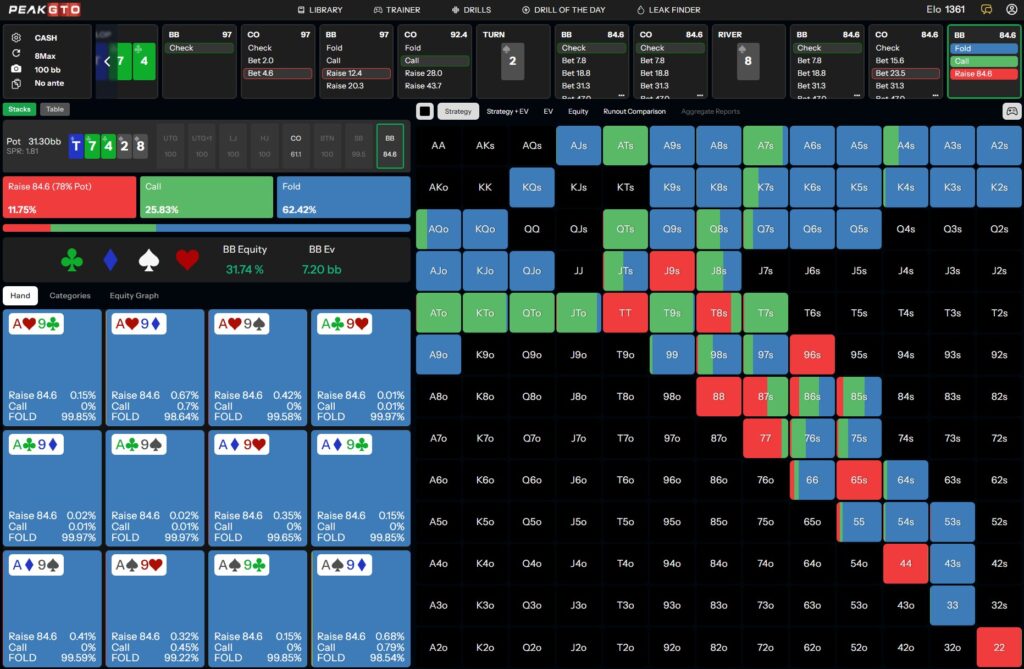
The river introduces some straight possibilities but does not dramatically favor the big blind’s range. Solver again prefers BB to check most of the time (68.6%), with betting reserved for specific value and bluff combinations. After BB checks, CO bets 23.5bb at a meaningful frequency (14.5%), alongside smaller and larger sizings, while checking 53.1% overall. In this case, CO does choose that 23.5bb sizing.
Against the bet, PeakGTO shows BB folding 62.4% of the time, calling 25.8%, and raising only 11.8%. With A♣9♥, folding is correct. The hand blocks some of CO’s bluffs and does not beat enough of the value range to justify a call. This is a key discipline point: despite having shown aggression earlier in the hand, solver logic clearly shuts down with this holding on the river.
Key Takeaways
- Flop: On dynamic, low-connected boards, BB can construct a meaningful check-raise range. A♣9♥ serves as a balanced, middling-equity raise alongside stronger value hands.
- Turn: The 2♠ is a complete brick. Solver shifts heavily toward checking, recognizing the drop in BB’s overall range equity after the flop raise.
- River: After a passive turn, BB must defend selectively. A♣9♥ does not meet the threshold to continue versus a sizable river bet and is correctly folded.
- Overall: GTO strategy emphasizes structure and restraint. Check-raising the flop does not obligate continued aggression; strong solver play depends on reassessing equity and range strength on each street.