When the preflop raiser checks back the flop in a single-raised cash game pot, the turn dynamic resets completely. The check-back reveals that the raiser declined to continue with a substantial portion of their range, filtering out many strong hands that would have bet. On the right turn cards, this shift in nut advantage allows the big blind to lead with a polarized overbet, putting enormous pressure on the raiser’s capped range.
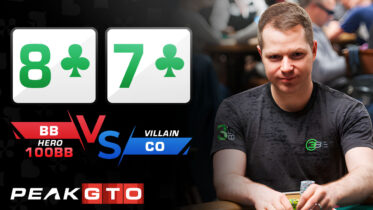
Today we will analyze a 100bb 8-handed cash game hand where the big blind defends 8♣7♣ against a cutoff open, the flop checks through on 9♦6♦4♥, and the A♠ arrives on the turn. This hand illustrates how a flop check-back shifts nut advantage, why the solver selects a 150% pot overbet as its primary turn sizing, and why checking the river with a bricked draw is the disciplined play when the J♠ fails to complete any of BB’s equity.
Assumptions
- Stacks: 100bb effective
- Format: 8-handed cash game
- Positions: BB (Hero) vs CO (Villain)
- Action: CO RFI, BB calls
- Flop: 9♦6♦4♥ (Pot: 6.5bb)
- Turn: A♠ (Pot: 6.5bb)
- River: J♠ (Pot: 26.1bb)
Flop: 9♦6♦4♥
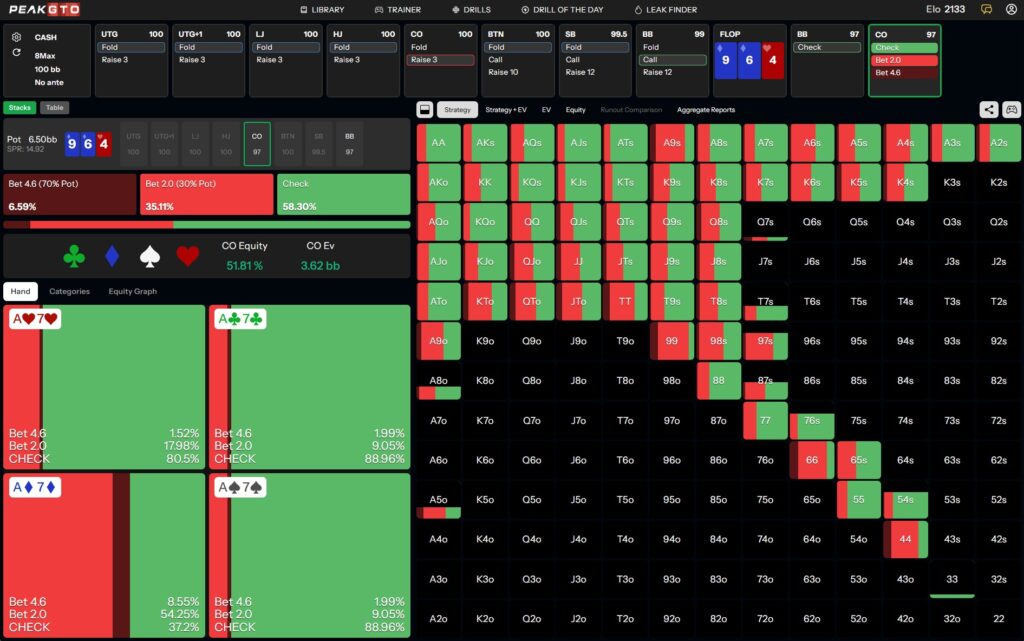
BB checks 100% of the time on this board. In a single-raised pot as the caller, the big blind always checks to the preflop raiser.
CO can bet 2.0bb at 35.1%, bet 4.6bb at 6.6%, or check at 58.3%. CO checked back.
PeakGTO shows CO checking 58.3% on this texture. 9♦6♦4♥ is a low, connected board with a diamond draw, and while CO retains equity advantage as the preflop raiser, this flop connects heavily with BB’s defending range. Pocket pairs, suited connectors like 87s and 76s, and suited aces with front door and backdoor equity all live in BB’s range. CO’s overcards (AK, AQ, KQ) miss this board, and many of CO’s weaker holdings prefer a free card. The check-back is a range-based decision on a texture that does not reward wide aggression.
For 8♣7♣, the flop check-through is ideal. Hero holds an open-ended straight draw (any 5 or T completes) and retains full equity heading into the turn. The checked pot remains at 6.5bb.
Turn: A♠
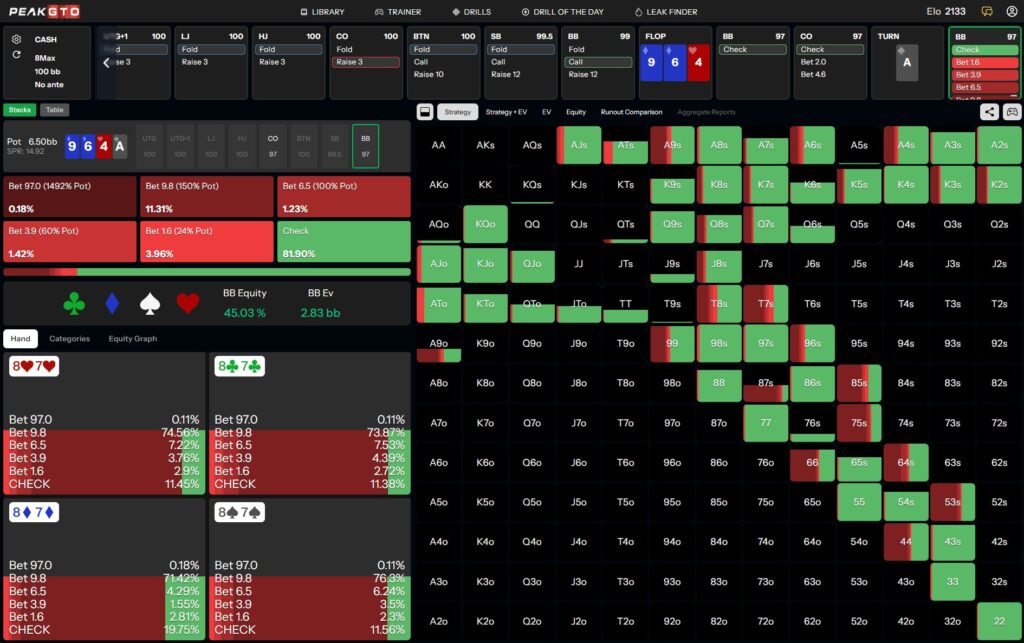
The A♠ looks like the worst possible turn card for the big blind. CO’s opening range is loaded with Ax hands, and pairing the ace appears to hand CO a massive advantage. But after the flop check-back, the dynamics are inverted. CO would have continuation bet many of their strongest flop holdings: pocket fours and sixes for protection, ace-nine suited for value, and strong two pairs to build the pot. By checking back, CO filtered these hands out of their range. BB retains everything: two pairs like 96 and 64, sets, and ace combinations that now pair the turn. The result is that BB holds nut advantage despite the ace appearing to favor the cutoff.
The solver has BB check 81.9% and bet 18.1% across all sizes. When BB does bet, the 9.8bb overbet (150% pot) is the primary sizing at 11.3%. The overbet is correct because BB’s value range reaches deep: the thinnest value hand is roughly two pair. King-nine suited is not strong enough to bet here. When the minimum value hand is that strong, a large polarized range maximizes pressure against CO’s most common holding, a single pair of aces. The bluffs in this range need equity against CO’s continues: flush draws, straight draws, and combo draws that can improve on the river.
8♣7♣ fits this profile with an open-ended straight draw (5 or T completes), giving roughly eight outs or about 16% equity against one pair. The combination of fold equity from the overbet sizing and draw equity when called makes it an ideal turn bluff candidate. CO’s response confirms the pressure: fold 59.6%, call 37.6%, raise at a combined 2.8%. CO called, and the pot grows to 26.1bb heading to the river.
River: J♠
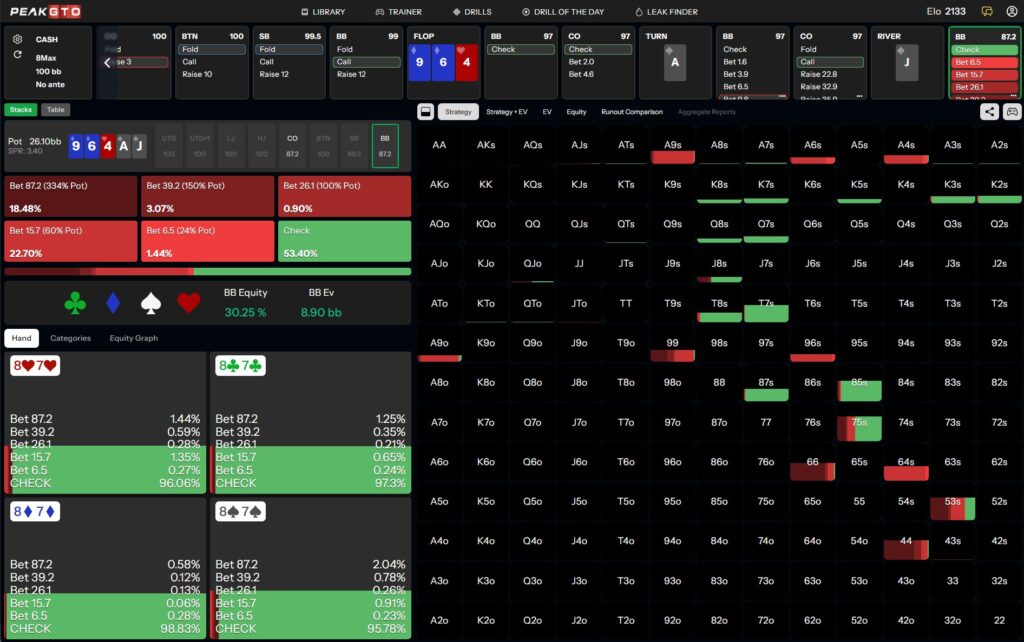
The J♠ completes none of BB’s draws. The straight needed a 5 or T. Diamonds did not get there. The board finishes 9♦6♦4♥A♠J♠. BB’s value hands (two pair and better) remain intact, but the draw-heavy bluffs have bricked almost entirely. On the turn, BB could carry a high number of bluffs because many rivers would improve those draws into value hands, rebalancing the range naturally. The J♠ is one of the rivers where that does not happen, and the solver reflects it: BB checks 53.4%, with 15.7bb at 22.7% and 87.2bb at 18.5% as the primary bet sizes when BB does continue.
For 8♣7♣ specifically, checking is correct. In GTO play, the key principle when selecting river bluffs is to unblock the opponent’s auto-folds. On this river, BB wants CO to hold weak offsuit aces (A2o, A3o, A5o) and high diamond hands (K♦x, Q♦x) that bricked their own draws. 8♣7♣ blocks A8o and A7o, both offsuit ace combinations CO would fold. By holding an eight and a seven, Hero reduces CO’s folding combos, making a bluff less profitable. The better candidates are hands with the lowest cards that do not block CO’s folding range and do not contain diamonds: hands like 5-3 and 5-7 without the diamond suit.
After BB checks, CO bets at a combined 39.6% or checks at 60.4%. CO also slows down on this river. CO checked, and the hand went to showdown with 26.1bb in the pot.
Key Takeaways
- Flop: BB checks 100% as the caller in a single-raised pot. CO checks back 58.3% on 9♦6♦4♥, filtering strong hands out of their range and setting up a turn where BB’s nut advantage takes shape. For 8♣7♣, the check-through preserves an open-ended straight draw at full equity.
- Turn: The A♠ shifts nut advantage to BB because CO would have bet their strongest flop holdings on the flop. BB’s primary bet size is a 150% pot overbet (9.8bb at 11.3%), reflecting a polarized strategy where the minimum value hand is two pair. 8♣7♣ qualifies as a bluff with eight outs to a straight. CO folds 59.6% to the overbet.
- River: The J♠ bricks all of BB’s draws. BB checks 53.4%. With 8♣7♣, checking is correct because the hand blocks CO’s auto-folds (A8o, A7o). The better bluff candidates are hands with the lowest cards that do not interact with CO’s folding range.
- Overall: This hand demonstrates the full lifecycle of a polarized overbet bluff: identifying nut advantage after a flop check-back, selecting the correct sizing and bluff candidates on the turn, and knowing when to stop on a river that does not improve your equity. The river check is what separates a losing overbet strategy from a winning one.