Paired board poker strategy at shallow stacks is one of the most misplayed spots in tournaments. On a board like 9-6-6, most big blind players either fold without a six or call passively with overcards. The solver builds a paired flop check raise range with trips for value and select backdoor draws as bluffs, then uses later streets to decide which bluffs continue.
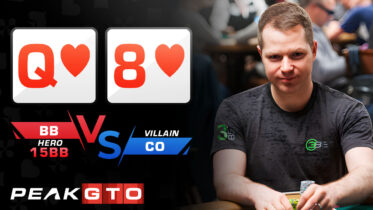
Today we will analyze a 15bb 8-handed tournament hand where the big blind defends Q♥8♥ against a cutoff open, check-raises a paired 9♠6♥6♦ flop with backdoor draws, shuts down on the 2♠ turn, and faces a thin bluff decision on the 7♦ river.
Assumptions
- Stacks: 15bb effective
- Format: 8-handed MTT
- Positions: BB (Hero) vs CO (Villain)
- Action: CO raises, BB calls
- Flop: 9♠6♥6♦ (Pot: 5.5bb)
- Turn: 2♠ (Pot: 13.3bb)
- River: 7♦ (Pot: 13.3bb)
Preflop
At 15bb, the cutoff splits between min-raises and all-in shoves. Pocket sevens and lower, ace-queen through ace-seven offsuit, and suited broadways nine or higher go all in. Everything else raises to 2bb. Q♥8♥ is a call. BB’s shove range includes all pairs and ace-nine and better, but Q8s falls short. Against a loose opener it becomes a reasonable jam.
Flop: 9♠6♥6♦
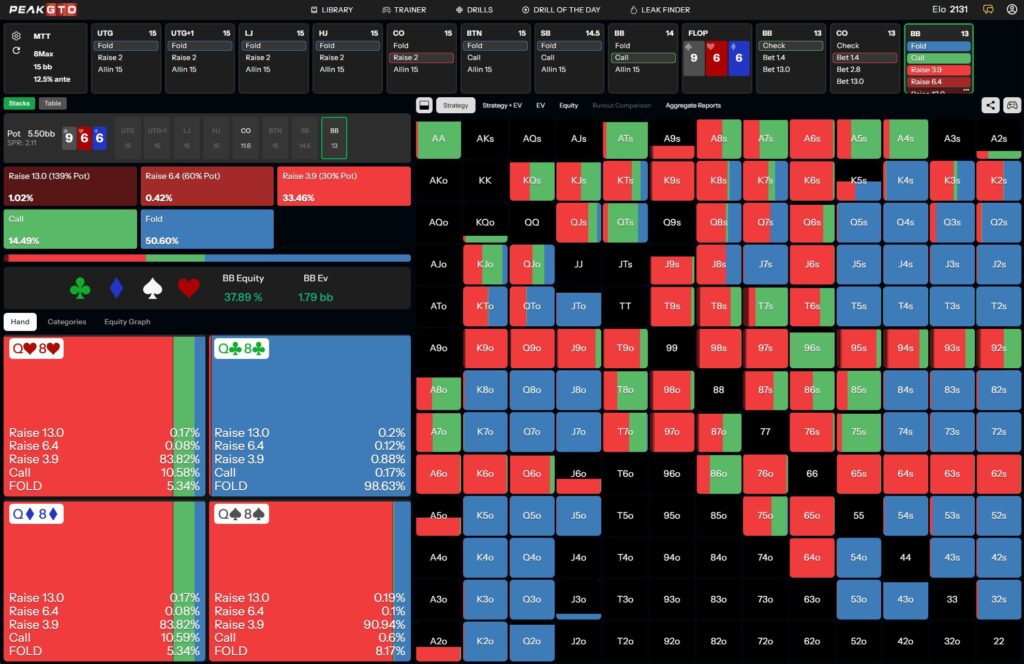
BB checks 98.58%. Trips crush at the top of BB’s range, but from the 90th percentile down, BB is far behind at just 38% equity. CO continuation bets 83.87% using the 1.4bb sizing. Villain bet 1.4bb.
After the small bet, BB check-raises 33.46% (to 3.9bb), calls 14.49%, and folds 50.60%. The check-raise range has two layers.
Value: any nine or any six. Pairs and trips check-raise the majority of the time. Nine-six slow-plays with a full house. At 15bb, even nines build a pot through a check-raise because the stacks set up an all-in trajectory in two more bets.
Bluffs: backdoor straight plus backdoor flush draw. Q♥8♥ has an overcard, a backdoor flush draw, and a backdoor straight draw through the 8-9 connection. The straight draw is the dividing line. Q5♥ has the same overcard and backdoor flush but folds because it lacks the straight component. Q♥8♥‘s check-raise gains +0.18bb over folding; Q5♥ loses 0.04bb by raising.
Hands with stronger draws prefer to call. 8-5 of hearts (gutshot plus backdoor flush), 7-5 of hearts, and T8 (overcard plus gutshot) call rather than risk a jam. Hero raises to 3.9bb. CO calls 39.98%, folds 30.10%, raises at a combined 29.93%.
Turn: 2♠
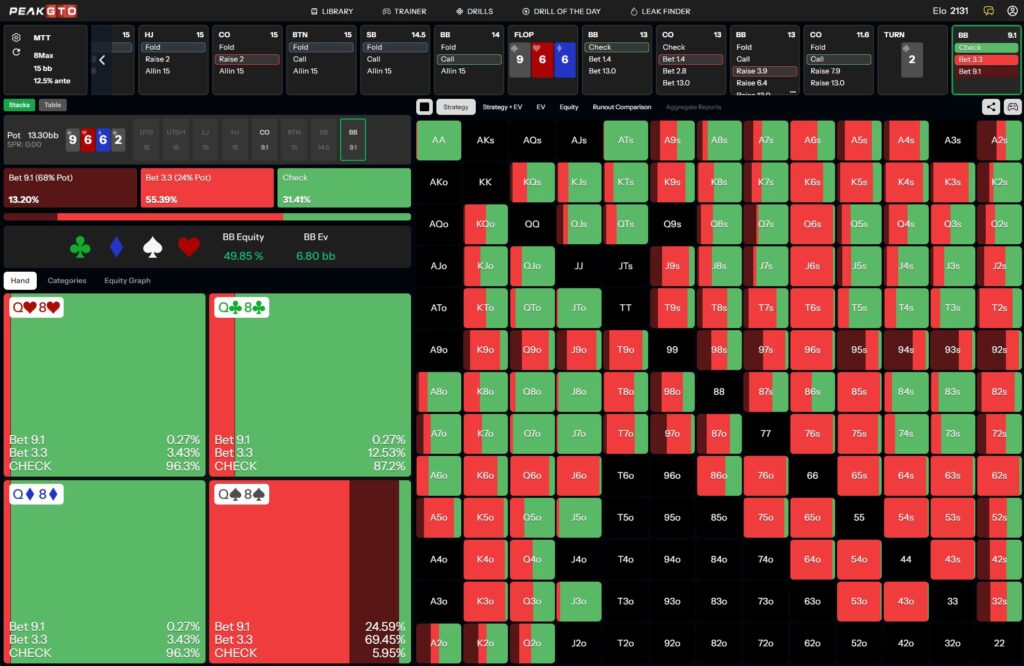
The 2♠ does not improve Q♥8♥. No heart, no straight card. The heuristic after a flop check-raise with backdoor draws: pick up equity on the turn, keep betting. Miss, shut down.
PeakGTO confirms this. Q8 of hearts bets only 3% on this turn. Q8 of spades, which turned a backdoor flush draw, bets 94%. The suit is the only difference. Hands that improved to a gutshot on the deuce (5-3, 5-4, 4-3) also keep betting.
Range-wide, BB bets 55.39% (3.3bb) and 13.20% (9.1bb), with 31.41% checking. The small size is primary because trips do not need folds and low-equity bluffs want cheap ones. BB checks some made hands to protect the checking range.
Q♥8♥ is done. Hero checks, folding to any bet. CO checks back.
River: 7♦
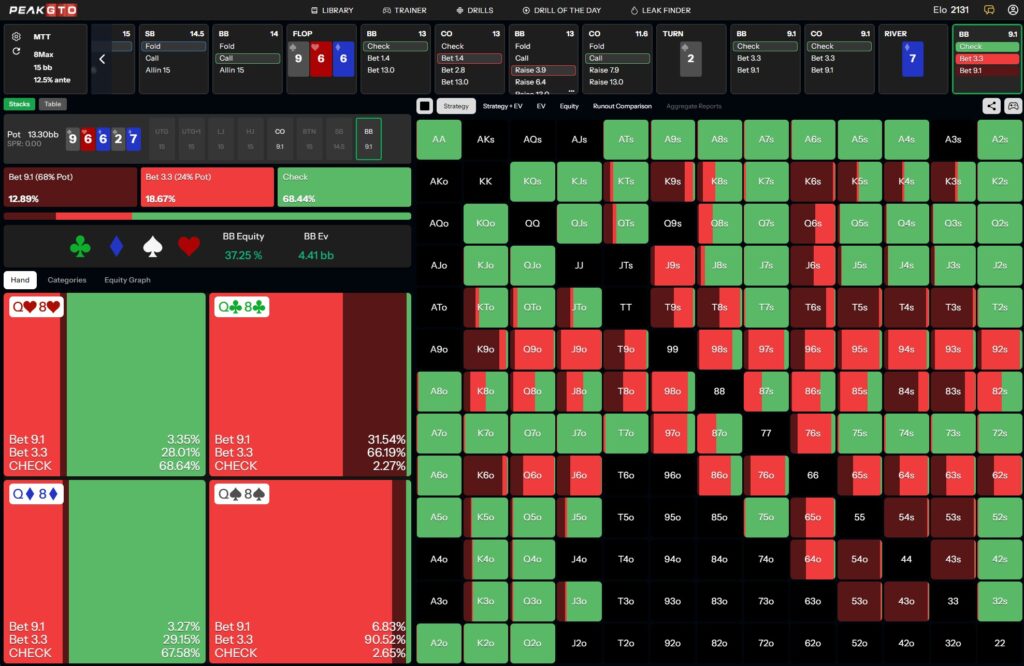
The 7♦ creates a decision most players overlook. BB checks 68.44%, bets 3.3bb at 18.67%, and bets 9.1bb at 12.89%. The high check frequency exists because BB already bet most sixes and nines on the turn. Without those turn check-backs, BB’s river range is almost entirely air with no license to bluff.
The bluff side is thin. The small bet gives excellent pot odds, so BB cannot bluff often. Jack-eight only bluffs 17%. The hands that shove most are king-five, king-four, and king-three: no showdown value and no blockers to the folding range.
Q♥8♥ should bet small about 30% of the time. The 3.3bb bet can fold out better hands like ace-eight suited, king-queen, king-jack, and queen-jack. The queen blocker is not ideal, but the absence of showdown value makes the bet profitable at a mixed frequency.
GTO says check or bet small, but in practice both the small bet and the shove work. When BB check-raises on a paired board, most opponents assume trips and rarely hero-call the river with ace-high. If your opponent over-folds, bluff more.
Hero checks. CO checks back.
Key Takeaways
- Flop: BB checks 98.58%. After CO c-bets at 83.87%, BB check-raises 33.46%, calls 14.49%, folds 50.60%. The bluff range requires both a backdoor flush and straight draw. Q♥8♥ qualifies; Q5♥ folds because it lacks the straight component.
- Turn: The 2♠ misses. Q8 of hearts bets 3%, while Q8 of spades (turned a flush draw) bets 94%. After a flop check-raise with backdoor draws, keep betting when the turn adds equity. Give up when it does not.
- River: Q♥8♥ bets small about 30%, targeting ace-eight, king-queen, and king-jack. Most opponents over-fold because the flop check-raise on a paired board reads as trips.
- Overall: Flop check-raise requires both backdoor flush and straight draws. Turn is the checkpoint: new equity means continue, none means give up. The river still offers a thin bluff when BB retains enough turn check-backs to support it.