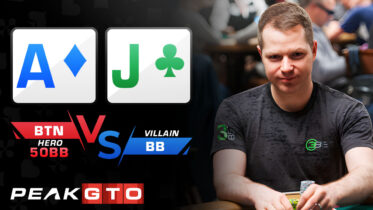
Facing check raise pressure from the big blind with nothing but ace-high, the natural instinct is to look for reasons to fold. No pair on a two-tone broadway board does not feel like a hand worth putting more chips in with. But position and draw equity change the calculus. A hand with a gutshot to the nuts and a backdoor flush draw has enough equity to justify continuing against a polarized check-raise range, and when the draw connects, position becomes the engine for extracting maximum value.
Today we will analyze a 50bb 8-handed tournament hand where the button opens A♦J♣, faces a check-raise on K♣Q♦5♦ with a gutshot and backdoor diamond draw, hits the nut straight on the T♠ turn, and must decide how to get all the chips in on a blank 2♠ river. This hand illustrates when calling a check-raise is correct despite holding no made hand, how to size bets after improving to the nuts, and why going all-in on the river is the only play with a polarized range.
Assumptions
- Stacks: 50bb effective
- Format: 8-handed MTT, 12.5% ante
- Positions: BTN (Hero) vs BB (Villain)
- Action: BTN raises, BB calls
- Flop: K♣Q♦5♦ (Pot: 5.9bb)
- Turn: T♠ (Pot: 23.1bb)
- River: 2♠ (Pot: 34.7bb)
Preflop
At 50bb, the button opens a wide range. A♦J♣ is a standard open from this position at any stack depth. Ace-jack offsuit connects well with broadway boards, provides overcard equity when behind, and plays comfortably in position against a big blind defend.
The big blind calls. At this stack depth, BB’s calling range is wide, including most suited hands, offsuit broadways, pairs, and suited connectors. A 3-bet from BB would typically use a polarized construction at 50bb: premiums for value, select offsuit blockers for bluffs. Calling keeps the pot small and preserves the positional disadvantage at a manageable SPR.
Flop: K♣Q♦5♦
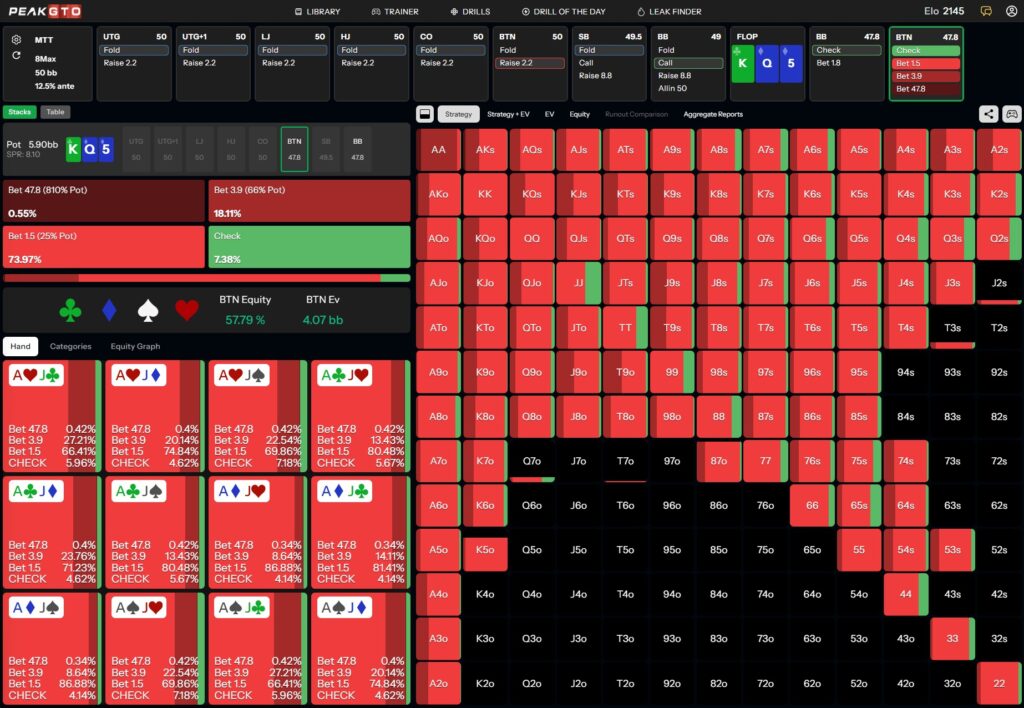
BB checks 99.6% of the time on this board. Two broadway cards heavily favor the preflop raiser’s range, and the diamond draw gives the board enough texture that leading from out of position accomplishes nothing productive.
This is a bread-and-butter continuation bet spot for the button. On two-high-card boards against the big blind, the preflop raiser has a significant equity advantage despite holding a wide range. The solver shows Hero c-betting 92.6% of the time, with the small 1.5bb sizing (25% pot) used at 74.0%. The large sizes rarely appear. The goal is to bet the entire range small, target BB’s air, and push the equity advantage across the board. If the button held a tighter, early-position range on this same flop, larger sizings with a nut advantage would make more sense.
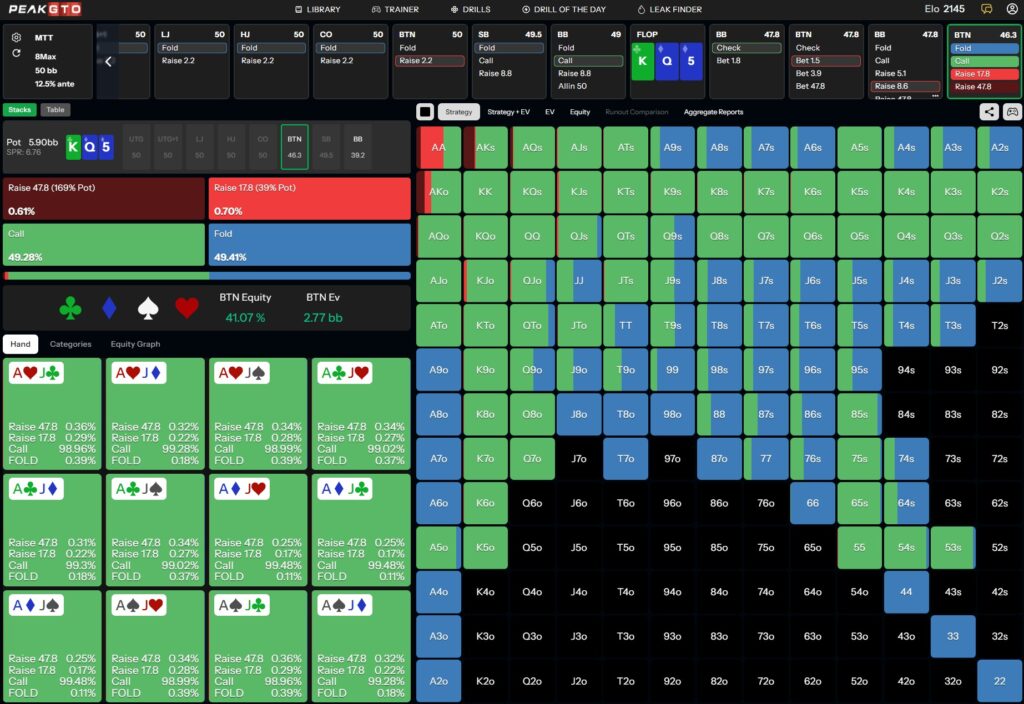
Hero bets 1.5bb. BB responds by calling 50.8%, folding 35.7%, and check-raising 13.5% across three sizes. The medium raise to 8.6bb (9.6%) is the primary check-raise sizing. BB’s check-raise range at 50bb on this board is polarized: strong hands like two pair, sets, and top pair with good kickers for value, paired with draws and select bluffs. At deeper stacks, the range polarizes further. BB does not check-raise marginal king-x or weak queens here the way it would at 25bb.
BB check-raises to 8.6bb. Now Hero faces a decision that is closer than most players realize: call 49.3%, fold 49.4%, raise 1.3%. It is nearly a coin flip. A♦J♣ has no pair, no made hand, and is staring at a large raise. But three factors tip the balance toward calling. First, the gutshot: any ten makes the nut straight (AKQJT). Second, the A♦ provides a backdoor nut flush draw in diamonds, adding equity on diamond turns. Third, position. Calling in position keeps the SPR deep enough to maneuver on later streets, and when the draw connects, Hero can extract value that an out-of-position player never could. Against a polarized check-raise range at 50bb, the correct response is to defend by calling, not re-raising. Re-raising only succeeds against linear check-raise ranges, which BB does not have at this stack depth.
Hero calls.
Turn: T♠
The ten of spades is the absolute dream card. Hero now holds the nut straight: A-K-Q-J-T. Every chip that goes in from this point forward is pure value.
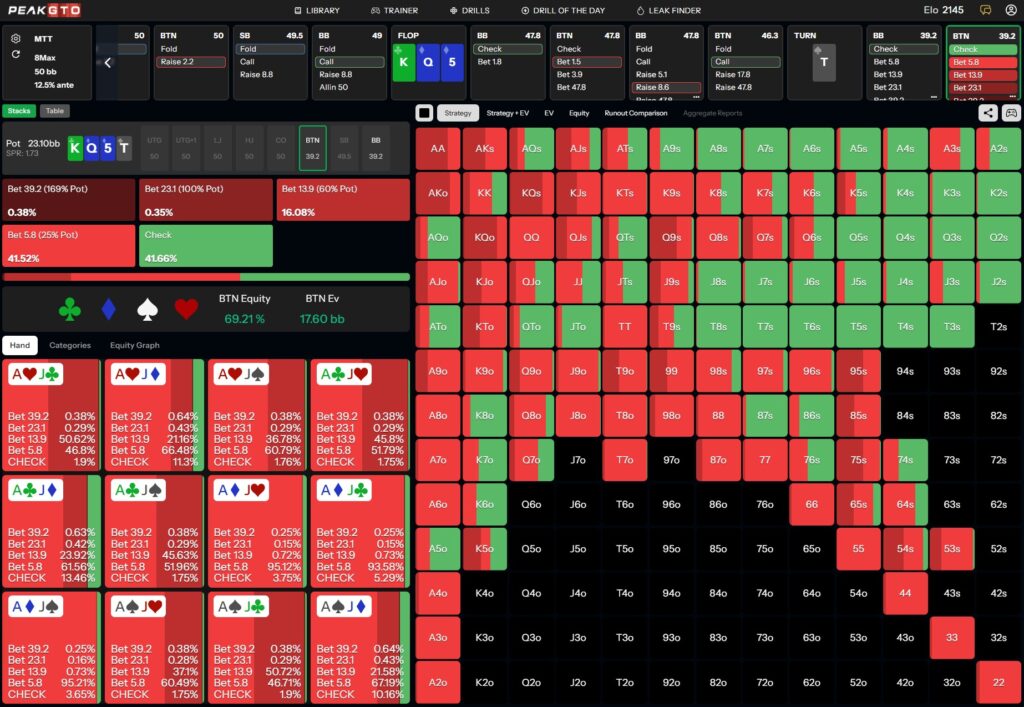
BB checks 60.6% of the time. When the check-raiser checks the turn, their range is concentrated in two categories: air and missed draws that have given up, and the weakest value hands from the flop check-raise that no longer feel confident enough to fire a second barrel. The strong hands, the sets and top two pairs, will continue betting. When BB checks, Hero has a massive equity advantage.
Hero bets at a combined 58.3%, with the small 5.8bb sizing (25% pot) at 41.5% as the primary option. PeakGTO confirms the counterintuitive result. Hero has the nuts, yet the solver prefers a small bet over a large one. The logic is positional: at 50bb with 39.2bb remaining behind, a small turn bet still leaves room for a meaningful river bet. There is no need to play a geometric sizing. The small bet accomplishes two things. It targets BB’s air and weak holdings that would fold to a larger bet, and it keeps the pot manageable enough that BB’s two pairs and sets might raise all-in, giving Hero an easy call for stacks. If BB has Q5, K5, or pocket fives, a small bet on the turn is more likely to induce a jam than a large one.
Hero bets 5.8bb. BB calls 30.7%, folds 45.9%, and raises 23.4% across two sizes. The fold rate might seem high, but remember that BB check-raised on the flop with both value and bluffs. Many of those bluffs have now given up, and folding to the turn bet is the natural conclusion for hands that picked up no additional equity.
BB calls.
River: 2♠
The 2♠ changes nothing. No flush completes, no full house fills, and Hero’s nut straight remains the best possible hand. BB checks 81.4% of the time. The remaining 18.6% that bets is a mix of thin value and blocking bets from hands that improved or want to set their own price.
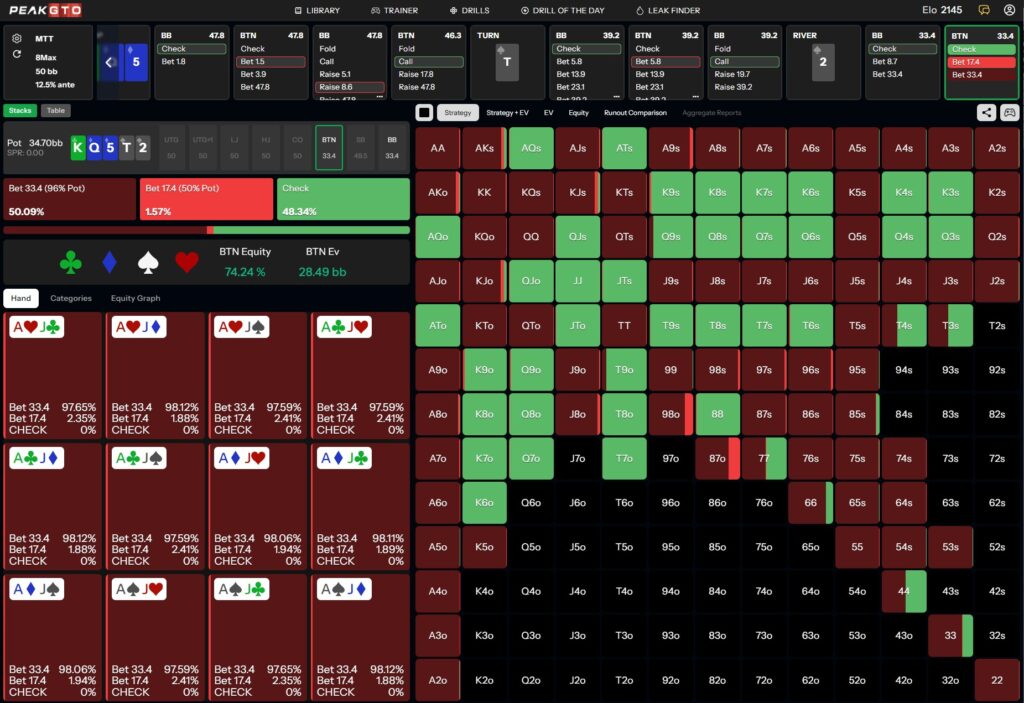
Hero’s decision is straightforward: bet 33.4bb (pot-sized, effectively all-in) at 50.1%, or check at 48.3%. The pot-sized shove is overwhelmingly the preferred bet size when Hero does bet, with the smaller 17.4bb option appearing only 1.6% of the time.
The case for going all-in is clear. Hero is unblocking all of BB’s value hands: queens, fives, two pairs, sets, even a slow-played J9. A♦J♣ contains neither a king, a queen, nor a five, so every combination of BB’s value hands that called the flop check-raise and survived the turn is still in play. From BB’s perspective, Hero’s range after calling a check-raise and betting two streets is polarized between the nuts and bluffs. Hero has plenty of natural bluff candidates here: busted diamond draws like 6♦7♦ or 7♦8♦ that continued the flop and bricked the runout. That bluffing range gives BB a reason to call with two pair or better.
A medium bet would be a mistake. If BB holds Q♥5♥ for two pair, a half-pot bet gets a call but leaves chips behind. The all-in gets the entire stack. With the GTO solution showing BB calling the all-in 23.4% of the time, that is nearly a quarter of BB’s range finding a call against the maximum bet. There is no reason to give BB a cheaper price when the larger bet still gets called at a high enough frequency to justify it. The pot odds math is simple: even at a 23.4% call rate, the expected value of shoving far exceeds any smaller sizing.
Hero bets 33.4bb. BB calls.
Key Takeaways
- Flop: On K♣Q♦5♦, BTN c-bets small at 74.0% as part of a near-range bet. Facing BB’s check-raise, A♦J♣ is a borderline call (49.3% call, 49.4% fold). The gutshot to the nuts, the backdoor diamond draw via A♦, and positional advantage make calling narrowly correct. Against a polarized check-raise range at 50bb, defend by calling, not re-raising.
- Turn: The T♠ completes the nut straight. When BB checks (60.6%), their range is weak. The small 5.8bb bet (25% pot) targets BB’s air while keeping the pot at a size where BB’s two pairs and sets might raise all-in, giving Hero an easy snap-call.
- River: The 2♠ blanks. Hero goes all-in for 33.4bb (50.1%). A♦J♣ unblocks all of BB’s value hands and Hero’s range has natural bluffs (busted diamond draws), so the maximum sizing gets called 23.4% of the time. No smaller sizing outperforms the shove.
- Overall: This hand demonstrates the full arc of calling a check-raise with a draw: accepting the borderline spot on the flop, recognizing when the turn card transforms a marginal hand into the nuts, and committing fully to value extraction on later streets. Position is the key enabler. An out-of-position player cannot size bets to induce raises, cannot control the pace of the hand, and cannot capitalize on a draw that connects the way the button can here.