The early levels of a poker tournament are not just a warm-up. They are where you build the stack that everything else runs on. Players who treat the early stages as low stakes — playing passively, waiting for premiums, avoiding confrontations — arrive at the middle levels with average stacks and no room to maneuver.
The goal in early Texas Hold’em tournaments is to accumulate chips while the blinds are still small and opponents’ mistakes are still the most expensive to ignore. Here is how to approach the early stages strategically.

Adjust Your Raise Sizing to Stack Depth
Your open size should reflect how deep you are and where you are raising from.
At 100 big blinds, the appropriate default is 2.5x to 2.7x. Use the higher end on the button and the lower end in earlier positions where more players can respond behind you. The slight positional adjustment matters less in recreational fields but becomes meaningful against players who understand how to squeeze.
As stacks shrink toward 30 big blinds or less, move to a min-raise. You do not want to open to 2.5x with 25 big blinds, get three-bet shoved on, and face a call that commits most of your stack. A 2x open still builds a pot and creates pressure while leaving you in a better spot if the action heats up.
The one nuance at full depth is hand playability. With a hand like a king-queen suit or a suited connector, there is a small argument for opening slightly smaller to encourage calls. When a hand plays well across many flop textures and benefits from a wider field, getting an extra caller has value. With more straightforward value hands, standard sizing is fine.
Know the Player Pool Before You Set Your Defaults
Tournament strategy should always be calibrated to the field you are playing, not a generic opponent in the abstract.
Different sites and different tournament formats attract very different player pools. Some fields are aggressive, filled with players who call down wide, re-bluff often, and open holdings you would rarely see from an experienced American recreational player. Other fields are softer and more passive.
Recognizing which environment you are in changes the right default. Against aggressive recreational players, you should expect more light calls when you build strong hands and should shade your bluffing frequency down accordingly. Against passive fields that fold too often, you can open your stealing range, bluff more rivers, and take pots that better fields would fight for.
Reading the player pool is not optional. It is one of the most consistent early-tournament edges available, and it costs nothing to pay attention.
Three-Bet Wide and Isolate Limpers Aggressively
At 100 big blinds, playing most of your strong hands heads-up is the default. A three-bet either wins the pot before the flop or creates a heads-up pot with initiative. Both outcomes are better than calling and going three or four ways to a flop out of positional advantage.
Your three-bet range adjusts based on who opened and from where. Against an under-the-gun open, tighten to a linear value-heavy range: the opener has a strong range, and you will be out of position if called. Against a button open, widen your range since the button is opening many weaker hands, and your three-bet earns more equity in fold equity.
When a weak player limps, isolating is extremely high value. You are not just picking up the dead money. You are playing a pot in position against someone likely to make significant postflop mistakes.
In my experience, players consistently underestimate how wide they can profitably isolate a limper in early tournament levels. Against a genuinely weak player who limps and calls too often, even hands with limited raw strength have positive expected value because the opponent’s postflop tendencies generate the profit, not the preflop holding.
Read the Board Texture Before You C-Bet
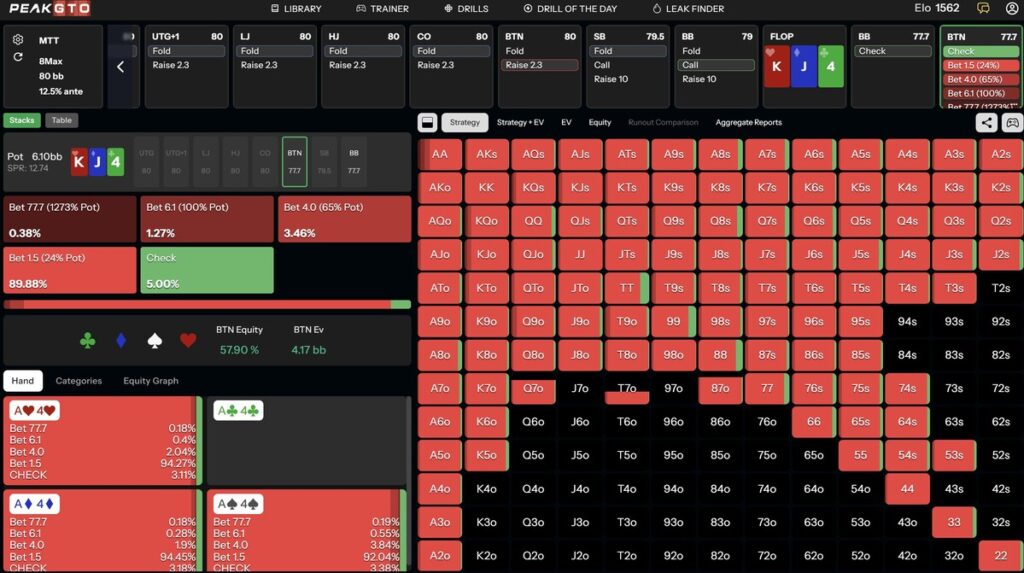
Not every flop warrants the same response from the preflop raiser. The correct c-bet approach depends heavily on who benefits from the texture.
Range Bet Boards
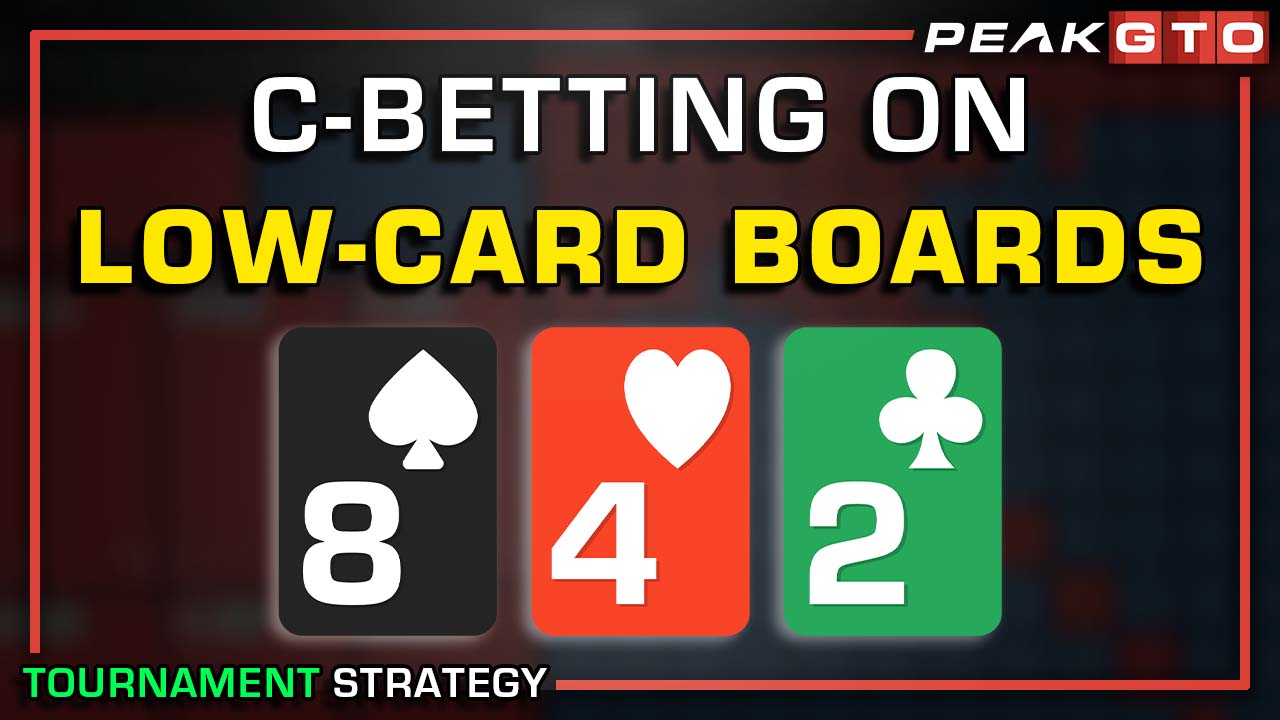
Some boards are so favorable for the preflop raiser that betting the entire range with a large size makes sense. Ace-high dry boards and three-low-card boards fall into this category. On these textures, the raiser’s range contains all the premium hands while the caller’s range is capped and filled with weaker holdings.
Use a large size on these boards: half pot to full pot. Betting big prevents the defender from peeling cheaply with hands that can outdraw you, and it extracts maximum value from the hands that will call.
Selective Bet Boards
Coordinated and wet boards require more restraint. On boards like king-nine-six with two suited cards, the big blind’s calling range contains more two-pair combinations, flush draws, and straight draws than the raiser’s range. You cannot fire every hand into that texture and expect consistent results.
On wet boards, select which hands earn the right to bet: strong top pairs, overpairs, and sets. Check back the rest and re-evaluate on the turn. Betting every hand into a board that favors the defender is a leak that compounds across a long session.
Paired Boards
On paired boards, fast-playing trips are almost always correct. When you connect with the paired card, raise immediately. Slow-playing trips on a board like nine-five-five gives the original bettor a free card and kills your action on later streets. The hand is strong enough to build a pot right now, so build it.
Plan Your Multi-Street Lines Before the First Bet
One reliable difference between strong tournament players and average ones is multi-street planning. Strong players decide how they want the hand to end before placing the first chip.
With a value hand, the goal is usually to extract three streets of calls from a weaker holding. Small consistent bets accomplish this by giving the opponent a manageable price on each street and keeping a wide range of weaker hands involved through the river. Large bets on the flop narrow calling ranges too quickly, leaving money on the table.
With a bluff, decide in advance whether you are going for small-small-large or small-large. The three-street approach builds the pot early and applies maximum pressure on the river. The two-street approach forces a fold on the turn and avoids the risk of committing to a third barrel. Both are valid: the choice depends on the opponent and the board.
The discipline required is never abandoning a bluff on the river after betting the flop and turn. A passive opponent who check-calls twice is arriving at the river with a capped range. Running poker solvers on these spots confirms it: the river is exactly when the bluff is most likely to succeed. Giving up at that moment wastes the two streets of investment and leaves chips behind.
Adjust to Stack Depth When Deciding Between Flat, Three-Bet, and Shove

The correct response to an open change significantly as the stacks get shallower. Understanding these thresholds prevents some of the most costly mistakes in the middle stages.
At 100 big blinds, three-betting is generally preferred over flatting with your strong poker hands. The deep effective stacks make heads-up play profitable and make multiway pots harder to navigate.
At 40 to 50 big blinds, flatting becomes more reasonable with suited hands and small pairs. The stack-to-pot ratio going to the flop is still manageable, and there is enough room to play real postflop poker without the hand forcing a shove-or-fold decision.
At 15 to 20 big blinds, push/fold charts become your primary guide. At that depth, three-betting and then folding to a four-bet wastes chips. Shoving over an open with your strong hands is cleaner: you get all the folds from hands that cannot call, and when called, you get all five cards.
One detail that trips up many players: always check the stack sizes behind you before committing chips. Reshoving over a 16 big blind open is correct with ace-ten, but only if no deep-stacked player behind you can wake up with a hand and force a call you did not plan for.
Conclusion
Early tournament ICM pressure is minimal, which means these levels carry almost no equity risk from aggression. The correct response is to exploit that freedom fully: build your stack through wide isolation, aggressive three-bets, smart c-betting, and multi-street planning.
Passive early-level play does not preserve chips and should not be part of your MTT strategy. It gives them one missed spot at a time. The players arriving at the money with large stacks are the ones who treated the first few levels like a real edge to be captured, not a waiting period to survive.