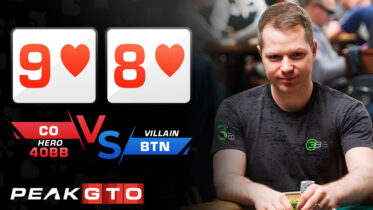
Bluffing out of position is harder than bluffing in position, because you have to act first on every street and you cannot see what your opponent does before committing chips. That forces you to check far more often, but it does not mean you give up your aggression entirely. Finding bluffs OOP is about pairing a strong, polarized betting range with the right junky hands, and then choosing the exact combinations whose card removal makes a bet profitable. A hand like 98 can fire all three streets, as long as it is the correct 98.
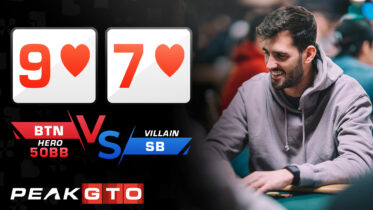
Today we will analyze a 40 big blind tournament hand where Hero opens 9♥8♥ in the cutoff, gets called by the button, and fires three streets out of position on a Q♠ J♠ 5♥ board that runs out 7♦ and 2♥. The small flop bet, the large turn barrel, and the river jam are a model for finding bluffs out of position, and the suit of the 98 decides everything.
Assumptions
- Stacks: 40 big blinds effective
- Format: 8-handed MTT
- Positions: Hero in the cutoff (the preflop raiser, out of position), Villain on the button (the caller, in position)
- Preflop action: Hero opens the cutoff, Villain calls on the button
- Flop (pot ~7bb): Q♠ J♠ 5♥, two-tone. Hero bets 1.8bb, Villain calls
- Turn: 7♦. Hero bets pot, Villain calls
- River: 2♥. Hero jams all in, Villain calls
- Hero: 9♥8♥ | Villain: 5♠5♦
Preflop
Hero opens 9♥8♥ from the cutoff and the button calls, leaving Hero out of position for the rest of the hand. Suited connectors are a normal part of the cutoff opening range, and their value is that they can flop draws that turn into credible bluffs and the occasional big hand. Out of position, though, you have to be far more selective with aggression than you would in position, because you will be guessing on later streets without information.
Flop: Q♠J♠5♥
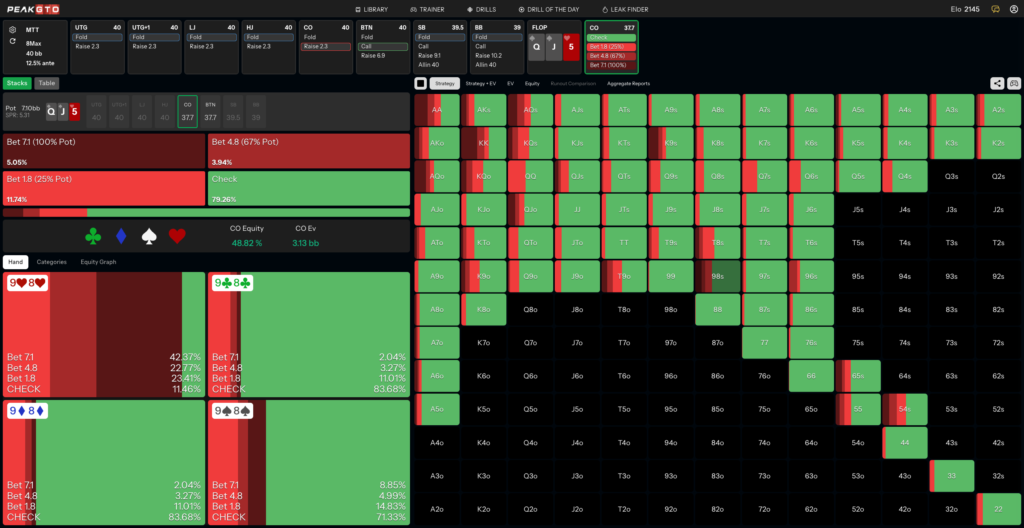
The flop is Q♠ J♠ 5♥, and out of position the first instruction is to check a lot. You still keep a polarized betting range, built from your best vulnerable hands and some draws. The value is mainly top-pair queens like AQ and KQ, plus two pair such as QJ, and the big pairs, while the draws are a mix of flush draws and gutshots. A hand like K9, a junky gutshot, bets a lot because you can fire it and fold to a raise, whereas KT does not, because it hates getting raised off its equity.
T9, T8, and 98 all bet a fair amount, and 9♥8♥ bets almost every time, precisely because you can bet it and let it go if raised. Hero checks the flop about 79% of the time, and when betting the tiny size is the most common one. Hero bets 1.8bb, and the button calls.
Turn: 7♦
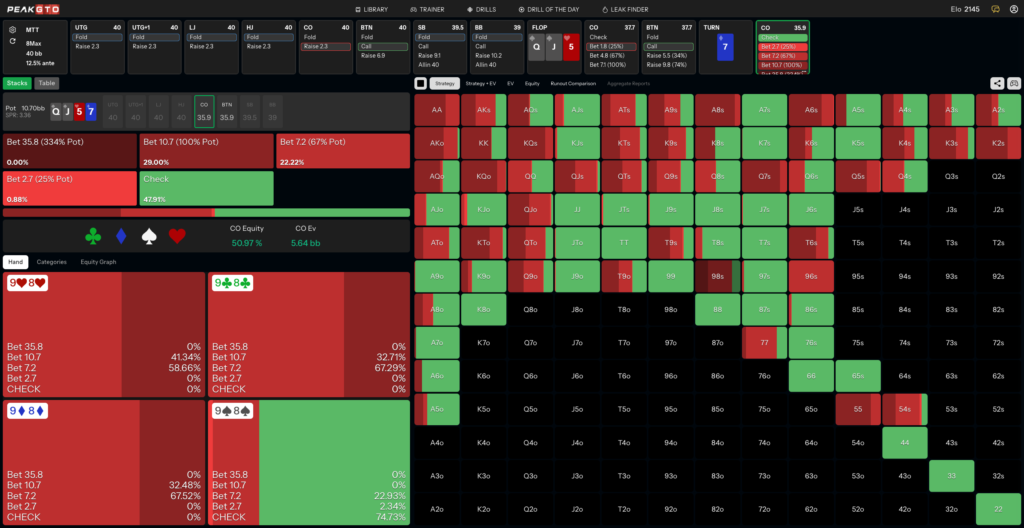
The turn is the 7♦, a brick, and although a polarized flop bet often lets you keep firing, this board is good for the button and you are out of position, so you still check a good amount. When you do bet, you stay polar: queens and better barrel, while jacks like AJ, KJ, and JT check. The counterintuitive part is which draws you bet. The spade versions of 98, 97, and T9 (which carry a flush draw) are not betting here; if you check and face a pot-size bet, those hands check-raise (or call) all in instead, because they have the equity to commit.
The 9♥8♥ with no spade is a different animal and a great hand to bet. It has a double gutshot, and if it gets jammed on, you fold easily. That is the rule: bet your very high-equity draws that can call a shove, and your very low-equity draws that can bet and fold, while checking the medium stuff. The PeakGTO solutions bet 98 and T♥9♥ here nearly always, with the plan that a call sets up river bluffs. You do not get to barrel pure junk like K♥3♥ or A♥4♥, because your opponent’s range is strong and you are out of position; it is the strength of your value-betting range that earns you the right to bluff a gutshot. Hero fires a large barrel on the turn, and the button calls.
It is worth sitting with why the spade and no-spade versions split so cleanly, because it is the heart of position-aware bluffing. A flush draw is a hand you are happy to get all the money in with, so out of position it would rather check and then check-raise when the button bets, turning the draw into a powerful semi-bluff that also realizes its equity. The no-spade gutshot has nowhere near that equity, so it cannot profitably check-raise; instead its value comes entirely from fold equity, which means it should be the one out front betting. Same rank, opposite plan, and the difference is whether the hand wants to play a big pot or just deny the opponent a free card while setting up the river.
River: 2♥
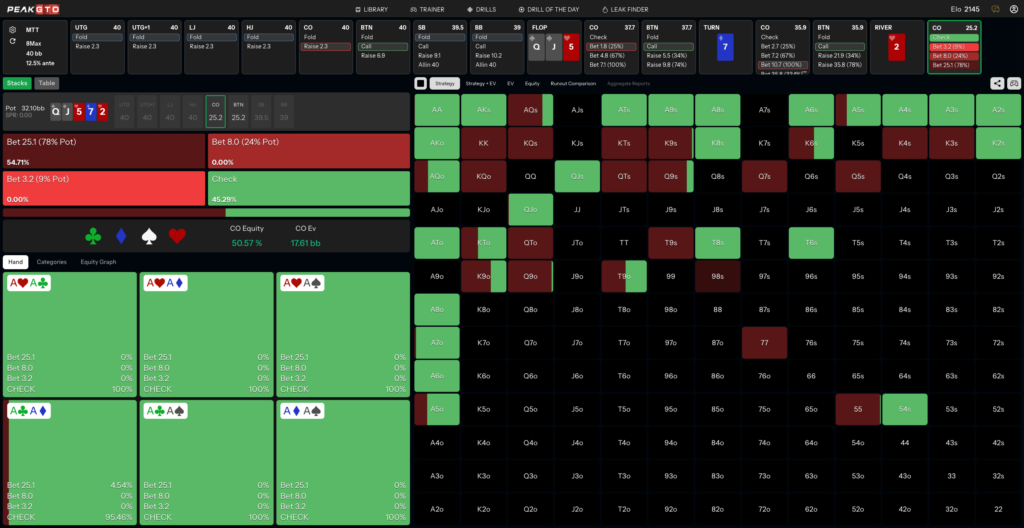
The river is the 2♥, a total blank, and Hero has to find a bluff. The first question is whether you are at the very bottom of your range with no showdown value, and 9♥8♥ is exactly that, the worst hand you can hold here. That alone is a strong reason to bet. The second question is whether you unblock the opponent’s auto-folds, which on this run-out are the busted flush draws. Since 9♥8♥ holds no spade, it does not block those folds at all, which is another excellent reason to jam.
So the no-spade 98 and T9 jam every time, while a hand like A♠6♠ should never go all in, because it has a little showdown value and its spades block the very flush draws you want the opponent to fold. With only about 78% of the pot left behind, the only size is all in, an underbet shove alongside your value hands, which are queens and better, while jacks and worse do a lot of checking. This is the same blocker principle that governs GTO bluffing everywhere: pick the combinations that hold none of the opponent’s folding cards. You rip it in and pray to win.
This time, Hero runs into the very top of the range: Villain flopped a set with 55 and calls. A correct bluff still loses to the occasional monster, but it profits against the whole range that folds. The discipline to fire here is what most players lack, because betting two streets out of position and arriving at the river with nine-high feels uncomfortable, and the temptation is to give up and save the last chips. But giving up wastes the entire line: you bet the flop and turn precisely so that this river jam would be credible, and folding now means you only ever showed up with value. By firing the correct combination every time, you make yourself impossible to play against, and you collect a pile of pots from the medium-strength hands that called you down and then cannot beat a triple-barrel.
Key Takeaways
- Flop: Out of position you check a lot, but still keep a polarized betting range of strong vulnerable hands and draws. A junky gutshot like 98s bets because it can fire and fold to a raise.
- Turn: Bet your highest-equity draws that can call a shove and your lowest-equity draws that can bet and fold. The no-spade 98 is a clean low-equity barrel; the spade versions prefer to check and check-raise.
- River: Jam the worst hand in your range when it unblocks the opponent’s folds. The no-spade 98 does not block the busted spade draws, so it bluffs, while spade-blocker hands check.
- Overall: Finding bluffs out of position means a strong, polar betting range earns you the right to fire junky draws, and choosing the exact non-blocker combinations is what makes the triple-barrel profitable.