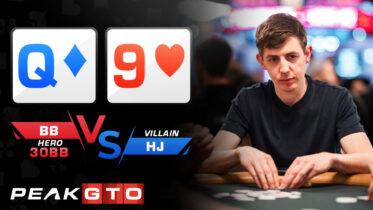
A triple barrel bluff is not a single brave decision on the river. It is a plan that starts on the flop, with a hand chosen as much for the cards it removes from the opponent’s range as for its own equity. When you put pressure on across three streets, the hands you hold as blockers and the way your opponent’s range narrows are what make the final bullet credible. Run it with a busted draw that blocks the right combinations, against a range that has quietly capped itself, and you can take a pot down with queen-high while representing a polarized, scary range.
Today we will analyze a 30bb 8-handed tournament hand where the big blind defends Q♦9♥ against a hijack open, check-raises the T♥8♦3♥ flop, barrels the 5♥ turn, and jams the bricked river with nothing but queen-high. The blocker logic matters at every step: why the suits matter on the flop, why a small turn size applies the most pressure, and why a busted queen-high holding the 9♥ is the right hand to fire the last barrel. This is a clinic in applying maximum pressure with a hand that has almost no showdown value.
Assumptions
- Stacks: 30bb effective
- Format: 8-handed MTT
- Positions: BB (Hero) vs HJ (Villain)
- Action: HJ opens, BB calls
- Flop: T♥8♦3♥ two-tone (Pot: 6.1bb)
- Turn: 5♥ (Pot: 15.5bb)
- River: 6♣ (Pot: 23.3bb)
Preflop
The hijack opens and the big blind calls with Q♦9♥. This is a routine defense getting a good price out of the big blind. At 30bb the stacks are shallow enough that a single check-raise and a couple of bets can threaten everything, which makes aggression from out of position a powerful tool. The plan is not formed yet, but the stack depth already favors the player willing to apply pressure.
Flop: T♥8♦3♥
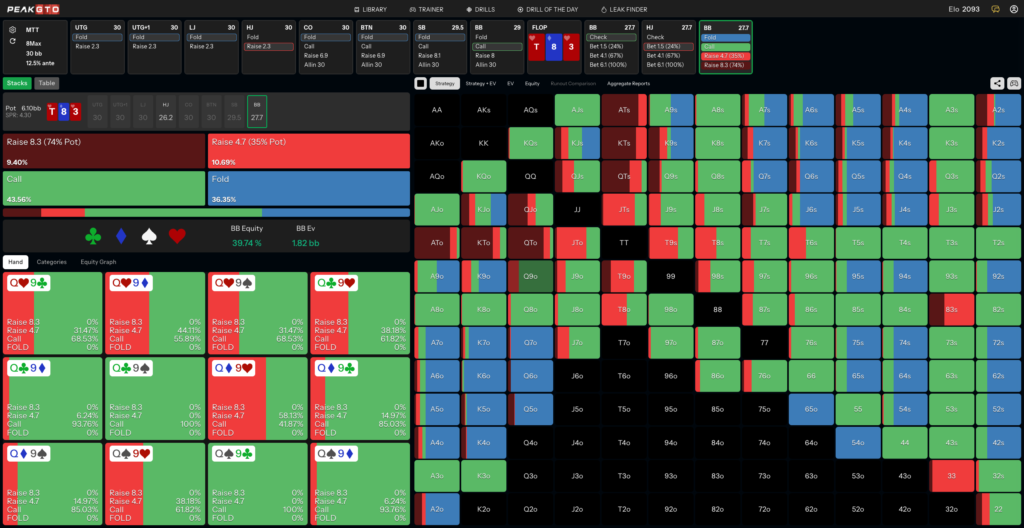
The hijack fires a small 1.5bb continuation bet, about a quarter of the pot. This board favors the hijack, so the preflop raiser should be c-betting a wide, somewhat weak range, and the big blind has to check-fold a good amount. The hands that fight back are the ones with equity and good blockers, and Q♦9♥ qualifies. It holds a gutshot to the jack and a backdoor flush draw, but the suits are what tip it toward raising.
This is the blocker insight that drives the whole hand. Any Q9 with a heart is a very respectable check-raise, but when you have a diamond as well, it stops your opponent from having some more floats. The heart blocks the hijack’s backdoor heart-flush hands, and holding the queen of diamonds itself removes specific float combinations like Q♦7♦ and K♦Q♦ from the calling range. That diamond removal is pure card-blocking, independent of any flush, since the flop has only one diamond on it. By holding both suits, Q♦9♥ attacks the exact hands that would otherwise continue. Across the range, the big blind check-raises about 20% of the time here. Hero raises to 4.7bb, and the hijack calls.
The reason this matters now is what it sets up for later. A check-raise that mixes genuine value with blocker-heavy bluffs like Q♦9♥ arrives on the turn and river already balanced, so the big blind can keep barreling without the range tipping toward bluffs the opponent can profitably call. Choosing bluffs by their removal effect rather than their raw equity is what lets the same hand credibly fire all three streets.
Turn: 5♥
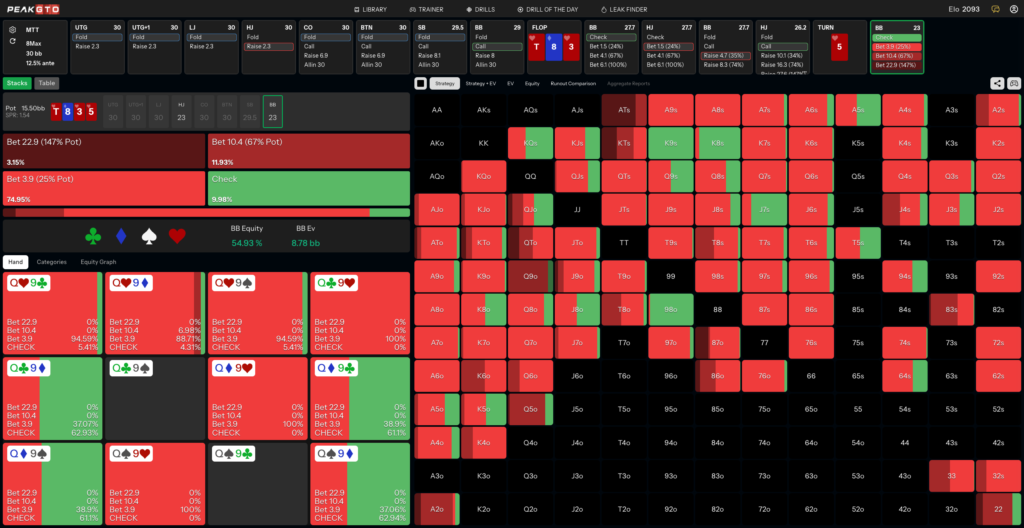
The 5♥ brings a third heart into play, and it is a great card for the big blind. Q♦9♥ now has a flush draw to go with its gutshot, but the bigger point is range advantage: the big blind’s range climbs to around 55% equity. Many of the big blind’s check-raises contain a heart or a made flush, and because the hijack only called the flop rather than jamming or 3-betting, its range is missing the strongest hands. The hijack is less likely to have some of the stronger hands like jacks, queens, kings, and AT, since those hands could have easily 3-bet on the flop. The turn also misses most of the hijack’s floats, since it is not a king or queen that pairs them up.
The size is the lesson here. PeakGTO barrels this turn about 90% of the time, and the primary size is small, just 3.9bb or a quarter of the pot. A small bet works best because the big blind’s value hands, the made flushes and strong pairs, are happy to keep a worried opponent in the pot, and a cheap bet still pressures the hijack’s entire range while folding out floats. Betting small lets the big blind apply pressure to everything without risking much, which is exactly what a strong, equity-rich range wants to do. Hero bets 3.9bb, and the hijack calls.
The small size also sets up the river beautifully. By keeping the turn bet cheap, the big blind preserves a stack-to-pot ratio that leaves a meaningful river jam available without committing too much on a card that has not yet bricked. The pressure compounds: the hijack calls a small turn bet with its marginal hearts, arrives at the river capped, and then faces a shove for most of the stack. Sizing is not just about this street, it is about what the next bet can threaten.
River: 6♣
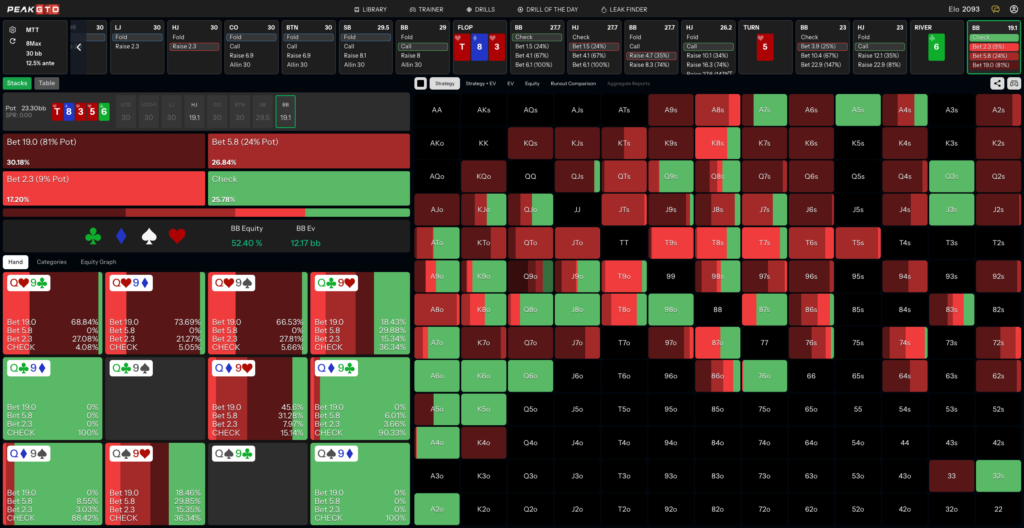
The 6♣ bricks. The flush missed, the straight missed, and Q♦9♥ is queen-high with a single heart. This is where the plan pays off. The hijack declined to shove the turn, which further discounts the strongest hands, so by the river its range is dominated by high-card floats that hold a heart: AK, AQ, AJ, KQ, and KJ with the heart of that suit. Those are hands that called along hoping to get there and have now missed. They fold to a big bet.
The big blind jams roughly 19bb, about 80% of the pot, which puts in essentially the rest of the effective stack. The river is heavily polarized, and the big blind’s value side is loaded: turned flushes, top pair with AT or KT, and the occasional rivered straight. With so much credible value, a busted queen-high is a natural hand to turn into a bluff. The blocker reasoning is worth getting right, and it is the opposite of what most players guess. The strongest jams are the combos that hold a high heart like the Q♥, because they block the opponent’s made flushes and best heart combos, so the solver fires those most often. Our Q♦9♥ holds only the 9♥, which removes a few of the opponent’s nine-with-a-heart floats but none of the made flushes, so it is a lower-frequency mixed jam: the solver rips it in close to half the time and otherwise mixes a smaller bet and a check. Against a range this full of foldable high cards, turning our busted queen-high into a bluff is still very reasonable, just not the every-time jam the high-heart combos are.
Hero jams, and the hijack folds AK. This is the heart of GTO bluffing: the river decision is easy precisely because the flop and turn were played to build a polarized range and the right blockers were retained. Maximum pressure comes from a coherent story, not from hoping the last bet works.
Key Takeaways
- Flop: On a board that favors the raiser, the big blind check-raises about 20%. Q♦9♥ raises because both suits block the hijack’s float combinations, not just because of its modest equity.
- Turn: The 5♥ favors the check-raiser, and a small 3.9bb barrel applies maximum pressure cheaply, since the value hands want to keep a scared opponent in.
- River: After the hijack’s range caps by just calling twice, a brick lets the big blind jam queen-high as a bluff against a range full of foldable high-card hearts. Counterintuitively, the combos holding a high heart like the Q♥ jam most because they block the opponent’s made flushes; our Q♦9♥ holds only the 9♥, so it is a lower-frequency mixed jam.
- Overall: A triple barrel bluff is built street by street. Blocker-aware aggression, a favorable turn, and a capped opponent let you apply maximum pressure and win a big pot with queen-high.