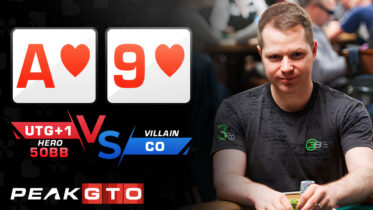
Most players are too passive when they are out of position. They check, they give up the initiative, and they let the in-position player run them over on boards that actually favor the out-of-position raiser. Playing well out of position is not about checking and hoping; it is about betting aggressively on the textures that hit your range hard, and then knowing exactly when to shut it down. The hand below shows both halves of that skill: a confident small bet with the entire range, followed by a disciplined fold when the board and the action say it is time to be done.
Today we will analyze a 50bb 8-handed tournament hand where UTG+1 opens A♥9♥, the cutoff calls, and the flop comes A♣K♥Q♦. Hero is out of position with top pair and a weak kicker, c-bets small with the whole range, checks a blank turn, and then faces a big pot-sized bet. The lesson is when to drive the action out of position and when that same out-of-position hand becomes an easy fold.
Assumptions
- Stacks: 50bb effective
- Format: 8-handed MTT, 12.5% ante
- Positions: UTG+1 (Hero) vs CO (Villain)
- Action: UTG+1 opens, CO calls
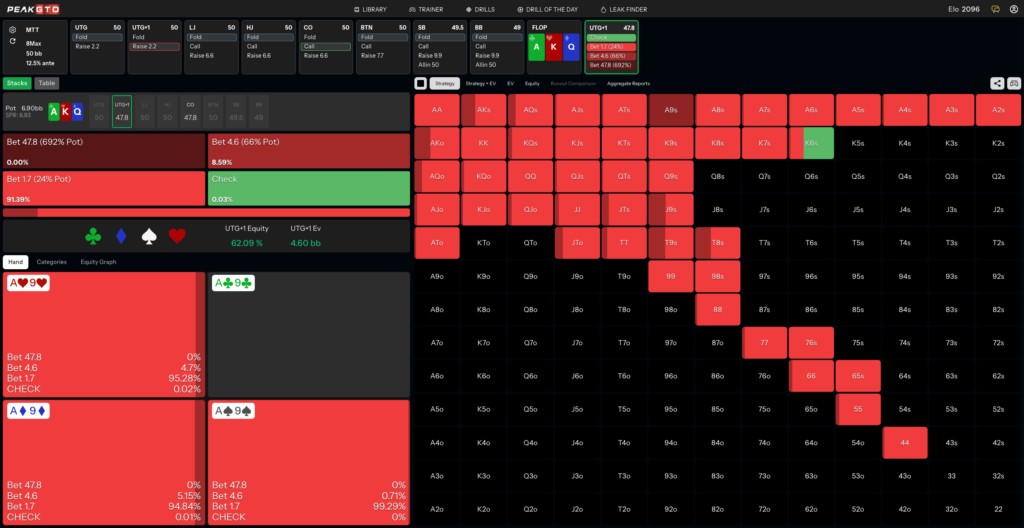
- Flop: A♣K♥Q♦ (Pot: 6.9bb), Hero bets 1.7bb, CO calls
- Turn: 6♠ (Pot: 10.3bb), Hero checks, CO bets pot, 10.3bb
Preflop
A9s is a fine open from UTG+1, a tight early position where Hero’s opening range is strong and condensed toward big cards. The cutoff calls, and everyone else folds. We take a flop heads-up but out of position, which is the harder seat to play from. The key, as we will see, is that the tightness of the UTG+1 range is exactly what makes aggression correct on the right flop.
Flop: A♣K♥Q♦
This is a textbook example of a board where the out-of-position raiser should bet aggressively. When you open a tight UTG+1 range and the cutoff just calls, three-broadway boards like A-K-Q are exceptionally good for you. Hero has far more offsuit top pair, more sets, more two pair, and more made straights than the cutoff, who would have three-bet many of the strongest combinations preflop. With that big range and nut advantage, the play is a small continuation bet with the entire range. Hero bets 1.7bb, about a quarter of the pot.
The small size does a lot of work. It pushes Hero’s equity advantage across the whole range, it charges the cutoff’s many second-best hands, and it keeps the pot small enough that Hero can play the turn comfortably from out of position. This is a spot where people check far too much and simply are not aggressive enough as the out-of-position player. Even a hand as modest as 44 wants to fire this small bet to target the cutoff’s fives through nines. A♥9♥ has top pair plus a backdoor flush draw and is happy to push its equity. The cutoff continues with worse aces, king-x, queen-x, and various pocket pairs getting a good price, even a hand like TT. The cutoff calls, and the pot grows to 10.3bb.
It is worth noting why the small size beats the alternatives here. A large bet would fold out exactly the worse aces and middling pairs that Hero wants to keep in, and an overbet would only get called by hands that beat A9. The small bet threads the needle: it denies equity to the cutoff’s overcards and backdoor draws, it gets value from the long list of second-best hands, and it does so at minimal risk to Hero’s stack. When you have a range advantage but most of your individual hands are medium strength, a small bet with everything is the most efficient way to monetize that edge from out of position.
Turn: 6♠
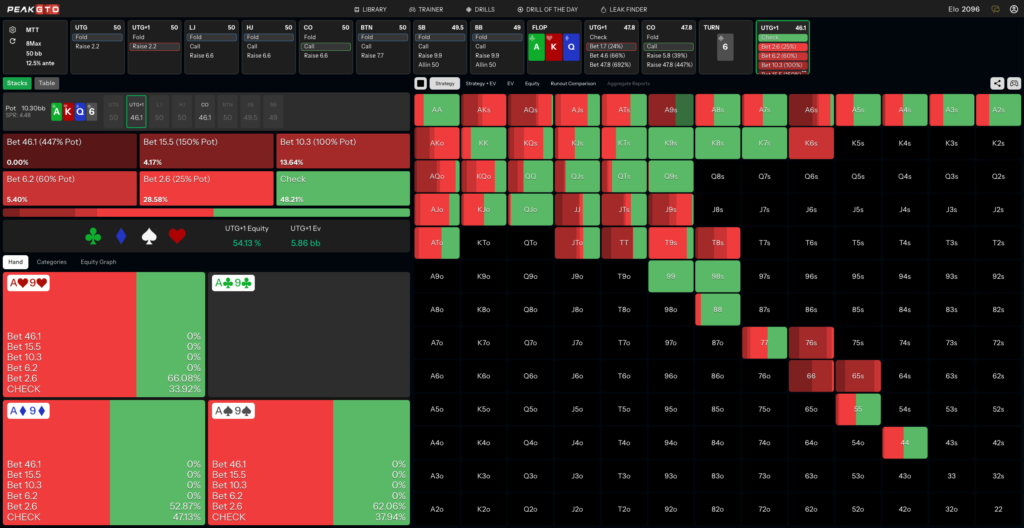
The 6♠ is a blank that misses everything. Hero has two reasonable options here: check, or fire a second small bet. PeakGTO mixes the two, and a second small bet is a perfectly good strategy. The logic of a small turn bet is interesting: you are essentially saying that both players can have the nuts, since the cutoff can show up with JT for a straight, but Hero still has far more of the strong aces, the two pair combos, and the AK and AQ type hands. A small bet keeps pushing that equity edge without committing to a big pot.
That said, the solver actually leans toward a second small bet here, betting A9 about two-thirds of the time and checking the rest. The line we take is the check, for pot control: A9 is not a hand that wants to bet three streets for value, so checking the turn keeps the pot manageable and preserves the option to bet the river for value across many run-outs. Top pair with a weak kicker is a one-or-two-bet hand, not a three-barrel hand. Hero checks, and the cutoff fires a big pot-sized bet of 10.3bb.
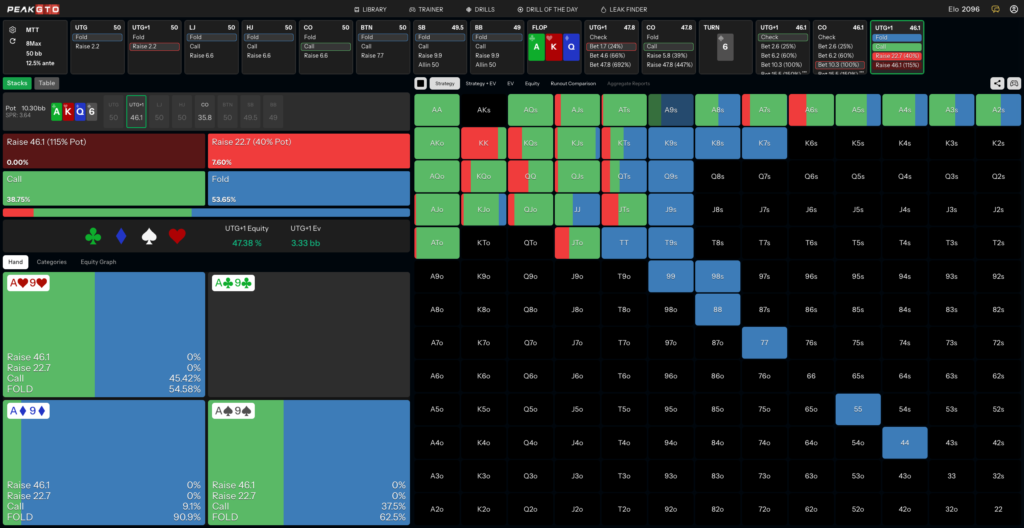
The size of the cutoff’s bet is itself a piece of information. A pot-sized bet on a blank turn is not a sizing that bluffs use lightly out of a calling range; it is a sizing that wants to get maximum value or to apply maximum pressure with a genuinely polarized holding. On a board where the most natural strong hands are top pair with a good kicker, two pair, sets, and the made broadway straight, the pot-sized bet skews heavily toward the value end. Hero has to weigh calling a bet this large with a hand that can beat almost none of that value, on a board that will keep changing, while out of position for the rest of the hand. That combination is exactly why the fold is comfortable.
This is where a lot of players get tripped up. They reason, “I checked, so I am not folding now; I have to keep them honest.” That logic misreads why Hero checked in the first place. Hero did not check because the hand was beaten; Hero checked because it could not profitably bet three times. When the cutoff responds to the small bet and the check by bombing a blank turn, they are telling a clear story: they have a genuinely good hand. Against that huge size, A9’s playability on the river is awful, and the hand is rarely good enough to call down. Hero folds. Against the polarized value range a pot-sized bet represents here, two pair, sets, AK, AQ, and the made broadway straight, folding is the slightly preferred side of a close decision, though the solver still defends this exact combo about 45% of the time.
The blocker math reinforces the fold. Hero’s 9 actually interacts with the cutoff’s most natural bluffs, the hands like T9 and J9s that pick up straight draws and want to barrel. By holding a nine, Hero removes some of those bluff combinations from the cutoff’s range, which means the pot-sized bet is even more weighted toward value than it first appears. With fewer bluffs to catch and terrible pot odds realization on future streets, the disciplined play is to let the hand go early and often rather than paying off a strong range.
Key Takeaways
- Flop: On three-broadway boards that smash the tight out-of-position raiser, c-bet small with the entire range. The aggression pushes a real equity advantage, and checking too often is the most common mistake from out of position.
- Turn: The solver actually bets A9 about two-thirds of the time, but checking for pot control is the simpler, lower-variance line with weak top pair. A9 is a one-to-two-bet hand, not a three-barrel hand, so the check preserves a river value option.
- Facing the pot-sized bet: Checking was about pot control, not a commitment to call down. When the opponent bets pot on a blank turn, their range is strong, Hero’s 9 blocks their bluffs, and folding loses far less than paying off JT and KQ.
- Overall: Good out-of-position play is aggressive on the right boards and disciplined on the wrong streets. Drive the action when the texture favors your GTO range, then fold without guilt when a big bet tells you the hand is over.