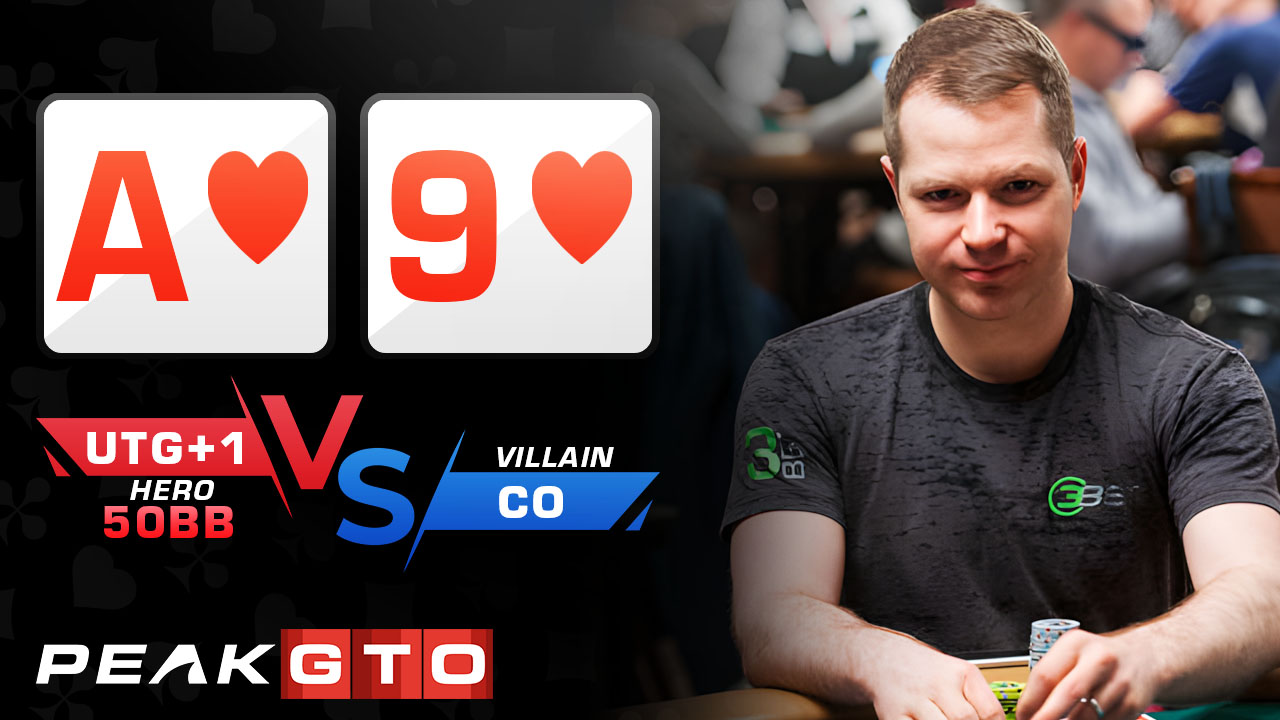
Aces are the best starting hand in poker, but they are still just one pair after the flop. The players who lose their stacks with aces are usually the ones who cannot let go when the board screams that they are beat. Playing AA postflop well is less about extracting maximum value and more about controlling the pot so that, when a bad card comes and your opponent fights back, you can make a clean fold without having committed your tournament life. This hand is a perfect example of that discipline.
Today we will analyze a 20bb 8-handed tournament hand where the hijack opens, the button cold-calls A♥A♦, and the flop comes T♣9♦8♦. Hero bets small with the aces, bets small again when the 7♠ completes the straight for any jack or six, and then makes an easy fold to a check-raise. The small sizing is what makes the fold painless.
Assumptions
- Stacks: 20bb effective
- Format: 8-handed MTT, 12.5% ante
- Positions: BTN (Hero) vs HJ (Villain)
- Action: HJ opens, BTN calls
- Flop: T♣9♦8♦ (Pot: 6.5bb), HJ checks, Hero bets 1.6bb
- Turn: 7♠ (Pot: 9.7bb), Hero bets 2.4bb, HJ check-raises to 8.2bb
Preflop
Hero cold-calls the hijack open with AA on the button, a flatting play at 20bb that keeps the hijack’s range wide and disguises the monster. The blinds fold, and we go to the flop heads-up and in position with enough chips behind to bet across multiple streets. Flatting aces is a legitimate part of a balanced range, and it sets up exactly the kind of trap that can win a big pot, or, as we will see, lose only a small one.
The flat is especially reasonable in position at this stack depth. Three-betting would fold out most of the hands aces dominate and could blow the pot up to a point where Hero is committed regardless of the board. By calling, Hero keeps the hijack’s weak hands in the pot, retains a positional advantage on every street, and preserves the flexibility to play a small pot when the board is dangerous. At 20bb the cold-call also avoids turning the aces face-up, since a button three-bet here is a narrow, value-heavy range that good opponents fold their dominated holdings against. That flexibility is the whole reason the trap works as a damage-control tool: when the run-out turns hostile, the button can simply keep the pot small and bail, which is exactly what happens here.
Flop: T♣9♦8♦
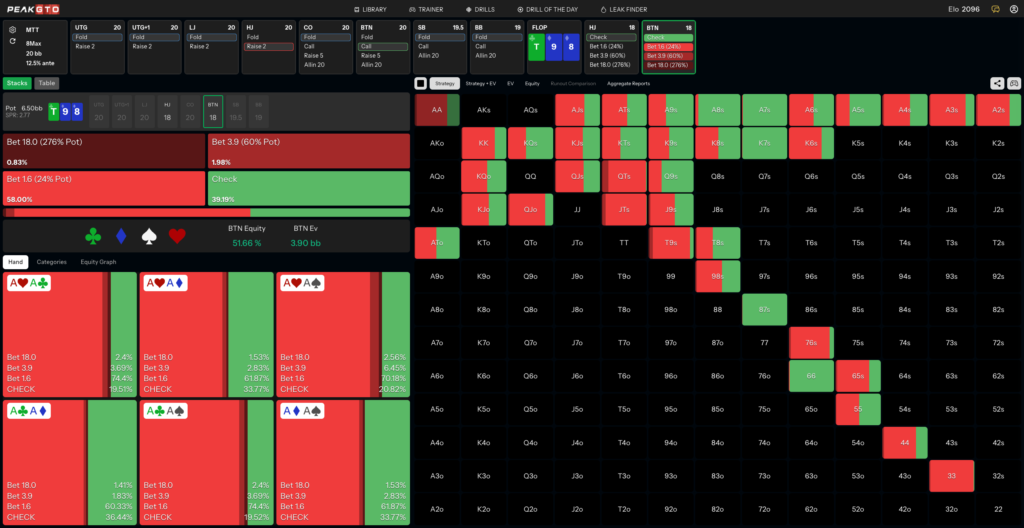
T98 with two diamonds is about as wet as flops get, and it is a board where the two ranges run surprisingly close in equity. Both players hold the offsuit straight combinations, plenty of tens, nines, and eights, and traps like Hero’s aces. The hijack checks, and Hero bets small, just 1.6bb, about a quarter of the pot. Unlike a standard continuation bet from the preflop raiser, this is a lead from the preflop caller, so the logic is built around equity and pot control rather than range pressure. The reasoning is to push the equity edge while the aces are still ahead of a huge chunk of the opponent’s range, and to do it cheaply so that a bad turn card does not kill the action. A small bet keeps the worse pairs, the gutshots, and the flush draws in the pot, and it can stack the jacks through kings right away if they decide to play back. Aces are a heavy favorite here, so betting beats checking, though both are fine.
Turn: 7♠
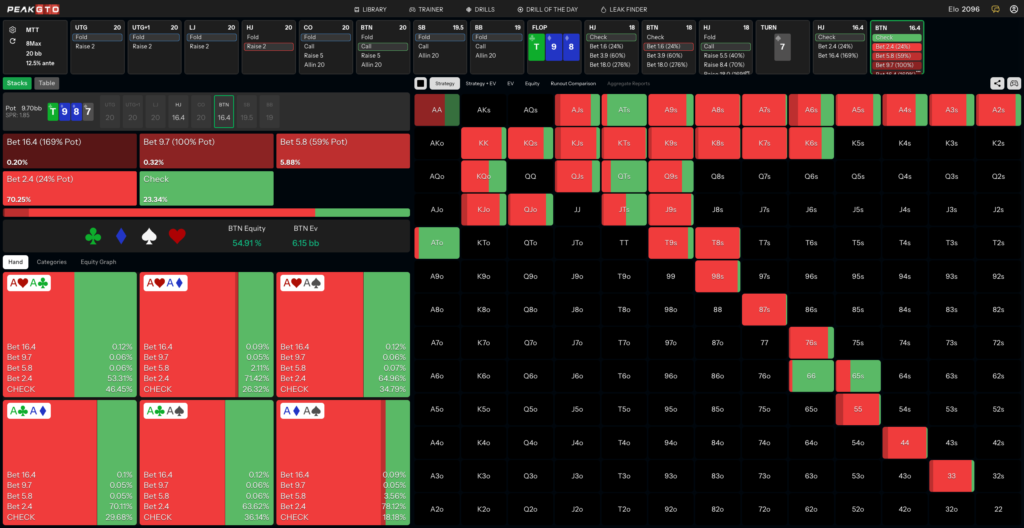
The 7♠ is a textbook example of a card that is good for Hero’s range but bad for Hero’s exact hand. It completes the straight for anyone holding a jack or a six, so the aces are now vulnerable to a lot of made hands. But the range as a whole is still strong, full of offsuit jacks and six-x combinations that smash this card, while the hijack holds many more overcard hands like KQ, AK, and AQ that just missed. That gap is what hands Hero the range advantage on this exact card, even though the aces themselves are no longer the nuts. With that range advantage and aces that still have plenty of equity, the right play is another small bet. PeakGTO bets about 70% of the time using the small ~quarter-pot size.
The A♦ matters here, because it blocks the diamond flush draws in the opponent’s range, which makes betting for thin value safer. Hero bets 2.4bb, continuing to push the equity advantage and to extract a street from the draws and weaker pairs like a ten. The whole point of the small sizing across both streets is to keep the pot manageable so Hero is never committed and the river decision stays simple. Then the hijack check-raises to 8.2bb.
It is worth pausing on why a small turn bet is correct even though aces are now vulnerable. The temptation with a big pair on a scary board is to bet large to “charge the draws” or to “find out where you are,” but both ideas backfire here. A large bet folds out the worse pairs and draws that you want to keep paying you, and it bloats the pot to a size where you can no longer fold profitably when raised. The small bet threads the needle: it keeps the dominated part of the opponent’s range in, it grows the pot in a controlled way, and it leaves you with an easy exit if the opponent shows real strength. Pushing thin value while staying uncommitted is the core skill of playing big pairs on dynamic boards.
Facing the Check-Raise
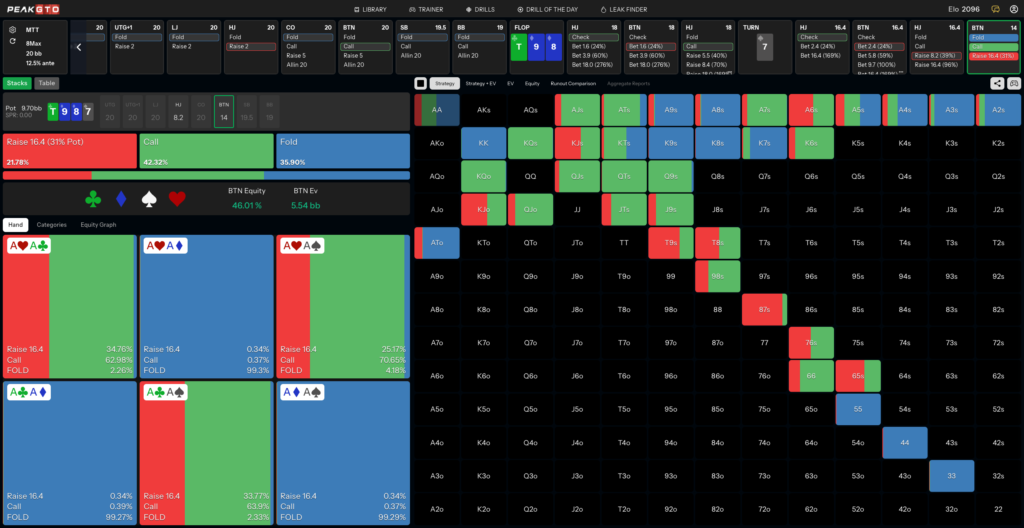
This is where the plan pays off. Against a turn check-raise on a board where every straight has come in, AA are a clean fold. The opponent is representing the straights that just completed, plus the occasional two pair, the very combinations that Hero’s small bets were designed to keep in, and on this run-out they have arrived. Aces are reduced to one pair against a range that is now heavily weighted toward made hands that beat them. This is an easy fold: the preflop trap did not work this time, but Hero saved the stack and never had to face a difficult river decision.
The beauty of the line is in the sizing. Because Hero bet small on both the flop and the turn, the check-raise is cheap to fold to, and Hero gives up only the small bets already invested rather than a stacked-off tournament life. Hero folds, the hijack turns up KJ for the nut straight, and the small-ball plan has saved a fortune. At equilibrium the GTO solver folds Hero’s exact combo of aces almost every time, about 99%. The ace of diamonds that justified the small turn bet now works against Hero, because it unblocks the diamond draws and broadways that keep barreling, leaving bare aces at the very bottom of the range on this run-out. The fold here is not an exploit, it is the solver’s own line for the hand.
Key Takeaways
- Flop: On a wet T98 board where equities run close, bet small with AA. The small size pushes your equity edge while keeping the pot controlled, so a bad turn does not put your whole stack at risk.
- Turn: When the straight completes, the card is still good for your range even if it is bad for your hand. Bet small again to push the range advantage and get thin value, using your ace blocker to keep the bet safe.
- Facing the check-raise: AA are one pair. Against a check-raise on a fully connected board, fold without hesitation. The small sizing makes the fold cheap and the river a non-issue.
- Overall: Playing AA postflop is about pot control as much as value. Bet small, keep your decisions easy, and let go when the board and the action say you are beat. Disciplined sizing keeps the pot small enough that the pot odds you would be getting on a call never tempt you into a hero call, and that is what turns a cooler into a small loss instead of a bust-out.