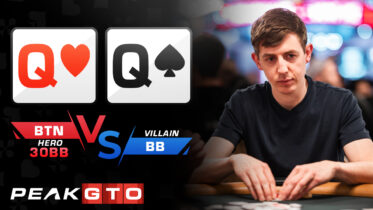
An overpair is one of the most common strong hands you will hold, and yet it is easy to misplay when the action heats up. When you raise preflop and the flop comes all undercards, you have a hand that is ahead of almost everything, but the moment your opponent check-raises, many players freeze and just call. At shallow tournament depths the more profitable answer is often to put the pressure right back. This hand walks through how to play QQ as an overpair through a flop raising war and two more streets, betting small and building the pot while your hand stays comfortably in front.
Today we will analyze a 30bb 8-handed tournament hand where Hero opens Q♥Q♠ on the button, the big blind calls, and the board runs J♦7♣2♥, 6♥, A♠. Hero c-bets small, faces a check-raise, re-raises in position, and then keeps betting small on the turn and river. This hand shows why the queens want to re-click the flop, why both later bets are tiny, and why even a scary ace river is a clear value bet.
Assumptions
- Stacks: 30bb effective
- Format: 8-handed MTT
- Positions: BTN (Hero) vs BB (Villain)
- Action: BTN raises, BB calls
- Flop: J♦7♣2♥ (Pot: 6.1bb): BB checks, BTN bets 1.5bb, BB raises to 4.7bb, BTN re-raises to 10.1bb, BB calls
- Turn: 6♥ (Pot: 26.3bb): BB checks, BTN bets 6.6bb, BB calls
- River: A♠ (Pot: 39.5bb): BB checks, BTN jams 10.9bb
Preflop
Hero opens Q♥Q♠ from the button and the big blind calls. The button is the best position at the table, and QQ are near the top of Hero’s opening range. The big blind defends wide for the price, so Hero takes a strong hand and the betting lead into a flop heads-up and in position, which is exactly where an overpair wants to be.
Flop: J♦7♣2♥
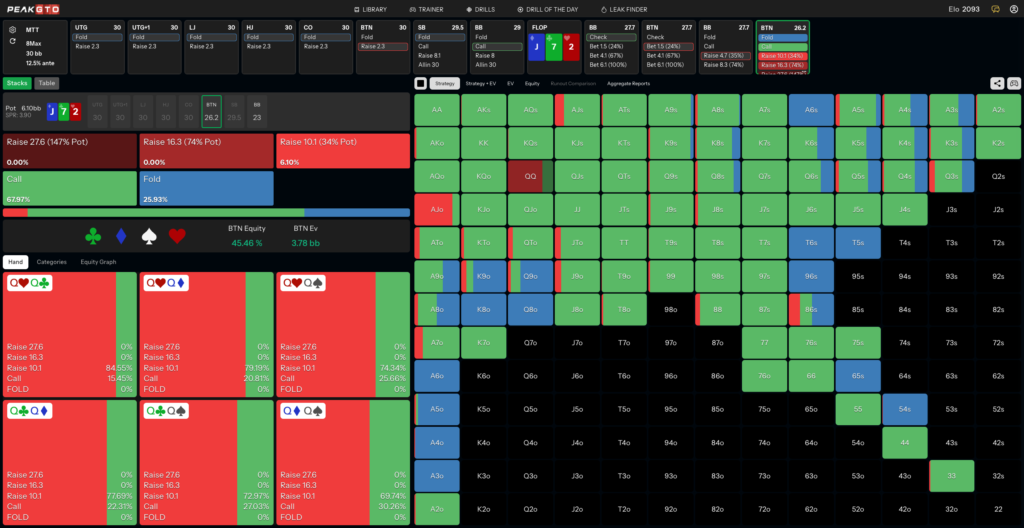
The first question to ask is who the board favors. J♦7♣2♥ is a dry, relatively blank rainbow board, so the button keeps its range advantage. This is not a low, connected texture like 653 where the in-position raiser has to check a lot, and the queens crush the big blind’s defending range. It is a board to continuation bet frequently, and queens always want to bet this combo. Hero uses a small 1.5bb sizing, the big blind check-raises to 4.7bb, and now the interesting decision arrives.
Facing the check-raise, Hero’s hand should feel great. The big blind’s check-raising range is a wide mix: strong jacks like KJ, QJ, JT, and J9 for value, plus a pile of lighter hands such as KT, T9, 98, and various king-x and queen-x suited holdings with backdoors and immediate equity, and the occasional J7 or 72. Because that range contains both made jacks and plenty of air, re-clicking works really well. Rather than just calling, Hero re-raises to 10.1bb in position. The queens want protection, and the re-raise puts the pressure back on the big blind, making the lighter check-raises like KT, T9, and 98 play a miserable spot. Even a jack now has to consider playing for stacks while Hero’s hand is still in great shape.
It is worth noting how rare this re-raise is for the overall range. The solver only re-raises this check-raise about 6% of the time with its entire range, mostly calling. But queens are one of the specific hands that wants to click, re-raising about 74% of the time and never folding. The big blind calls the 10.1bb, and the two players go to the turn with a 26.3bb pot.
The general principle is worth holding onto. Calling a check-raise with an overpair is fine when the opponent is unlikely to be bluffing or when your hand needs to keep their air in, but it surrenders the initiative and lets the worse hand decide the price on later streets. Re-raising flips that around and lets you set the price while your hand is far ahead. At 30bb the stacks are shallow enough that the re-raise commits you to a clear stack-off plan, which is precisely why it works so cleanly with a hand this strong.
Turn: 6♥
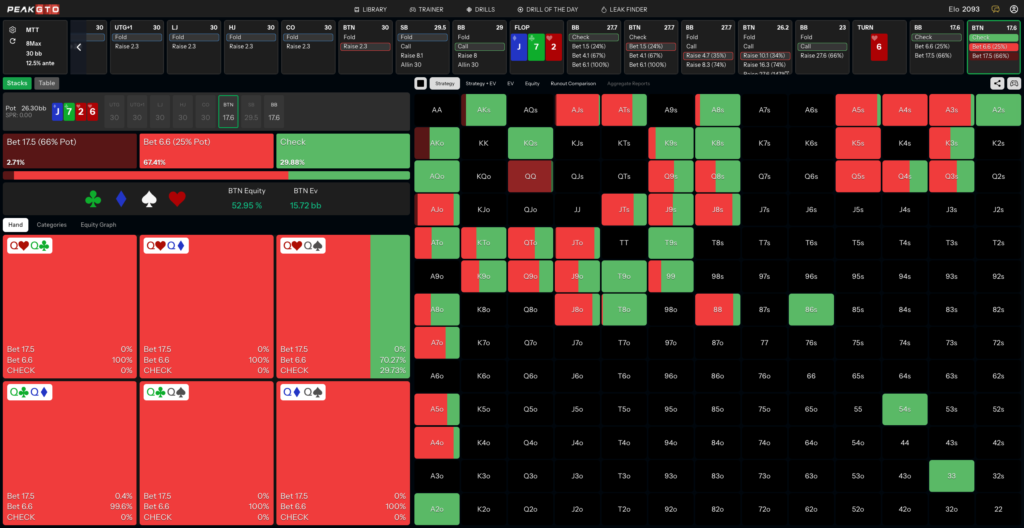
The 6♥ brings some straight draws around the six and makes the board two-tone, adding a few heart combos, but Hero’s Q♥ blocks the queen-high flush draws and, more importantly, QQ is still an overpair on a brick turn, so Hero stays well ahead, and the big blind checks. The key tell is what did not happen on the flop: the big blind called the re-raise rather than jamming. A strong jack like JT or QJ will often shove the flop for protection, and while some still flat, the flat skews toward weaker jacks such as J8 and J6, turned draws like 87 and T9, and floats. That capped, vulnerable range is something Hero wants to keep betting into.
Hero bets small, just 6.6bb into the 26.3bb pot, about a quarter of the pot. PeakGTO uses this small size for two connected reasons. First, with about 17bb behind going into the turn, the small sizing keeps Hero’s bluffs (the KT and QT that re-clicked the flop, plus the occasional A8 or ace-x click) credible, so the value bets are not isolated. Second, it makes the big blind want to stack off a jack or a seven, because the price is so good. There are also very few bad rivers: the opponent’s draws have few clean outs, so even this small bet sets up getting all the money in on almost every river. The big blind calls, and the pot swells to 39.5bb.
River: A♠
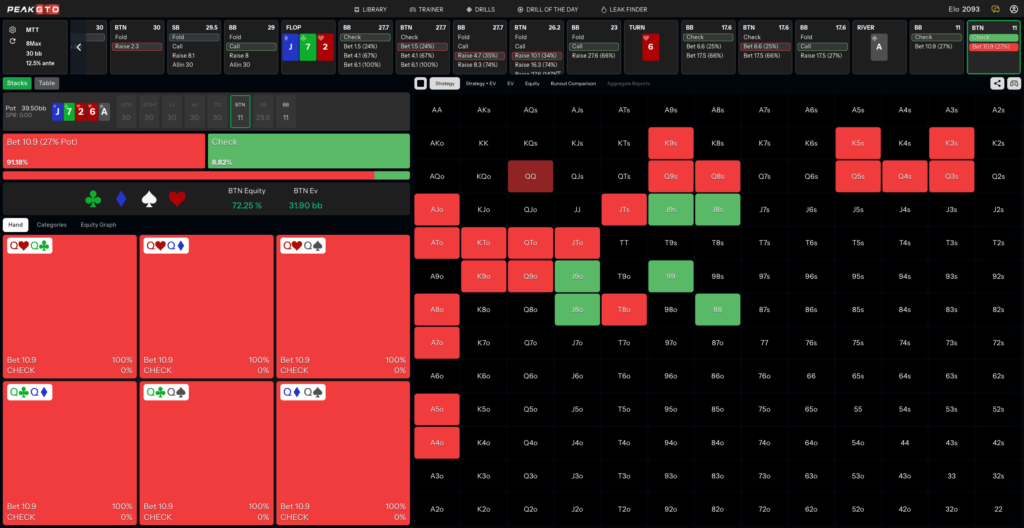
The A♠ looks like a scary card for a hand that was an overpair on the flop, but the right question is whether the opponent can actually have an ace. Work through it: AJ would have gone in preflop at 30bb, and A7 is possible but unlikely. Most of the big blind’s range here is jacks such as J6 and J8, plus hands like 87 and 97. The ace barely interacts with the range that called twice, so it changes very little. The big blind checks.
With only about 10.9bb left in a 39.5bb pot, Hero jams, a bet of just over a quarter pot. The solver jams this river more than 90% of the time across Hero’s range, and queens jam 100%. Because the bet is so small relative to the pot, the pot odds the big blind is getting are enormous, so a jack or even a seven can talk itself into a call. That is exactly what Hero wants, because queens still beat the bulk of the opponent’s range. Going for value here is clearly correct in GTO terms, with the solver having the big blind call the jam about 61% of the time. Occasionally the opponent quietly got there with a slow-played 72 that made two pair, but that is just variance. The hand is far too strong to check back and give up the last bet.
Key Takeaways
- Flop: On a dry J♦7♣2♥ board the button keeps its range advantage, so queens always c-bet small. Facing the check-raise, an overpair would rather re-click to 10.1bb than call, because the big blind’s range is full of both jacks and air. The whole range re-raises only about 6%, but queens click about 74%.
- Turn: The big blind flatting the flop rather than jamming caps its range toward weaker jacks and draws. Hero bets a small quarter pot to keep bluffs in the range, charge the draws a little while keeping the price tempting for worse hands, and set up getting stacks in on almost any river.
- River: The A♠ rarely helps the opponent, who would have stacked off AJ preflop. Hero jams the remaining 10.9bb for value, giving a jack or a seven a tempting price to call. Queens beat most of the range, and the small size is what gets the worse hands to pay.
- Overall: Playing an overpair well is about pressing your advantage rather than playing scared. Re-raise the flop check-raise to seize the initiative, bet small to keep the opponent’s worse hands in, and value bet every street, including the river that only looks frightening.