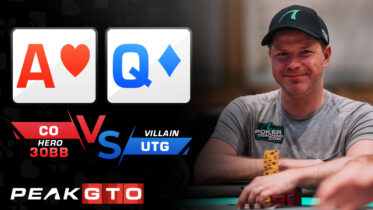
Deciding how many streets of value to bet is one of the most money-critical skills in poker, and top pair with a good kicker is where it bites hardest. Bet too few streets and you leave value on the table against worse hands that would have paid you. Bet one street too many and you get raised off the best hand or pay off a holding that just improved. The answer is almost never a flat three barrels with one pair; it depends on the kicker, the board, and the exact river card. This hand walks through that decision with AQ in a 30bb tournament.
Today we will analyze a hand where Hero calls an under-the-gun open in the cutoff with A♥Q♦, flops top pair on A♠6♥4♦, bets the flop and the J♠ turn for value, and then checks back the 9♣ river. We will look at why AQ value bets two streets but not three, how protecting your checking range shapes the line, and why the river answer flips depending on whether your opponent is a solver or a typical player who never protects their own checks.
Assumptions
- Format: 8-max MTT, 30bb effective stacks
- Positions: Hero is in the cutoff (caller, in position); Villain is under the gun (preflop raiser, out of position)
- Hero’s hand: A♥Q♦
- Preflop: Under the gun raises to 2.3bb, Hero calls. Pot of 7.1bb.
- Flop: A♠6♥4♦ (pot 7.1bb). UTG checks, Hero bets 1.8bb, UTG calls.
- Turn: J♠ (pot 10.7bb). UTG checks, Hero bets 7.2bb, UTG calls.
- River: 9♣ (pot 25.1bb). UTG checks, Hero checks back.
Preflop
Under the gun opens to 2.3bb and Hero calls in the cutoff with A♥Q♦. A 3-bet is a perfectly reasonable alternative, but calling keeps a strong, dominating hand in the pot in position against an early-position range that is already fairly tight. Hero takes the flop with position and a hand that flops top pair or better a healthy share of the time.
Flop: A♠6♥4♦
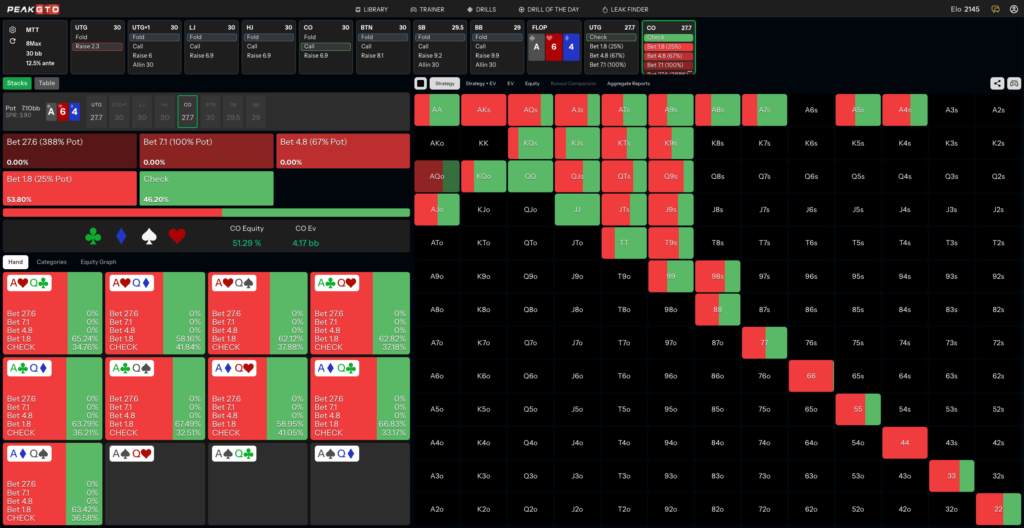
Hero flops top pair with a queen kicker, and the under-the-gun player checks, which they should do around 60% of the time. Now the kicker question begins. Against an opponent who protects their checking range well, by mixing in some AK, AQ, AJ, and sets, you do not get to value bet your own AQ every single time. The solver responds with a mixed strategy, betting most of the aces more often than it checks but still checking back some AQ to keep the checking range honest. Hero takes the preferred small 1.8bb continuation bet, and the under-the-gun player calls.
There is an important real-world note here. Most players do not protect their checks the way the solver does; they bet their AK and AJ rather than checking them, and they tend to check-raise their very best hands instead of check-calling. That means when a typical opponent checks and calls, their range is usually capped below AQ, which quietly makes Hero’s hand much stronger than the balanced solution implies.
The small sizing is deliberate too. On an ace-high board the preflop raiser has surrendered the initiative by checking, and a small bet accomplishes everything Hero needs: it charges the worse aces and pocket pairs that will call, it denies equity to the unpaired overcard combos and gutshots, and it keeps the pot a manageable size so the turn and river bets stay within the shallow 30bb stacks. There is no reason to bloat the pot with a hand that wants to get to showdown against a capped range, so the quarter-pot bet is plenty.
Turn: J♠
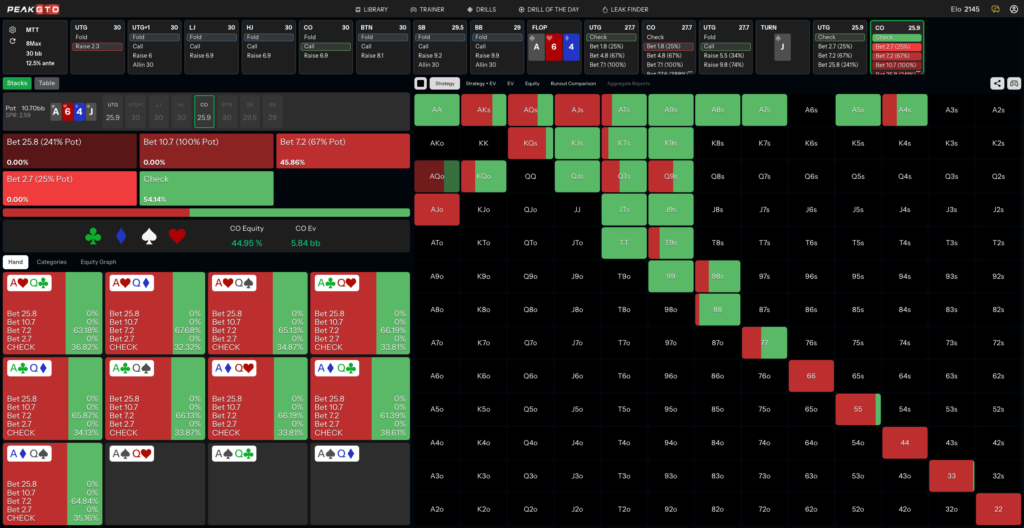
The J♠ is a fine card to keep building the pot, and the under-the-gun player checks again. This is the second street of value, and AQ is one of the better hands Hero can have. PeakGTO bets AQ here about two-thirds of the time, blasting it alongside the hands that fire every time like AJ and the small sets, while the weaker aces check to protect a range that can comfortably call a river bet. Hero takes the larger two-thirds-pot size, 7.2bb, and the under-the-gun player calls again.
The same real-world adjustment grows stronger on the turn. Because most opponents would have check-raised their two pair and sets and bet their strong aces earlier, a player who simply checks and calls twice is rarely ahead of AQ. In practice that makes this turn bet close to a pure value bet rather than the marginal one the balanced solution describes, and it sets up the river with a healthy pot and a hand that is usually still best.
It also matters which hands Hero checks back here instead of betting. The weaker aces and the marginal pairs prefer to check the turn so that the betting range stays strong and the checking range still has hands that can call a river bet. Picking the bluffs is its own exercise: backdoor and gutshot combos like Q♥T♥ and 8♥7♥ make sense as example bluffs, with spade flush draws and two-overcard combos rounding out the betting range, though the strongest flush draws sometimes decline to bet to avoid being jammed off their equity. Building the turn range with that care is what lets AQ bet confidently.
River: 9♣
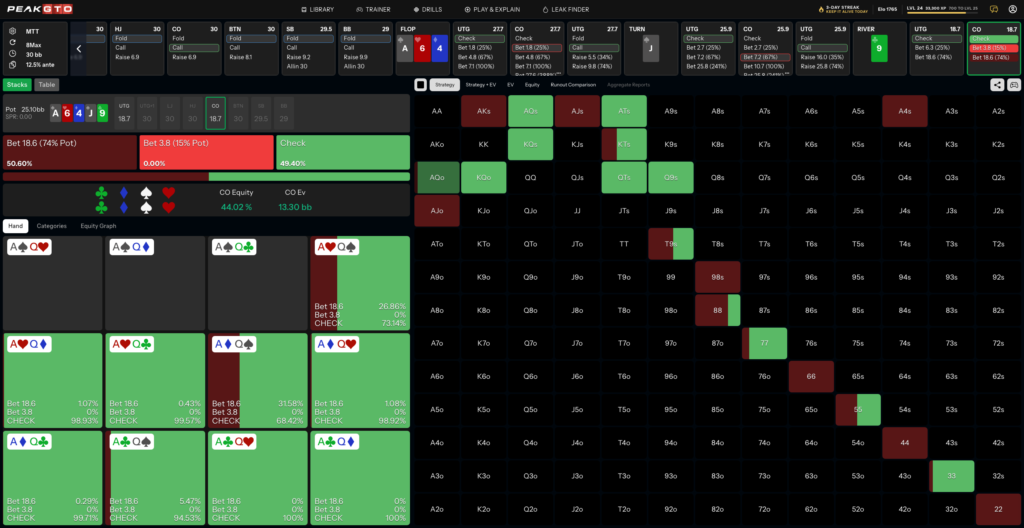
The 9♣ completes the board at A♠6♥4♦J♠9♣, the under-the-gun player checks, and this is where the third street of value is in question. The nine is a meaningful card, because it pairs a common holding, turning A9 into two pair, and improves part of the opponent’s range. In GTO terms the value-betting threshold jumps to two pair and better, joined by a few bluffs from busted draws, and AQ mostly drops out of the betting range. It mixes between value and a check, but it errs toward checking, so Hero checks back and the answer to the headline question is two streets, not three.
The real world tugs the other way, though, and it is worth being honest about it. Against the typical opponent who never protected their checking range, the river check-callers are still loaded with worse aces and the occasional pocket pair that cannot fold, and very few of them are the two pair that just got there. Those opponents will call a river shove with hands AQ beats, which makes an exploitative value bet quite reasonable even though the balanced solution checks. The discipline is recognizing the difference: against a strong, balanced player you take your two streets and check the river, while against a weak, unprotected range you can fire the third barrel and get paid by worse. Hero checks here, and while the nine happened to give this particular opponent two pair, the check-back is the correct default against a range that just improved.
Key Takeaways
- Flop: Top pair with a good kicker bets a small size but mixes in checks to protect the checking range when the opponent is balanced. Against the field, who rarely protect their checks, you can value bet more freely.
- Turn: AQ fires its second street of value about half the time. Because most opponents would have raised their strongest hands earlier, a check-call twice is usually behind, making the bet stronger than it looks.
- River: On a card that pairs the board, the value threshold rises to two pair and better, so AQ checks back by default. The exploitative exception is a weak opponent whose calling range is full of worse aces.
- Overall: How many streets of value to take is a function of your kicker, the river card, and your opponent. Two streets with top pair is often the answer against good players, with the third barrel reserved for ranges that simply will not fold worse.