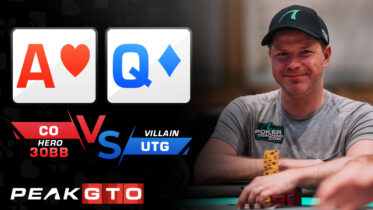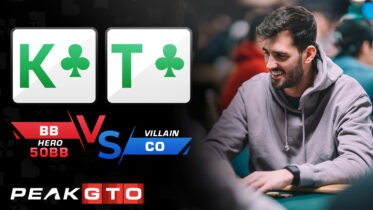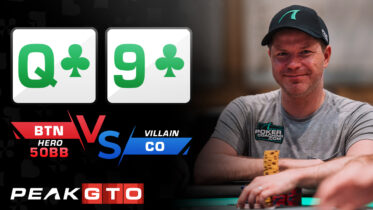
Checking back the flop in position does not mean the hand is over. Many players treat a flop check as a white flag, planning to give up and showdown whatever air they have. That is a costly habit. When the action checks through, the in-position player often gets a second chance to take the pot with a delayed continuation bet on the turn, and then a third chance on the river. Knowing which hands to fire those delayed barrels with, and which sizes to use, turns a passive checked-down loss into a profitable bluff.
Today we will analyze a 50bb 8-handed MTT hand where the button calls a cutoff open with Q♣9♣, checks back a dynamic 8♠4♠2♥ flop, and then bets the 6♦ turn and the J♥ river with nothing but queen-high. This hand, the final spot in the button-versus-cutoff series, shows why queen-high mixes in a flop check, why the turn calls for a delayed continuation bet at a specific size, and why checking down air on the river is a mistake you should almost never make in a tournament.
Assumptions
- Stacks: 50bb effective
- Format: 8-handed MTT
- Positions: BTN (Hero) vs CO (Villain)
- Action: CO raises, BTN calls
- Flop: 8♠4♠2♥ (Pot: 6.9bb), checks through
- Turn: 6♦ (Pot: 6.9bb)
- River: J♥ (Pot: 15.1bb)
Preflop
The button flats the cutoff open with Q♣9♣, a standard call in position. The blinds fold and we take a flop heads-up against the cutoff with a hand that will usually miss but retains good barreling potential when it does.
Flop: 8♠4♠2♥ (checks through)
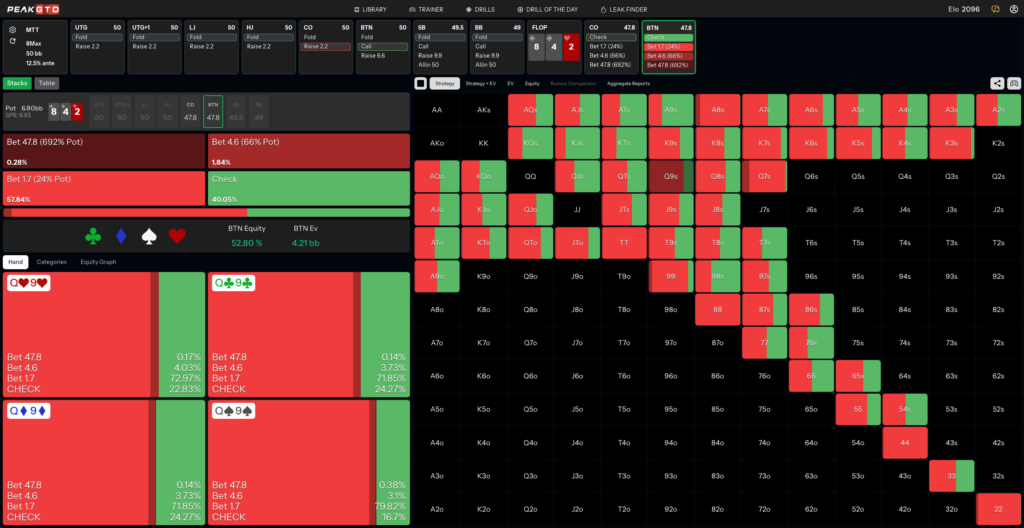
Hero misses with queen-high on this dynamic two-spade board, holding two overcards and a weak backdoor straight to fall back on. The cutoff checks, and Q9 has a decision. As we saw earlier in the series, this hand usually fires a small continuation bet, but it is not a mandatory bluff, and it checks back about 25% of the time. The solver mixes a flop check with a chunk of its unpaired high cards, including KJ, KT, K9, QJ, QT, Q9, JT, J9, and T9. Taking the check keeps the pot small, controls the hand, and sets up the option to bet a turn or river when the opponent reveals more weakness. This time Hero checks back, and the flop goes check-check.
Why mix a check at all with a hand that usually bets? Because a strong, balanced range needs to protect its checking line too. If the button only ever checked back its weakest air and its made hands, the cutoff could attack every checked-through turn relentlessly, knowing the button rarely has anything worth defending. By salting the flop check with hands like Q9 that have backdoor potential and overcards, the button keeps a credible turn and river range after the flop checks through. The flop check is not a sign that the hand is weak; it is a deliberate decision that keeps Hero dangerous on every future street, which is exactly what makes the delayed barrel so effective.
Turn: 6♦
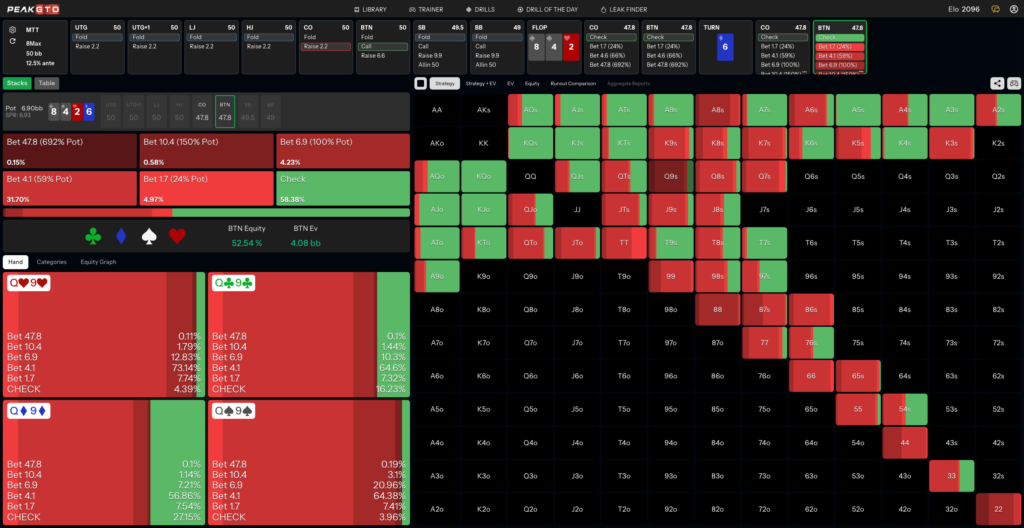
The 6♦ arrives. A quick note on discipline first: if the cutoff leads any meaningful size into the checked-through flop, queen-high simply folds, because there is no reason to run a wild bluff into a player who has woken up. But when the cutoff checks again, the delayed continuation bet comes alive. The hands that want to bet are the ones with no showdown value and ideally a little equity if called. PeakGTO bets the gutshots like K7 and K5, the 97, and the overcard hands such as K9, Q9, J9, QJ, QT, JT, and T9. Q♣9♣ is one of the overcard hands that bets a chunk of the time.
The sizing is the crucial detail. The hands that are not betting are the ones with real showdown value, the ace-highs and the best king-highs like KQ and KJ, which prefer to check and win at showdown. Q9, with two overcards and no showdown value, wants the opposite. It bets a 60% pot size of 4.1bb rather than a tiny stab, and the reason is specific: a tiny bet gets called by every ace-high, while the larger size starts folding out ace-highs and king-highs, exactly the hands Q9 needs to push off. The bet also keeps the door open to improving to top pair, and if Hero gets raised, it is a trivial fold. Hero bets 4.1bb and the cutoff calls.
River: J♥
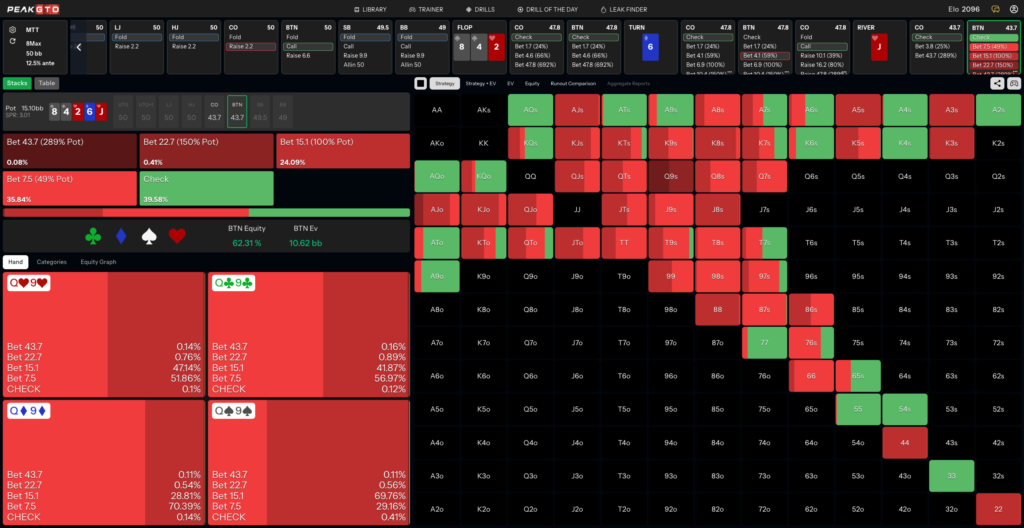
The J♥ completes the board and the cutoff checks. This is the moment that decides whether the whole line was worth it, and the answer is unambiguous: you have to bluff. Nearly all of Hero’s no-showdown-value hands fire here, because the button now holds plenty of clean jacks for value, QJ, JT, and J9, while the capped cutoff holds very few. The range splits its sizing between a pot-sized bet and a smaller half-pot bet. Q9 fires close to 100% of the time as a pure bluff, and our exact Q9 leans toward the smaller half-pot size, mixing in the pot-sized bet less often.
The river card does shape which air hands bluff. Q9 fires on almost every runout, but on a card like the ace of spades it would check, deferring to the unpaired hands that hold the spade blocker. On this offsuit jack, Q9 has no such conflict. The broader and more important lesson is the one most players ignore: after the flop checks through, the plan is not to surrender and lose with queen-high. If you take the delayed continuation bet on the turn, you usually need to follow through and bluff the river with your lowest showdown-value hands. The GTO solution makes that crystal clear. Checking down queen-high and conceding is one of the most common and costly mistakes in the game. Hero bets, and the cutoff folds.
It is also worth seeing how the smaller pot from the flop check shapes the river. Because Hero declined to bet the flop, far less money went in early, so the river bet caps out at a pot-sized stab rather than the giant overbet you would use after building the pot with a flop continuation bet, and our exact Q9 leans toward the smaller half-pot size here, mixing in the pot-sized stab less often. That sizing still does the job: against a capped range the pot odds the cutoff is offered do not matter, because it lacks the hands to call profitably at any price. The check-back line trades a bigger river bluff for a cheaper, lower-variance one, and the fold equity is what makes it print. Either path, betting the flop or checking back and delaying, ends with queen-high taking the pot away rather than conceding it.
Key Takeaways
- Flop: On 8♠4♠2♥, queen-high usually bets but mixes a check about 25% of the time. Checking back is not surrender, it sets up a delayed continuation bet on later streets.
- Turn: The 6♦ is a delayed barrel spot. Fold to a lead, but when checked to, bet the no-showdown-value hands. Q9 fires a 60% pot 4.1bb, sized to fold out ace-highs rather than a tiny stab that everyone calls.
- River: The J♥ demands a bluff. Queen-high bets close to 100% as a pure bluff, because the value-heavy range needs bluffs and the cutoff is capped.
- Overall: A delayed continuation bet is a plan, not an afterthought. Check back air on the flop when appropriate, then barrel the turn at a size that folds out high cards, and follow through on the river. Surrendering with queen-high is the real leak, and recognizing the second and third chances the checked-through flop hands you is what turns a passive miss into a won pot.