You bet the flop with nothing, your opponent calls, and now the turn stares back at you. Most players either give up on the spot or fire again blindly, and both mistakes cost real money.
The truth is that double barreling with low equity is a solvable problem. A handful of questions about the turn card, your range, and your stack depth tell you whether to fire, and the answers are often the opposite of what feels natural.
This guide covers when to double barrel the turn as a bluff in Texas Hold’em, which turn cards keep the barrel alive, which hands make the best low equity bluffs, and the exploitative barrels that print against predictable opponents.

What a Flop Call Does to Both Ranges
Start with what just happened. When you bet the flop and your opponent calls, their range loses all of its junk, because the junk folded. Your range only keeps its junk if you were betting almost everything.
That asymmetry is the whole game on the turn. If your flop betting range was tight and polarized, you barely have any junk left, so the low equity barreling question rarely comes up.
But when you c-bet a wide range, you arrive at the turn with plenty of hopeless poker hands against a range that just got stronger, and the equities sit close to even. That means you cannot barrel everything, and the spot demands polarized, deliberate choices.
One habit makes all of this manageable. Think ahead before the turn arrives. Know which cards are good for you and which are bad while the dealer is still burning, because shot clocks and online timers do not leave room to work it out from scratch.
The Turn Cards That Keep the Barrel Alive
The best turn card for a wide flop bettor is an overcard to the board, and the reason is beautiful once you see it.
When you bet everything on a flop like jack-nine-six, your misses were high cards, hands like ace-king, ace-queen, and king-queen. When the turn comes an ace, a huge chunk of your missed range just became top pair, while your opponent folded most of their ace-highs to the flop bet.
Suddenly your range is full of aces, theirs is full of jacks and draws, and you get to bet relentlessly. The same story plays out when eight-five-deuce turns a queen or nine-seven-five turns a king, and on those cards even your remaining king-high and queen-high junk keeps firing, carried by the strength of the range around it.
Neutral turns call for polarized, selective betting. And on turn cards that favor your opponent, like ones completing their obvious draws, the barrel mostly dies, and the few bluffs you do fire should carry real equity. The frequency follows the card, and the card either recruited your misses into top pair or it did not.
How Big to Barrel
Once the card says fire, three questions set the size. Do you have the range advantage? Do you have the nut advantage? And does your opponent’s range still connect with the board?
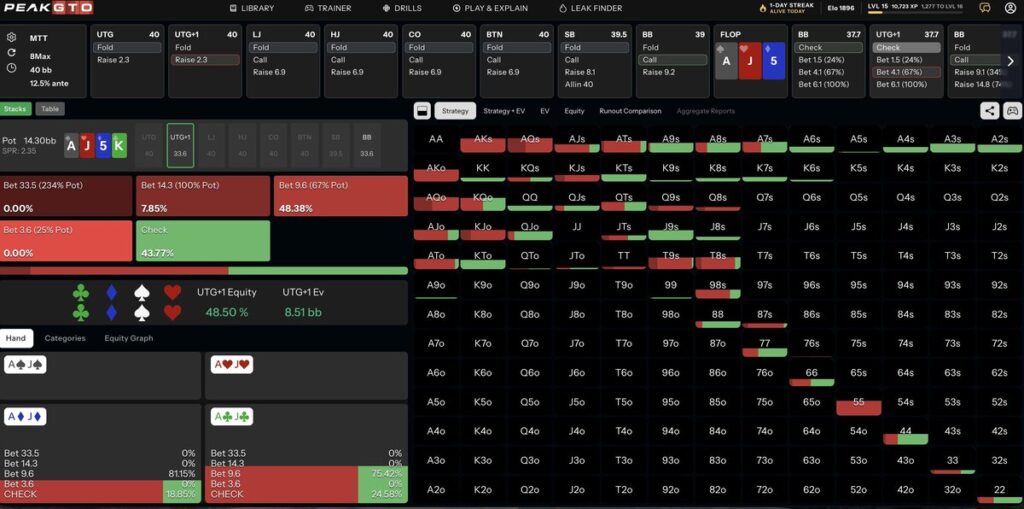
Take an early position raise called by the big blind on ace-jack-five. A king or queen turn completes your gutshots and misses their range, so you barrel frequently and big, because their remaining jacks and draws are strong enough to pay.
A second ace kills their connectivity, so you still bet often but downshift to small, since almost nothing worse can call big. And a jack is a warning light, because their calling range holds far more jacks than your raising range, so the barrels mostly stop.
Strong turns with a connected opponent take big bets, strong turns against a gutted range take small ones, and drilling these textures in a trainer like PeakGTO makes the pattern automatic far faster than memorizing charts.
Barrel the No-Draw King-Highs, Check the Flush Draws
Now the part almost everyone gets backward at tournament stacks. Around 40 big blinds, your best low equity barrels are suited king-x and queen-x with no draw at all, while many of your flush draws prefer to check.
The logic shifts when you get raised. At this depth, a check-raise is effectively a shove, and your stack-to-pot ratio leaves no room to call with a middling draw. Bet a nine-out flush draw, face a jam, and you are forced to surrender all those outs or call off badly. Bet king-high with nothing, face the same jam, and folding costs you almost nothing. So your bluffs want to live at the extremes, high enough equity to call the shove happily, or low enough to fold without a flicker, and never in the miserable middle.
These no-draw king-highs bring quiet bonuses too. They still beat your opponent’s queen-high, and ten-high draws at showdown when the river checks through, and when the king lands, you make top pair the opponent rarely has.
The pattern usually reaches down to the lowest few kickers, the king-fours and king-threes of the world, plus stray offsuit hands with two overcards to the middle cards. I am probably still not finding all of these bluffs myself, and every time I study the spot the list gets longer.
Deeper stacked, the logic flips back, because your big draws can bet and call the raise, and the barrel returns to the hands that can improve.
The Exploitative Barrels That Print
Everything above assumes a solid opponent. Against predictable ones, double barreling gets far simpler.
Watch for the player who raises the flop with every top pair and better. When that player just calls your c-bet on eight-six-three, their range is capped at middle pairs, underpairs, and king-highs, and none of it survives a medium turn bet followed by a big river bet.
The same goes for the player who raises every flush draw on the flop. When the flush card lands on the turn, they almost never have it, so you barrel the scare card that scares them instead of you. A board like king-eight-three running out nine-four looks unbluffable until you realize their eights and threes are never calling two more streets.
The craft here is precision about what your specific opponent does wrong. Not “he is loose” but “he raises all his flush draws” or “he never slowplays top pair.”
When you can name the exact leak, you know exactly which runouts leave their range hollow, and you can barrel off with genuine nut-lows while they fold the best hand over and over. And when someone does call you down light, fine, you found the station, and the value bets get bigger from here.
Conclusion
The double barrel decision compresses into three checks. Did the turn card recruit your missed hands into top pair? Does the sizing story match whose range holds the nuts and whether theirs still connects? And are your bluffs at the right end of the equity spectrum for the stack depth?
Fire the overcard turns with confidence, size to their connectivity, and at tournament stacks send the no-draw king-highs into battle while the flush draws wait. Then keep a separate list of the opponents whose flop raises cap their calling ranges, because those players hand you barrels no chart would ever approve.
Give up less, barrel smarter, and the turns you used to surrender start paying for your bad beats.