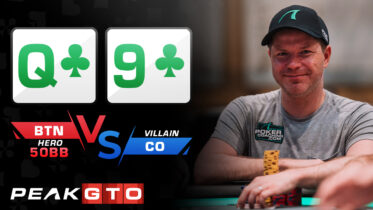
Try This Hand Yourself
Play this exact spot against the solver in PeakGTO before reading the analysis.
Triple barreling with a complete air ball feels reckless, and that is exactly why so many players never do it. They bet the flop, maybe fire the turn, and then check the river with nothing, convinced that betting again is spew. Against the right opponent on the right board, that surrender is the real mistake. When you hold a nut advantage and the river caps your opponent’s range, even a hand as weak as queen-high becomes a mandatory bluff, and giving up leaves a large amount of money on the table.
Today we will analyze a 50bb 8-handed MTT hand where the button calls a cutoff open with Q♣9♣ and barrels a dynamic 8♠4♠2♥ flop, the 6♦ turn, and the J♥ river with nothing but queen-high. This hand, part of the button-versus-cutoff series, shows why barreling queen high is correct when the cutoff checks an uncapped range, how a nut advantage powers a polarized turn, and why a river that caps the opponent turns air into a confident jam in a tournament.
Assumptions
- Stacks: 50bb effective
- Format: 8-handed MTT
- Positions: BTN (Hero) vs CO (Villain)
- Action: CO raises, BTN calls
- Flop: 8♠4♠2♥ (Pot: 6.9bb)
- Turn: 6♦ (Pot: 10.3bb)
- River: J♥ (Pot: 30.9bb)
Preflop
The button flats the cutoff open with Q♣9♣, a routine call in position. A suited Q9 is too strong to fold against a cutoff open and not strong enough to justify a 3-bet at 50bb, so flatting on the button is the standard choice. It keeps the cutoff’s worse hands in, holds the in-position advantage that lets Hero apply pressure on every street, and retains the kind of suited connectivity that flops draws and equity. The blinds fold and we take a flop heads-up against the cutoff, holding a suited hand that has clean equity when it connects and good barreling potential when it does not.
Flop: 8♠4♠2♥
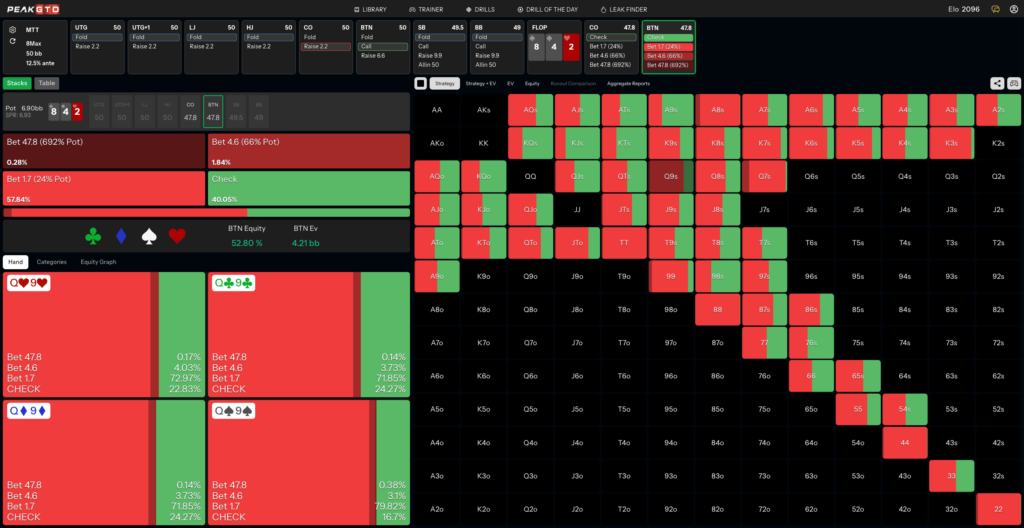
Hero completely misses, holding queen-high with a backdoor club draw on a dynamic two-spade board. The cutoff checks, which it does a large amount of the time, keeping its range uncapped with overpairs, top pairs, and a chunk of its sets. As in the rest of this series, an uncapped opponent means the button bets small even on a wet board, so the question is which of Hero’s air hands get to fire that small continuation bet. The answer is the hands with a nine. T9, J9, Q9, K9, and the junky king-highs all bet a good amount, with or without a backdoor flush draw, because the nine adds a sliver of equity and useful card removal. Q♣9♣ bets the small 1.7bb size around 70% of the time. It may feel rough, but if it gets raised it is a trivial fold. The cutoff calls.
It is worth understanding why the nine is the dividing line for which junk bets. A bluff on the flop is not just about taking the pot now; it is about which hands can keep applying pressure on later streets and which cards improve them. A hand with a nine can pick up a pair or a straight draw on a wide set of turns, and it removes a card from the opponent’s pairing and connecting range. A hand without that connectivity, like a stone-cold king-high with no backdoor anything, makes a worse barrel because it has fewer good cards to fire on and tends to want to realize whatever showdown value it has. The solver is not betting Q9 because it is strong, it is betting it because it has the right shape to keep bluffing.
Turn: 6♦
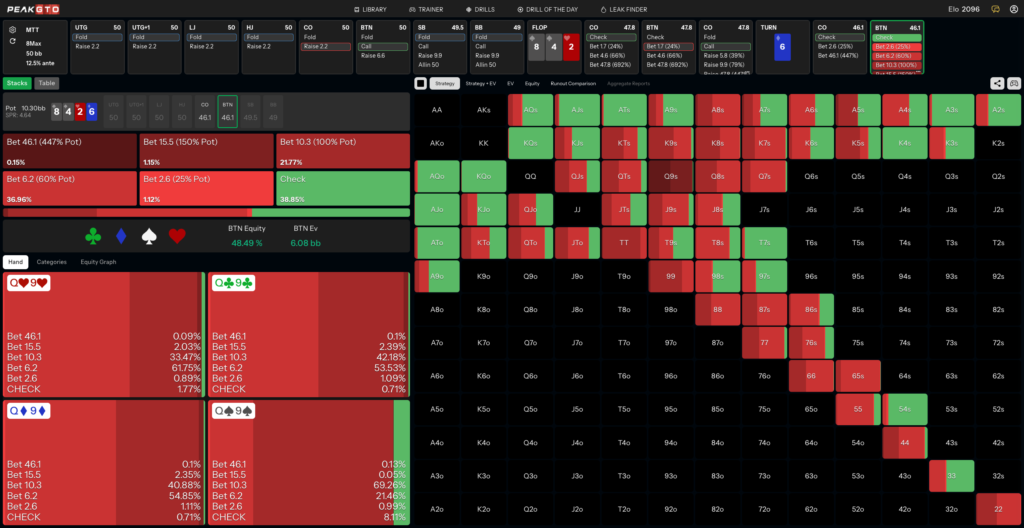
The 6♦ arrives and the cutoff checks its entire range. Hero has only about 48% equity, but at the top of the range the in-position player holds the nut advantage, so the bet goes out polarized and fairly often. The solver bets about 60% of its range here, leading with an eight or better for value and pairing those value hands with bluffs that have a little backing and can comfortably fold to a jam: T9, J9, Q9, JT, QT, QJ, K9, and KT. PeakGTO shows Q♣9♣ betting close to every time, choosing a pot-sized or 60% pot size.
The bluff selection follows a clean principle: as a hand’s showdown value goes down, it bluffs more. The ace-high hands have enough showdown value that they mostly check, unless they carry a flush draw, and KQ and KJ check a good amount too. The genuinely worthless unpaired hands, Q9 very much included, are the ones doing the betting. Q9 is exactly the profile the turn barrel wants: no showdown value to protect, a tiny amount of equity, and an easy fold if the cutoff wakes up with a check-raise. Hero pots for 10.3bb and gets called.
Notice the elegant division of labor on the turn. The hands that can win at showdown, the ace-highs and the king-x with a real kicker, prefer to check and keep the pot small so they can realize that value. The hands with no showdown value when the hand checks down, like Q9, have nothing to protect and everything to gain by betting, so they take on the bluffing workload. This is the opposite of how most players construct their ranges. They bet their decent hands and give up with their air, when the correct approach often flips it: bet the hopeless hands as bluffs and pot-control the medium ones. Recognizing that Q9 belongs in the betting range, not the checking range, is the whole insight.
River: J♥
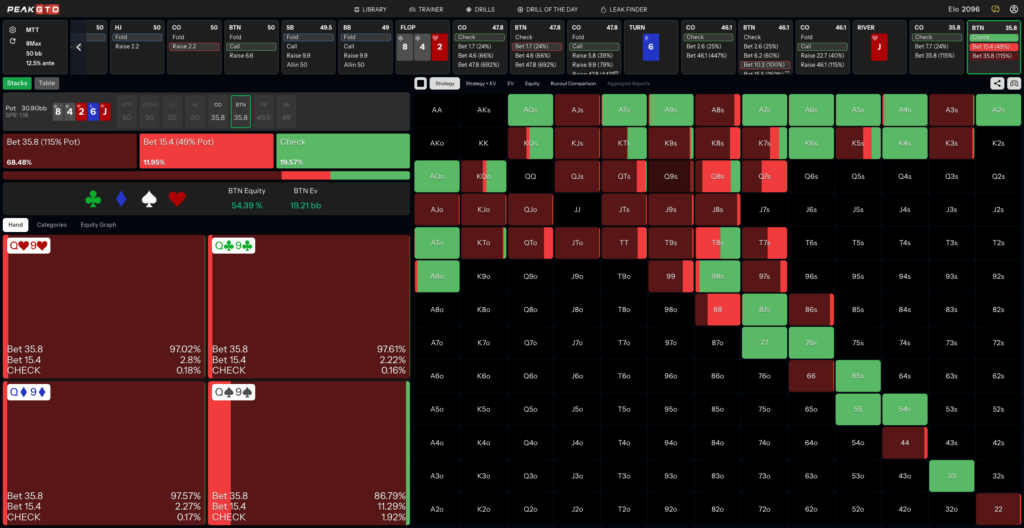
The J♥ is the perfect card to jam, and the reason is that it caps the opponent almost completely. The cutoff should arrive here with virtually no jack-x, since it would have needed to check-call the turn with something like AJo, which rarely happens. With the opponent so capped, Hero gets to shove very aggressively, value betting any eight or better, plus its strongest top pairs, straight up. That heavy value side is what creates room for a wide bluffing range, and Q9 is right in it, jamming the river close to 98% of the time. From a GTO standpoint this is an automatic bluff.
The river card also dictates which air hands bluff, a subtlety worth internalizing. If the river had been the jack of spades, completing the flush, Q9 would still bluff, because few unpaired flush-blockers remain in range while combinations like QJ and JT improve, so Q9 joins KT, K9, and QT in firing. If the river had been a low spade like the deuce of spades, the many unpaired high cards holding a spade blocker that failed to pair would prefer to bluff instead, and Q9 would step aside. On this offsuit jack, Q9 has no such conflict and is a clean bluff. The broader lesson is the one most players miss: when you bet the flop and turn, you have to follow through and triple it off on the right rivers. The pot odds you lay with the overbet only matter if the opponent has the hands to call, and a capped range simply does not. Hero jams, and the cutoff folds.
Key Takeaways
- Flop: On the dynamic 8♠4♠2♥, the button bets small against the cutoff’s uncapped check. Queen-high bets about 70% because the nine adds equity and removal; it folds easily to a raise.
- Turn: The 6♦ sees the button fire a polarized pot-sized bet with its nut advantage. Q9 barrels because it has no showdown value and can fold to a jam, the ideal bluff profile.
- River: The J♥ caps the opponent, who has almost no jack-x. Queen-high jams nearly 100% as the value-heavy range demands a wide set of bluffs.
- Overall: Barreling queen high is correct far more often than most players believe. With a nut advantage and a river that caps the opponent, follow through and triple it off. Checking back the turn or river with air is the real leak, and it is the one separating most players from the line the solver actually wants.