Try This Hand Yourself
Play this exact spot against the solver in PeakGTO before reading the analysis.
Defending the big blind well is not about waiting for big hands. It is about knowing what to do with the marginal draws that make up most of your range. A gutshot with a backdoor flush draw is not a hand most players think twice about, yet it is exactly the kind of holding that lets you apply pressure without a made hand. The semi-bluff check-raise turns that thin equity into a weapon: you build a pot you can win immediately, set up barrels for the turns that help you, and keep your strong made-hand range protected. The trick is following through with discipline, because the same draw that should raise the flop should often surrender the turn.
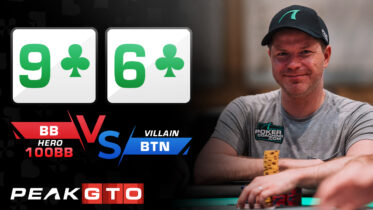
Today we will analyze a 100bb 6-handed cash game hand where the big blind defends 9♣6♣ against a button open and flops a gutshot with a backdoor flush draw on 8♣5♦3♥. We will work through a semi-bluff check-raise on the flop, a disciplined check when the turn bricks against us, and a river bluff once the draw has fully missed. Each street is a different lesson in playing a draw from out of position: when to apply pressure, when to give up the aggression, and how to pick a bluff size that actually folds out the hands you are targeting.
Assumptions
- Stacks: 100bb effective
- Format: 6-handed cash game
- Positions: BB (Hero) vs BTN (Villain)
- Action: BTN opens, BB calls
- Flop: 8♣5♦3♥ rainbow (Pot: 5.5bb)
- Turn: J♠ (Pot: 24.3bb)
- River: Q♠ (Pot: 24.3bb)
Preflop
The button opens and the big blind calls with 9♣6♣. This is a routine defend. Suited, connected-ish hands flop well enough to continue against a button range that is wide and capped relative to a strong defender. The important thing to accept is that the big blind will be out of position for the rest of the hand. That makes proactive aggression, rather than passive calling, the way to fight back. When you act first, the check-raise is the tool that stops the in-position player from betting freely.
Flop: 8♣5♦3♥
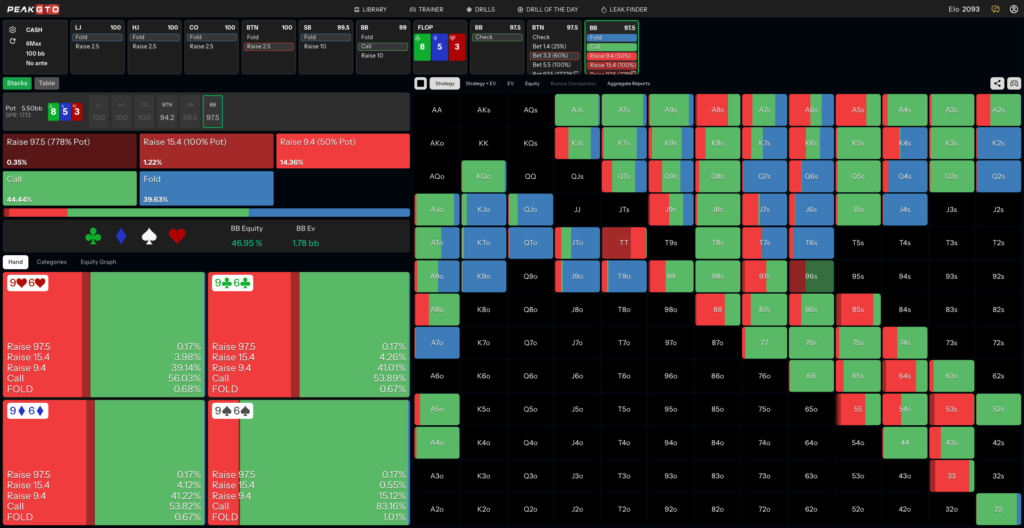
The big blind checks the entire range, as it always does from out of position. The button fires a 3.3bb continuation bet, roughly 60% of the pot. The button cannot actually bet its whole range here and should be checking about 42% of the time, so when it does bet, the range is somewhat polarized. That matters, because it tells the big blind that folding too much would be a mistake against a betting range that contains plenty of air.
9♣6♣ flops a gutshot to the seven, plus a backdoor club flush draw, plus a nine that plays as a small overcard to the board. No gutshot is folding at this point. If you fold your gutshots, you are folding way, way too often, especially to only a 3.3bb bet. The only question is whether to call or raise, and the hands with backdoor flush equity are precisely the ones that mix in the check-raise. Our specific combination, with its backdoor flush and an overcard, is right in that mix, leaning slightly toward a call at about 56% and check-raising the other 40% or so as a semi-bluff.
The overall numbers back this up. Facing the c-bet, the big blind folds 39.6%, calls 44.4%, and check-raises about 16% of the time, almost always to 9.4bb. The raise is deliberately not huge. As you go huge, you have to have fewer and fewer draws, and here you have a lot of draws. A smaller raise lets you include the wide semi-bluffing range that hands like 9♣6♣ belong to. The raise range is built from value, two pair and sets, plus the strongest draws like 6-4, which is why the raise stays balanced even though premium combos are not especially dense. Most players make the opposite mistake, check-raising only their nutted hands and showing up far too tight.
There is a follow-up worth internalizing. If you make it 9.4bb and the button clicks it back to roughly 21.6bb, a little over 2x your raise, your gutshots are not folding. Against a small re-raise they call or shove, mostly call. The button should only re-raise about 15% of the time, with a polarized range of overpairs and better, and most opponents will not even do that. They just call, which is exactly what happens here. Hero check-raises to 9.4bb, and the button calls.
Turn: J♠
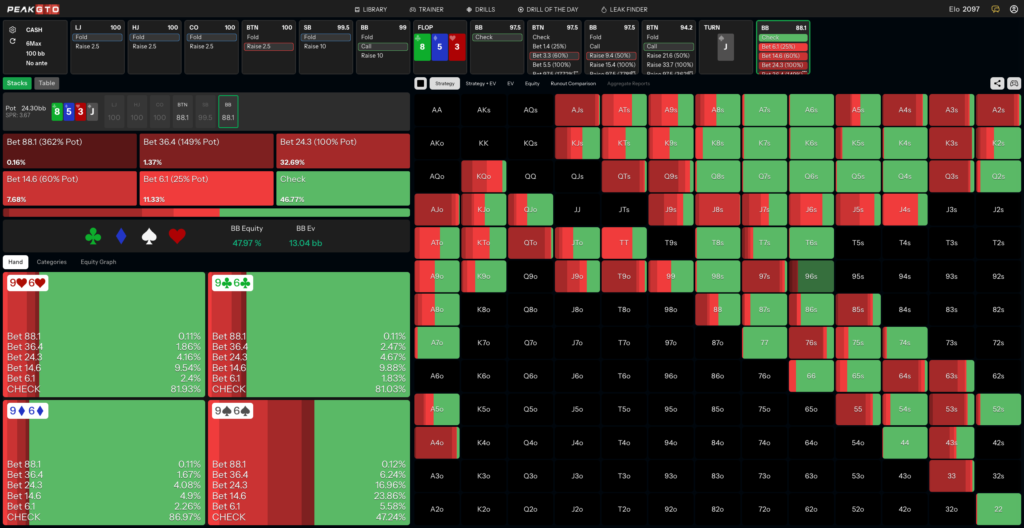
The J♠ is a bad card for the check-raiser. It is an overcard that connects far better with the button’s calling range than with ours, and our gutshot did not improve. This is the moment that separates disciplined draw play from spew. PeakGTO has the big blind checking about 47% of the time, and the hands that do keep betting are the draws that picked up extra equity, not the ones that stalled. When you barrel here, you are very polarized: jacks, sets, two pair, the draws that improved to higher equity, like 6-4, plus the draws that now have an overcard and a gutshot, such as Q-10, Q-9, and 10-9.
9♣6♣ is none of those. It has no overcard to the jack, the backdoor flush is dead, and it holds only the same gutshot it had on the flop. The rule is clean: when you check-raise a smattering of draws, various cards interact with them in various ways, and when you get a card that is bad for you, you simply check. So we check. The button, holding a hand that is fine but not strong enough to value bet for a third street, checks back. If we had bet and gotten raised, or checked and faced a big bet, 9♣6♣ would simply fold. Both players check, and we go to the river.
River: Q♠
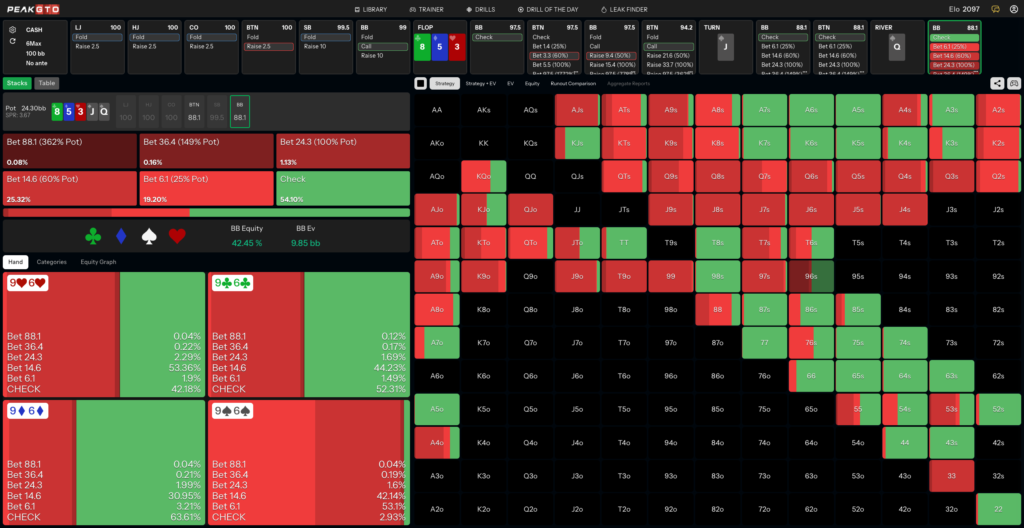
The Q♠ bricks. The final board is 8♣5♦3♥J♠Q♠, and 9♣6♣ is nine-high with no pair and no draw left. Because the turn checked through, the big blind gets to lead the river. The principle is the backbone of balanced play: if you want to have value bets, you should have bluffs. The big blind can value bet any decent eight here, so it needs a supply of bluffs to go with them, and a busted nine-high is a natural candidate. There is no showdown value to protect.
Sizing is where this river gets instructive. The solver bets about 46% of the time, splitting between a 60% pot bet of 14.6bb and a 25% pot bet of 6.1bb. The larger size is the better choice with nine-high, and the reasoning is about what each bet folds out. At 14.6bb, even pairs like 77 and 66 are supposed to fold, and weak holdings like a busted ace-high are priced out. At 6.1bb, those same pairs call, and even AK continues a large share of the time. Since the entire point of bluffing here is to make better hands fold, the bigger bet does the job the small one cannot. The pot odds you lay determine which hands you actually fold out of the pot, so the size is the strategy.
Hero bets 14.6bb. It is worth being honest about a wrinkle here: both the solver and most aggressive players likely over-bluff rivers like this. Exploitatively that is often fine, because most opponents fold too much, which means the GTO bluff frequency is usually a floor rather than a ceiling against the field. Suppose the button calls with a hand like AK and wins. Against the 14.6bb size, GTO expects AK to fold most of the time, which is exactly why such a call is a deviation that pays us off over the long run rather than evidence the bet was wrong. That single result would not invalidate the line. The check-raise, the turn give-up, and the river bluff are each correct in isolation, and over a large sample that sequence prints money. Playing the result, rather than the process, is how good lines get abandoned after one bad outcome.
Key Takeaways
- Flop: Against a small c-bet, no gutshot folds. 9♣6♣ is a mix that leans slightly to calling but check-raises to 9.4bb often enough to belong in the ~16% raising range; this hand takes the raise. Keep the size modest so the raise can include many draws, and do not fold to a small re-raise.
- Turn: The J♠ is a bad card that misses us and helps the button. With no improvement, no overcard, and a dead backdoor flush, 9♣6♣ checks. Only draws that improved keep barreling.
- River: With value bets available, the busted nine-high becomes a bluff. Choose the 60% pot size (14.6bb) over 25% pot, because only the larger bet folds out pairs and ace-high, which is the entire goal.
- Overall: Playing a draw from the big blind is a three-part skill: apply pressure with the semi-bluff check-raise, surrender the turns that do not help you, and bluff the bricked river at a size that actually folds out made hands. The line is correct even when a single result goes against it.