You get all in before the flop with pocket aces and lose to a player who called with jack-nine offsuit. Twenty minutes later, you’re raising hands you’d normally fold and calling river bets you know are for value.
Your knowledge of the game didn’t change in those twenty minutes, but your state of mind did.
That’s poker tilt, and for a lot of players it costs more than any technical leak. You can study Texas Hold’em strategy for months and hand the whole edge back in one bad hour.
This guide covers what tilt is, the forms it takes, how to catch it early, what to do about it at the table and before you ever sit down, and how to adjust when the tilted player is your opponent instead of you.

What Is Tilt in Poker?
Tilt is a state of mental or emotional confusion or frustration in which you play worse than you know. That’s the short tilt definition, and the second half is the part that matters.
Being annoyed isn’t tilt. Playing differently because you’re annoyed is.
Most of the time tilt shows up as too much aggression or too much calling. Some players go the other way and get tight, like the player who has a bluff called and decides they’re not bluffing again any time soon.
Both directions are tilt.
Any time you move away from good poker that takes advantage of your opponents’ mistakes, you’re the one making the mistake, and you’re handing equity to the table.
When you aren’t thinking clearly, you fall back on whatever your default level of knowledge is. That’s why players who are studying hard look sharp while things go well, then slide back into old habits the moment a session turns.
It’s also why the best players in the world can be visibly frustrated and still play almost as well as before. Their default is very good. So you have two jobs, which are to get bothered less often and to train until your worst game is still a solid one.
The Types of Poker Tilt and What Triggers Them
Pretty much anything outside your control can set you off. A bad beat, a misdeal on the hand where you would have had aces, a drink spilled on you, an opponent who plays a hand terribly and gets rewarded for it.
Work out which of these get to you and why. With a bit of honest thought, you’ll usually find the reason is a little silly.
Bad Beat Tilt
This is the classic. You got your money in good and lost, so you feel wronged. Underneath it is entitlement, the belief that you’re supposed to win because you had the best hand or because you’re the better player.
Nobody is owed a pot. Aces are the best starting poker hand you can be dealt, and all in before the flop against jack-nine offsuit they still lose about 16% of the time, roughly one time in six. Sometimes that happens two or three times in a row.
If you play solid, tight-aggressive poker in loose games, you’ll usually get your money in ahead. That means when you do lose, it will almost always be to a bad beat.
You also need your opponents to make these blunders. If everyone played well, nobody would win, and the house would rake away the money.
A long time ago I was told that at some point I would run far worse than I ever thought possible. It was true, and it will be true for you. A long losing stretch has its own fixes, and I cover those in my guide to surviving a poker downswing.
Get-Even Tilt
This one is about the scoreboard. You’re down for the session, and you start gambling to get back to zero.
The start and end of a session are artificial markers, especially in cash games. The last hand of today is just the first hand of tomorrow. Yet I see players who are down a handful of big blinds late in a session start playing crazy to get even.
The most expensive version is moving up. You get stacked a few times at $1/$2, get mad, and jump to $2/$5. You get stacked there and jump to $5/$10. The next thing you know, you’re broke.
Card Dead Tilt
Some days you fold for hours. The tilt here is boredom, and it shows up as forcing action with hands you’d normally throw away. Keep folding them. Good opponents will simply assume you’re card dead.
Scared Tilt
Not all tilt is loud. After a few losses, some players start checking back hands that should be bet, or folding hands they know they should play, because they expect something bad to happen.
Others tighten up at the end of a winning session to protect the profit. It feels responsible, but it’s still a deviation from your best game.
Winner’s Tilt
Emotions hurt your play when you’re elated, too. There’s a stretch from Hustler Casino Live that shows it well. Rampage made a big river call against Nik Airball with a weak top pair and won a huge pot.
Shortly after, he 3-bet jack-eight suited from the big blind, checked the flop, then bet the turn and shoved the river with no pair and no draw. He was drawing dead when he bet the turn, and his opponent called him down with top pair.
The slower version is the player who wins a few tournaments in a row, decides they’re far better than they are, and moves up to games they can’t beat.
How to Spot Tilt Early in Yourself
It’s hard to know in the moment that you’re tilting. What you can catch is the thing that happens just before.
For me, that sign is physical. I normally put my chips into the pot the same controlled way every time. When I hear and feel myself putting them in too hard, I know I’m about to get flustered.
Your signal may be different, so learn what it is. These are the ones worth watching for:
- You’re playing more hands than you were an hour ago. Tommy Angelo points to this as the first sign of a player sliding off their A-game.
- You’re acting faster. Our coach Lexy Gavin lists speed clicking online and snap calling among the early warnings.
- You make a river call when you know you’re beaten because you feel you’re owed a win.
- You’re targeting one specific player because they’ve won a few pots from you.
- You’re checking hands you’d normally bet, or folding spots you’d normally take.
- You’re thinking about what you’re down instead of the hand in front of you.
The subtle forms are the dangerous ones. Obvious rage is easy to notice. A slightly too loose call or a slightly too passive check is not, which is why you need a habit that makes you look.
Tommy Angelo’s habit is deliberate stillness between hands, where you stop moving for a moment and notice what state you’re actually in.
What to Do at the Table When You Feel Tilt
Once you’ve caught the sign, run the same four steps every time.
Step 1. Name It
Tell yourself plainly that you’re getting tilted, and ask what you’re frustrated about. In my case, the answer is almost always that something silly happened and I’m reacting irrationally.
Step 2. Sit Out a Hand or Two
Don’t make a big decision right after a big loss. Fold anything that isn’t clearly strong for the next hand or two, and play a little tighter for a few hands after that while the reaction fades.
Online, take your hand off the mouse between decisions. It’s a small thing, and it stops the instant click you regret a second later.
Step 3. Reset
Stand up. Take a breath. Have some water. I like to walk around the table and count everybody’s chips, because it gives my mind a simple job and puts me back in the game.
Give yourself one line to repeat. Mine is “relax.” Justin Saliba uses “trust yourself.”
Alex Fitzgerald’s is “I am responsible.” It doesn’t mean the bad beat was your fault. It means you take responsibility for how you play the next hand. A line like this works better than “just don’t tilt,” because you can’t delete a reaction, but you can replace it.
Step 4. Decide Whether to Stay
Ask one question. Do I expect to play well for the next hour? You should quit a session when you expect to play poorly, and not before.
Lee Jones did this in the middle of a bad poker session. He walked down the block and asked himself whether the game was still good, whether he was playing well, whether he was having fun, and how he felt. The answers were fine, so he went back with one instruction, which was not to make it worse.
If you stay, play simple, fundamentally sound poker. In any medium or large pot, take a few seconds on the turn and river and ask what has changed before you act.
If you can’t judge your own state, use Tommy Angelo’s tool. Decide that you’ll play one more significant pot, and if you lose it, you’re done.
Don’t quit over a single bad beat, though. If you get stacked with aces on the first hand of the night, leaving would be ridiculous. You were a huge favorite when the money went in. A break is a bandage. You make nothing when you aren’t dealt in, so the real goal is to stop being bothered by things that will always be part of the game.
How to Stop Tilting Before You Sit Down
Most tilt control happens away from the table. By the time you’re steaming, you’re relying on rules you already set.
Start with the right goal. Your job is to show up and play well for the whole session, and you have very little control over the result of any single one.
Play Within Your Bankroll
If you’re playing bigger than your bankroll supports, you’ll be emotionally attached to the result, and you won’t think clearly. Proper bankroll management is what makes one losing night small enough to shrug off.
Set a Session Stop-Loss
A session stop-loss is the amount you allow yourself to lose in one sitting before you leave. Be clear about what it is. It’s a tilt-control tool that protects you from your own worst game. It is not a bankroll requirement, and it says nothing about how much money you need to play a stake.
There’s no single correct number. Here are the ones our coaches use or suggest, with the game each applies to.
| Who | Game | Session stop-loss | What it is |
|---|---|---|---|
| Me | Live small stakes cash | Three buy-ins, about 300 big blinds | My suggestion for most small-stakes players |
| Me | Live $5/$10 and $10/$20 cash, years ago | About 450 big blinds, $4,500 at $5/$10 | My own rule at the time |
| Me | Online 6-max cash, multi-tabling | About ten buy-ins | My own rule at the time |
| Tommy Angelo | Live cash | Three buy-ins | His own rule, and his starting point for anyone new to stop-losses |
| Evan Jarvis | Cash | About four buy-ins live, eight online | His own rule |
The numbers differ for good reasons. I suggest three buy-ins for small stakes players because many of them go on tilt after losing a few big pots. I used a bigger number myself because I played a high-variance style, and even then I hit it roughly once every seven to ten sessions.
Online is a different game. If you play a lot of tables for a long session, you’ll be down 300 big blinds at some point in almost every one, so a live number would have you quitting constantly. That’s also Evan’s warning about setting the limit too tight.
A stop-loss only works if you can’t override it. Bring only your session money to the casino and leave the ATM card at home.
Tournaments have a stop-loss built in, with one exception. If you bust and can re-enter, ask whether you’re on tilt and whether you’re still properly bankrolled for the event. I don’t re-enter the biggest buy-ins I play, because I know I may not play quite as well right after busting.
Set a Quit Rule for Time and Game Quality
When I played live cash every day, I started at noon and usually quit at midnight so I never played overly tired. If the table was full of good players, I’d give it an hour to see if weaker players sat down, and leave if they didn’t. Show up rested, too. My focus is the first thing to go when I’m tired.
If you struggle to actually stand up, Lee Jones posts a session quit timer to a group of friends before he plays. The accountability does the work for him.
Being ahead is not a reason to leave. If you’re a winning player in a soft game and you’re playing well, stay.
Playing scared is a reason. If you’re up and suddenly afraid of giving it back, you’re no longer playing your best game, and locking up the win is fine. And if you’re honest that you don’t beat the game yet, leaving after a double-up costs you nothing.
How to Spot and Play Against a Tilted Opponent
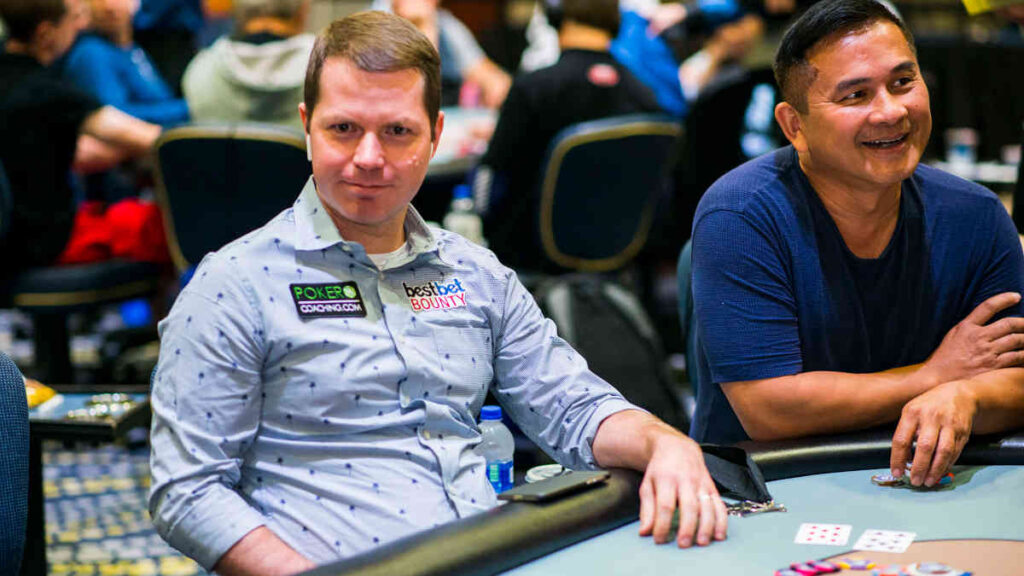
Everyone at the table deals with the same variance you do. If your opponents lose their minds after losing two flips in a row and you don’t, you profit from that difference alone.
A strong regular who is stuck and chasing can be the softest spot in the game that night.
Signs an Opponent Is Tilting
- They just lost a big pot, especially to a bad beat or to a player they have history with.
- They’re stuck a lot. Players who are losing big tend to play worse than players who are losing a little.
- There’s been trash talk or a confrontation.
- They’re drinking heavily, or they arrived already rattled.
- They’re betting without looking at the board.
How to Adjust
The adjustment depends on which way the player is tilting, so work that out first.
If they’re doing the betting for you, don’t raise them out of the pot. Eric Persson and Alan Keating played a hand at Hustler Casino Live that shows why.
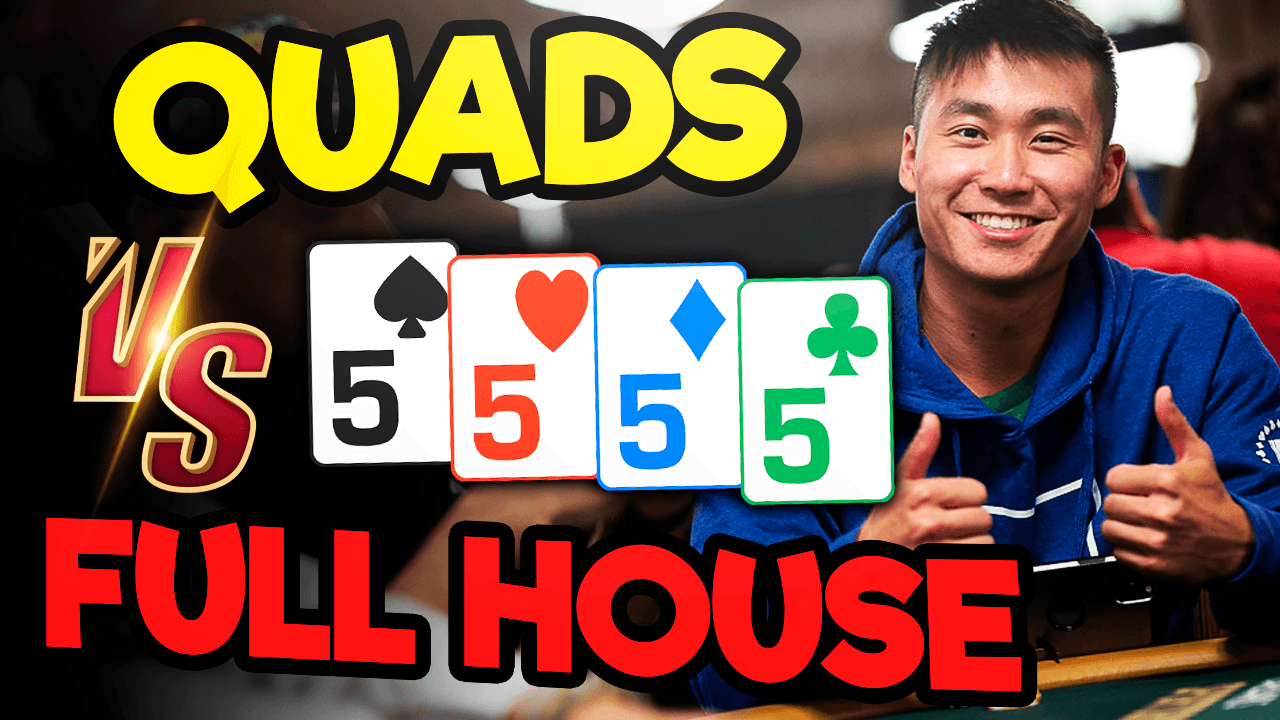
Persson raised before the flop with ace-queen and Keating called with pocket fives. Persson then bet before the flop was dealt. It came jack-five-deuce, giving Keating a set.
Betting blind is usually a sign that a player is on tilt, or that they hold a huge hand and don’t care what comes. With a set, the right play against either is to just call and keep them in. Keating did. Persson bet the turn blind as well and moved all in on the river, and Keating called with a full house.
If the tilted player has stopped folding instead, the adjustment runs the other way. Bluffing someone who is call-happy gives money away, so save your bluffs and bet your good hands. You can often bet them bigger, too, because a player who is stuck and annoyed may pay off more than usual.
These are the adjustments the examples point to, not fixed rules. Confirm what the player is actually doing before you lean on them.
Don’t Assume Tilt That Isn’t There
The stronger your opponent’s mindset, the less yesterday matters to them.
Brad Owen had a heavy losing session at The Lodge and came back the next day. On the second hand he ran a multi-street bluff, and his opponent folded three of a kind on the river. A strong player still bluffs in good spots, whatever happened the day before.
A recreational player on a three-day poker trip who isn’t used to big losses is different. They may well sit down already tilted. Read the player in front of you.
Common Mistakes Players Make With Tilt
- Relying on willpower. “Don’t tilt” isn’t a plan. A stop-loss, a quit time, and a routine you run every time are.
- Playing on to get even. No session has to end at zero. Chasing it is how one bad night wipes out several good ones.
- Bluffing the tilted player. Angry players call. Value bet them instead.
Final Thoughts on Poker Tilt
The most useful thing you can do about poker tilt is decide your rules before the session starts. Know your stop-loss, your quit time, and your own first warning sign.
At the table, your only job is to notice the sign and run the routine before it reaches your decisions.
Do that consistently and tilt stops being something that happens to you. It becomes something that happens to the other players, and one of the more reliable edges you have.