Ask a room full of poker players which hand they hate most, and someone will say ace-king. They get it all in, lose a flip, miss the flop, and decide Big Slick is overrated.
It isn’t. Ace-king is one of the most profitable hands you can be dealt in No-Limit Texas Hold’em. Players who lose with it are almost always making the same three mistakes.
This guide covers what makes Big Slick in poker so strong, how to play it before the flop at different stack depths, when to fold it, and how to play it after the flop when you hit and when you miss.

What Is Big Slick in Poker?
Big Slick is the nickname for ace-king, the strongest starting hand that isn’t a pair. You’ll see it written as AK, with AKs for ace-king suited and AKo for ace-king offsuit. If you’re curious where the name and the other nicknames come from, our list of poker hand nicknames has the story.
You’ll be dealt ace-king about once every 83 hands, and ace-king suited about once every 331.
How Strong Is Ace-King?
Ace-king is ranked fourth among Texas Hold’em starting hands, behind only aces, kings and queens. Here’s how it does all in before the flop.
| Ace-king against | Ace-king offsuit wins about | Ace-king suited wins about |
|---|---|---|
| A small pair like 2-2 | 47% | 50% |
| Q-Q | 43% | 46% |
| K-K | 30% | 34% |
| A-A | 7 to 12% | 12% |
| A-Q | 74% | 75% |
Two things jump out. Against any pair, ace-king is at best a coin flip. And against the one hand it dominates, ace-queen, it’s a big favorite.
That tells you most of what you need to know. Ace-king loves playing against a wide range full of weaker aces and kings. It hates playing a huge pot against a tight range full of big pairs.
How to Play Ace-King Before the Flop

Opening and Facing a Raise
When nobody has raised, open ace-king from every position. In the PeakGTO 100 big blind cash game charts, both suited and offsuit ace-king raise from every seat, with the small blind’s offsuit ace-king being the only exception, where it mostly limps.
When someone opens in front of you, 3-betting is usually right, but not always. In the 100 big blind chart for the hijack facing a lojack open, ace-king suited 3-bets most of the time and offsuit ace-king 3-bets about two-thirds of the time, calling the rest. Calling some of the time keeps your calling range strong and your opponent guessing.
When You Get 3-Bet
This is where players start losing money with ace-king. They open, someone 3-bets, and they automatically 4-bet and get it all in.
Deep stacked against a reasonable player, that’s usually a mistake. If you open from a tight early position and the small blind 3-bets you, their range should be tight too. When you 4-bet, the hands that put the rest in are aces, kings, queens and ace-king, and against that range Big Slick is in bad shape.
Calling is often better. It keeps all the weaker aces, suited kings and ace-queen in their range, and against those hands ace-king is a big favorite.
Here’s the 100 big blind cash game chart for the cutoff facing a small blind 3-bet.
Show Image
Notice that ace-king suited just calls every time, and ace-king offsuit splits roughly half 4-bet and half call. Even pocket aces sometimes just call. You’d rather play a medium-sized pot with a big edge than a huge pot with a small one.
When There’s a 4-Bet or Big Action in Front of You
If you’re the one who 3-bet and your opponent 4-bets, the PeakGTO charts get much more aggressive with offsuit ace-king at 100 big blinds, putting it all in most of the time. One opponent showing strength once is not enough to fold Big Slick.
When two players show strength, it’s different. If one player 4-bets and another shoves, or there’s a raise, a 3-bet and a 4-bet before it gets to you, their ranges are aces, kings and little else. Ace-king and even queens become folds.
The deeper the stacks, the more this matters. At 200 big blinds against players who only 4-bet the nuts, folding ace-king is often right.
Short Stacked in Tournaments
With 30 big blinds or less, everything changes. Ranges are wider, there’s less money behind, and ace-king’s equity is worth getting in. In the PeakGTO tournament charts at 20 and 30 big blinds, ace-king goes all in every time it faces a 3-bet and calls every time it faces a shove. Check the right preflop charts for your stack depth, but at short stacks ace-king is an all-in hand.
How to Play Ace-King After the Flop

You’ll flop a pair or better about one time in three. The other two times you have ace-high, and how you play those flops decides whether ace-king makes you money.
When You Miss the Flop
When you miss, ace-king is a medium-strength hand. Ace-high often wins at showdown when the pot stays small. It rarely wins when the pot gets big.
That means you don’t need to continuation bet every flop. On low, connected boards like 8-6-3 or 6-5-3, the big blind’s calling range hits much harder than yours. If you bet and get check-raised, you’re in a terrible spot. Checking back keeps their weak unpaired hands in, gives you a free card to hit your ace or king, and often lets you pick off a bluff later.
Be even more careful multiway. If you raise and three players call, a missed ace-king is just ace-high against three ranges. Check, and if someone bets into the field, let it go.
The flip side is calling down when it checks through. If the flop and turn check and your opponent bets the river on a blank, ace-high often beats their missed draws. Pot odds mean you don’t need to be good very often.
When You Hit Top Pair Top Kicker
This is the other big leak. Players flop top pair top kicker, get scared of not getting paid, and bet small or slow down.
Top pair top kicker against a wide range is a premium hand. Bet big. On a board like A-10-2 or A-9-7 with draws around, bet on the larger side of the flop, bet big again on the turn, and plan to get all the money in by the river. Your opponent’s second-best aces and draws are going to call anyway, so make them pay the maximum.
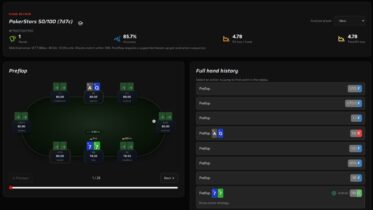
Here’s a small-stakes cash game hand that shows it. Ace-king suited raises and the big blind calls. The flop comes A-9-7 and the big blind checks. Hero bets $8 into $13. The turn is a four, the big blind checks again, and hero overbets to $35 into $29. The river is a two and hero shoves $151 into a $99 pot. The opponent calls with A-4.
Because hero bet big on the flop and turn, there was enough in the pot to shove the river. Compare that with a player who held the same hand on an A-10-2 board, bet $3 into $13 on the flop, $10 on the turn and $25 on the river, and got called by ace-four. Same kind of opponent, a fraction of the money.
When I’ve played small-stakes online cash games recently, this is the leak I see more than any other with ace-king. Players get the money in preflop when they shouldn’t, then refuse to put it in after the flop when they finally have the best hand.
When Top Pair Isn’t That Good
Top pair top kicker drops in value when the board gets scary. If the turn and river complete obvious straights and flushes, hands well above one pair in the poker hand rankings, and your opponent suddenly bets big, slow down. Most players don’t run big river bluffs when they could easily have the nuts against you. A single straight card on a random river is not a reason to stop betting.
Common Ace-King Mistakes
- Getting it all in deep against tight ranges. Call 3-bets more often and fold when two players show big strength.
- Continuation betting every missed flop. Check boards that favor your opponent’s range, especially multiway.
- Betting small with top pair top kicker. Bet big and build the pot toward an all-in.
- Folding ace-high too easily when it checks down. Against a river stab after a lot of checks, ace-high is often good.
Conclusion
Ace-king makes money when you treat it as two different hands. With top pair top kicker or better against a wide range, bet big and get paid. When you miss, or when the action tells you your opponent is very strong, keep the pot small or fold.
Before the flop, raise it everywhere, don’t rush to get it all in deep stacked, and respect big action from more than one player.
Once you stop overplaying it preflop and underplaying it postflop, Big Slick goes from the hand you complain about to one of your biggest winners. If you want to see a full solver breakdown of a missed flop, our hand review of ace-king offsuit from the lojack is a good next step.