Try This Hand Yourself
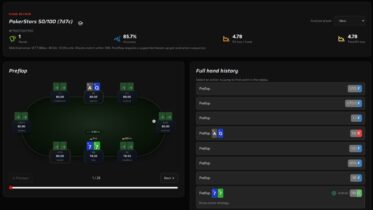
Play this exact spot against the solver in PeakGTO before reading the analysis.
Calling a bet on one street does not commit you to calling on the next. Players talk themselves into stacking off with top pair because they “already put money in,” as if each call were a down payment on the next one. The opposite is true. A hand can be a clear call on the flop and turn and a clear fold on the river, and recognizing when the opponent’s aggression has crossed from polarized to purely value-heavy is what saves a stack. This hand walks through exactly that progression with top pair, a marginal kicker, and an opponent who keeps firing.
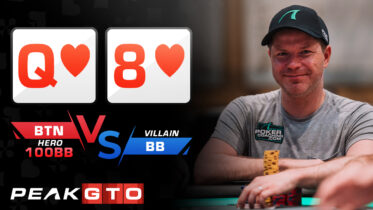
Today we will analyze a 100bb 8-handed cash game hand where the button opens Q♥8♥, flops top pair on Q♣6♦4♥, gets check-raised, and then has to navigate a big 9♠ turn bet and a 2♠ river jam. This hand shows how top pair, marginal kicker plays when facing a check-raise: why it calls the flop, why it continues against a pot-sized turn barrel, and why folding the river jam is the right exploitative play even after committing on the earlier streets.
Assumptions
- Stacks: 100bb effective
- Format: 8-handed cash game
- Positions: BTN (Hero) vs BB (Villain)
- Action: BTN raises, BB calls
- Flop: Q♣6♦4♥ (Pot: 6.5bb)
- Turn: 9♠ (Pot: 20.9bb)
- River: 2♠ (Pot: 62.7bb)
Preflop
From the button, Q♥8♥ opens routinely and the big blind calls. We take a flop in position with a hand that flops a strong, if not premium, top pair.
Flop: Q♣6♦4♥
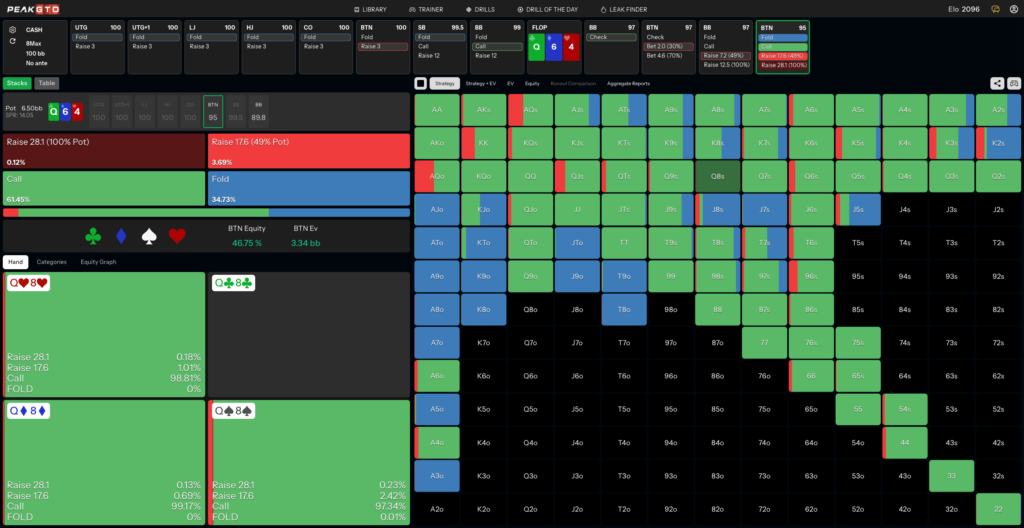
Hero flops top pair with an eight kicker. The button is not heavily favored with its entire range here, but the middle and top of that range is well ahead, since it holds many more pairs and top pairs than the big blind. So the play is not to bet everything, but to bet the best hands, and Q8 mixes, continuation betting about 68% of the time and usually for a small size. The small size is reserved for the nutted hands and the good but non-premium top pairs like QT, Q9, and Q8, while a bigger size carries the polarized mix of premiums and bluffs. Hero bets small, and the big blind check-raises to 7.2bb.
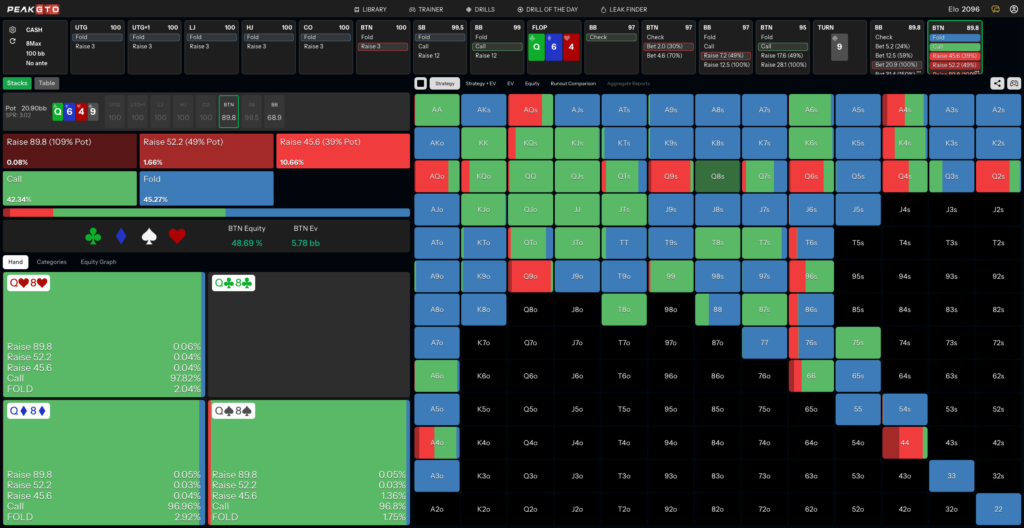
Facing the check-raise, the first question is whether the opponent is raising the correct range. On Q6-four, most players find the value raises, sets and two pair, and the obvious draws like the open-ended 75 and the 87 gutshot, but they tend to miss the non-obvious bluffs such as K5, K7, or A3 with a backdoor flush draw. That means a typical opponent’s check-raising range is lighter on bluffs than the solver assumes, so you should call a touch tighter than the equilibrium suggests. Even so, Q8 is far too good to fold. It smashes every draw in the raising range, and the solver continues with essentially any pair. Re-raising is not the answer either, since the solver’s re-raise range is a tiny value-only range, around 3.6% of hands (the strongest top-pair queens like AQ, an overpair like kings, and the occasional QJ), and Q8 is not strong enough to join it. Against a polarized opponent Hero simply calls.
Q8 sits at the strong end of the continuing range that PeakGTO defends against the check-raise, holding roughly 47% equity against that range as a whole, behind the value but well ahead of the draws. Beyond the raw equity, the real edge in flat-calling is positional. It keeps the opponent’s bluffs in the pot, controls the size, and leaves Hero with position and the option to reassess on every later street. Acting last on every subsequent street is precisely what makes the call comfortable, since Hero sees what the big blind does before committing another chip. The call also sets up the hand’s implied odds: if a queen or an eight arrives later, Hero is well placed to extract more, and if the action escalates instead, position gives Hero the cleanest possible spot to fold. That flexibility is exactly what a strong-but-not-premium hand wants when it is unsure how committed it should be.
Turn: 9♠
The 9♠ arrives and the big blind continues with a pot-sized bet. By now the opponent’s range should be very polarized: a good queen or better, or a draw with equity. The hands that keep betting are the sets, two pair, and better holdings, plus the straight draws like 87, 75, and 53, joined by the occasional KJ or T7 that just picked up a gutshot. The hands that did not improve, like K5 or K7, should give up. Against that polarized barrel, Q8 is still a call. The stack-to-pot ratio also matters here: with the pot already near 21bb and roughly 90bb still behind at the decision point, calling the turn does not yet pot-commit Hero, and after the call roughly 70bb remains, which preserves a genuine fold option for the river rather than turning the call into an automatic stack-off. The GTO solution continues with Q8 the vast majority of the time, where weaker queens like Q3 start to fold more often. Hero calls.
This is where opponent reads matter most. The reason to call the flop check-raise in the first place is implied odds: if Hero spikes a queen or an eight, the hand is usually best and stacks the aggressor. When the turn bricks and the opponent keeps blasting, those implied odds evaporate, which is why folding a queen here against a tight, straightforward player who only barrels with the goods is a perfectly reasonable exploit. The solver does not have that read and continues, but in practice, against the segment of the field that is never out of line, letting the queen go on the turn is fine. This time Hero calls and goes to the river.
River: 2♠
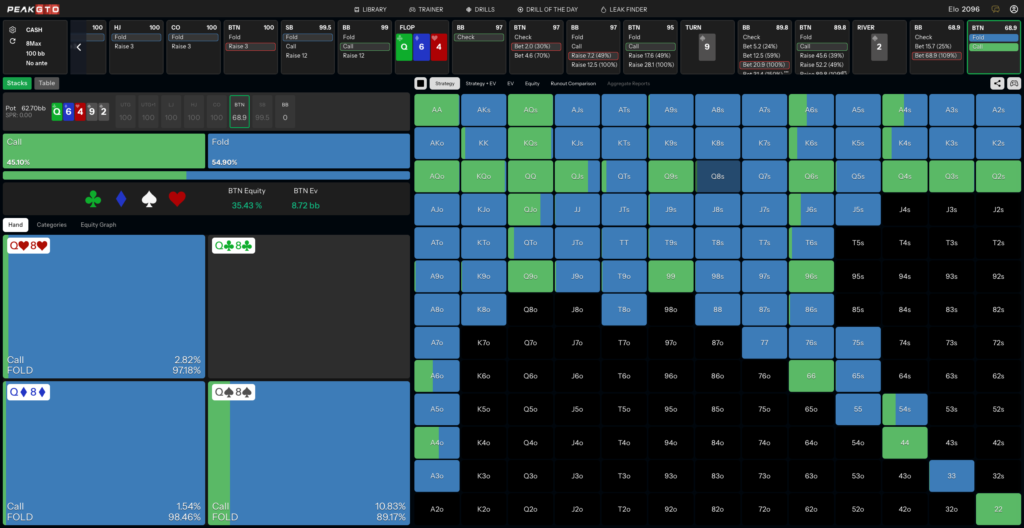
The 2♠ is a blank that is great for the big blind, because all of its good hands are still good and its remaining busted low straight draws should rip it in as bluffs. The likely jamming range is sets, two pair, the made straight 53 (filled on the deuce), and the logical busted low draws like 75 and 87. The non-obvious bluffs that might have balanced it, like K7 or A3, would have given up by now, and most players never had them in the first place. Facing the all-in, Q8 simply folds.
It can feel nitty to call the flop, call the turn, and then fold top pair on the river, but the opponent has handed you very clear, aggressive information that they like their hand. This is an exploitative overfold, and it is grounded in a simple population read: most players, at small, medium, and even high stakes, do not enjoy jamming the river as a pure bluff. They prefer to put their stack in with a hand that wants a call, which means a real opponent’s jamming range is even more value-heavy than the solver’s. The pot odds only require you to be good about a third of the time, so against a wild, aggressive opponent who barrels weak hands you should call, but against a straightforward player you fold every time. Hero folds, and the hand is over.
Key Takeaways
- Flop: On Q♣6♦4♥, Q8 bets small as a good non-premium top pair, then calls the check-raise about 99% of the time because it crushes the draws and re-raising would be far too thin.
- Turn: The 9♠ pot-sized barrel comes from a polarized range, and Q8 calls the vast majority of the time. Against a tight player who only blasts the goods, folding the queen is a fine exploit.
- River: The 2♠ jam is value-heavy, so Q8 folds. It is an exploitative overfold based on the read that most players do not jam rivers as bluffs.
- Overall: Calling early streets does not commit you. Top pair with a marginal kicker calls a flop check-raise and a turn barrel, then folds the river jam when the opponent’s aggression caps out as value. Read the population, not just the cards, and let each street’s decision stand on its own merits.