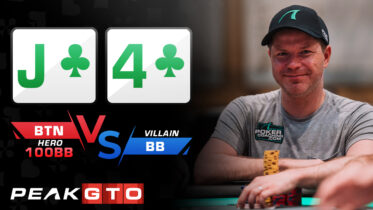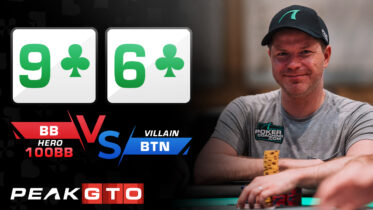
Try This Hand Yourself
Play this exact spot against the solver in PeakGTO before reading the analysis.
The most profitable bluffs are usually set up streets before the chips actually go in. When you defend the big blind against a button that is opening a very wide range, the hands you choose to continue with on the flop quietly determine which rivers you get to attack later. Pick the right weak continues and you will find yourself with a perfect candidate for an overbet bluff on exactly the cards your opponent cannot withstand. Pick the wrong ones and you arrive at a great river with nothing credible to bet. This hand is a clean example of that whole chain, from a humble flop call to a pot-burying river overbet.
Today we will analyze a 50bb tournament hand where we defend J9o with a spade in the big blind against a button open, call a small flop continuation bet on A72 with two spades, check through a blank turn, and then face a river that completes the flush and pairs the board. With total air but the right blockers, the correct play is to fire a large overbet bluff and take the pot away. We will trace the flop defend, the turn check, and the river sizing decision that ties it all together.
Assumptions
- Format: MTT, 50bb effective stacks
- Hero: J♠9♦ in the big blind (BB)
- Villain: button (BTN), the preflop raiser
- Preflop: folds to the BTN who opens to 2.2bb, BB calls. Single-raised pot
- Flop: A♠ 7♠ 2♥ (two-tone), pot 5.9bb. BB checks, BTN bets 1.5bb, BB calls
- Turn: 6♥, pot 8.9bb. BB checks, BTN checks back
- River: 2♠ (third spade, pairs the board), pot 8.9bb
Preflop
The button opens and the action folds to us in the big blind. Because the button is raising a very wide range and we are getting a great price to close the action, J9o is an easy call. The key is that we are not defending blindly. We are defending because hands like this give us a way to fight for pots later, and because the looser our opponent’s opening range is, the more our marginal defends overperform against the weak holdings they show up with. We take the discounted flop and look for a board that interacts with our range.
Flop: A♠7♠2♥
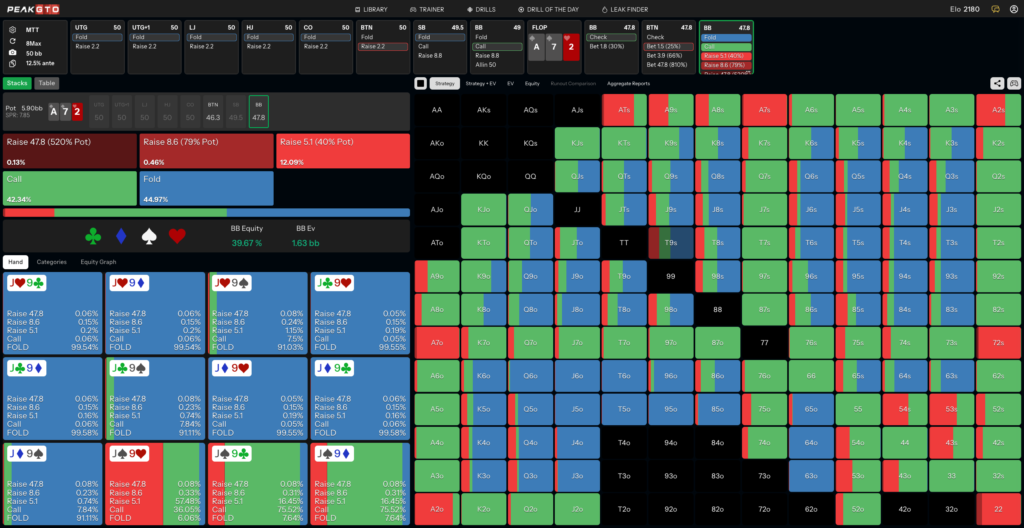
The flop comes A♠ 7♠ 2♥, a two-spade board, and the pot is 5.9bb. We check and the button fires a small continuation bet of 1.5bb, about a quarter of the pot, which they will do close to every time on an ace-high board. Now we have to think carefully about which hands defend. The useful study question is, what are my weakest continues here? On a board like this, the answer is the backdoor hands with a spade: 89 with a spade, J9 with a spade, JT with a spade, and QJ with a spade. The spade matters because it adds a backdoor flush draw on top of two overcards, and that combination is what earns a marginal hand a spot in the defending range.
Our exact combination is J♠9♦, which holds the spade and therefore defends about 92% of the time, mostly calling and occasionally check-raising. That detail is worth stressing: the J9 combinations without a spade fold roughly 99% of the time, while the J-of-spades versions continue. We are not calling because we expect to make a big hand and stack off across future streets. We will actually fold most turns to further aggression. We are calling because this hand gives us board coverage and bluffing potential across a lot of runouts, and because the button’s check-back range is going to be too weak to defend the pot when good cards arrive. Check-calling is the most natural choice, and we take a turn.
Turn: 6♥
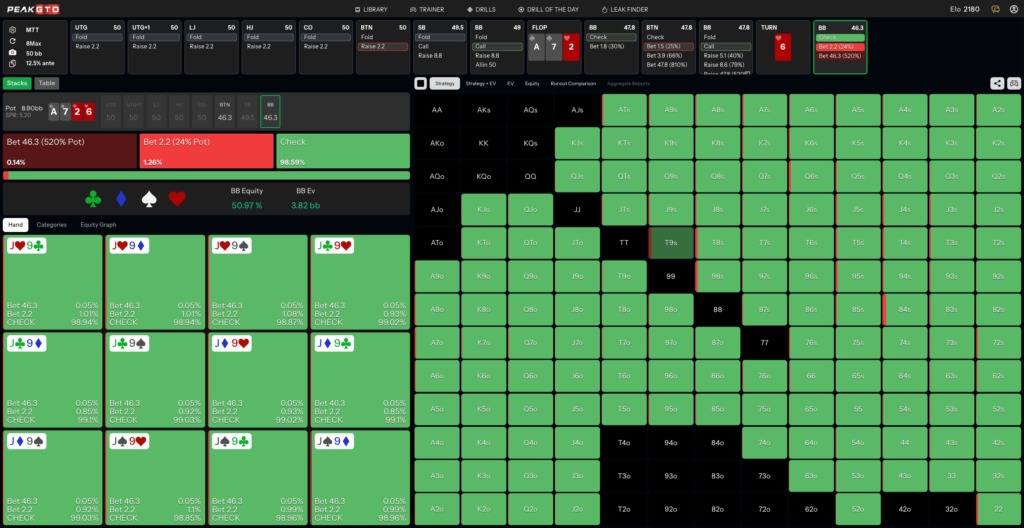
The turn is the 6♥, a complete blank for our hand. We have not improved, we still have only jack high, and there is no reason to turn a hand with this much give-up frequency into a bet here. We check almost 99% of the time, and the button checks back a capped range, since the strong hands would keep barreling. The pot stays at 8.9bb, and crucially the turn checking through is exactly what loads up the river. The button has now told us that their range is capped, full of the offsuit king-high and queen-high hands that did not want to barrel. A solver such as PeakGTO confirms that the big blind should be checking nearly its entire range on this turn and waiting to attack on the right river. We do exactly that.
River: 2♠
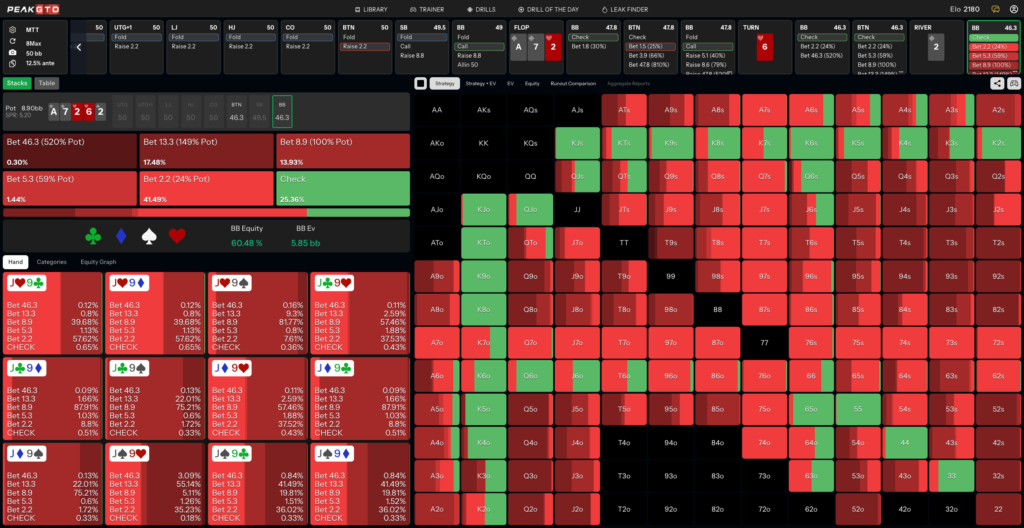
The river is the 2♠, and it is a dream card for the big blind. It brings the third spade, completing the flush, and it pairs the board, putting trips and full houses in play. This is a very high expected value river for us, because our range can credibly represent all of those big hands while the button’s capped range cannot. Our betting frequency wants to be extremely high. Our value bets are the made flushes and the deuces for trips, plus some ace-x and seven-x hands, and our bluffs are the busted backdoor draws we so carefully kept on the flop. Our range bets about 75% of the time here, and with J♠9♦ we have total air but the right blockers, so our exact combo is a clear bet.
The sizing is where the real lesson lives. The way to choose how a bluff fits into the range is by its blocker quality: the better your blockers, the larger you want to bet. A hand with bad blocker properties, such as QJ with a heart, actually blocks the KQ and KJ combinations that the button needs to be folding, so it gets slotted into a small block bet that bluffs for a cheap price. Our hand is the opposite. J♠9♦ holds no king and no queen, so we unblock all of the offsuit king-x and queen-x hands the button wants to fold, and the J♠ blocks some of their would-be made flushes. Those are excellent blocker properties. Across our whole betting range the solver splits the sizing: the small 2.2bb block is the most-used size at about 41%, a pot-sized 8.9bb bet about 14%, and the 13.3bb overbet, roughly 1.5x pot, about 17%. The point of that split is which hands get routed where. Hands with poor blockers fill the cheap small block, and hands with excellent unblocking properties get routed into the larger sizes, which is exactly where J♠9♦ belongs. A practical simplification is to merge toward a single large size, something like a 145% pot overbet, so you do not have to juggle multiple sizings at the table.
The reason the overbet works is that it puts maximum pressure on a range that simply cannot continue. When we understand the pot odds we are laying the button, a pair of sevens or a missed king-high is priced out of calling an overbet on a paired, flush-completing board. The button folds, and our flop discipline cashes in. We had nothing, but we had the perfect nothing.
Key Takeaways
- Flop: Defending the big blind against a wide button means continuing with your strongest weak hands. J9 with a spade calls about 92% on A72, while the non-spade combinations fold, because the backdoor flush draw is what earns the defend.
- Turn: On the blank 6h we check nearly 100% and keep the pot small. The turn checking through caps the button’s range and sets up the river attack.
- River: The 2s completes the flush and pairs the board, so our bet frequency is high, around three-quarters. With J9 we have air but great blockers, unblocking the button’s folding hands, so we choose the overbet.
- Overall: Strong GTO play is a chain of decisions. The flop call you make for board coverage is what gives you a credible, well-blocked overbet bluff three streets later.