Try This Hand Yourself
Play this exact spot against the solver in PeakGTO before reading the analysis.
Not every turn card is created equal. When you fire a continuation bet on a low flop and get called, the card that comes next decides whether you keep firing or shut down. The best turns to keep barreling are high overcards that miss your opponent’s range while still giving your own range plenty of equity. On those cards a gutshot is happy to put in a second barrel, because the fold equity is high and the draw is live. This cash game hand shows exactly which turn card turns a marginal flop into a profitable double barrel.
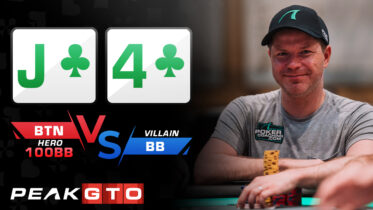
Today we will analyze a 100bb 6-handed hand where Hero opens J♣4♣ on the button, the big blind calls, and the board runs 3♣6♦7♥, T♠, Q♥. Hero has a gutshot to the straight and c-bets the flop, then keeps barreling when the ten overcard arrives, and shoves the river when the draw misses. This hand shows why a low flop is still a c-bet, why the ten is the ideal turn to keep firing, and why a busted gutshot becomes an overbet shove.
Assumptions
- Stacks: 100bb effective
- Format: 6-handed cash game
- Positions: BTN (Hero) vs BB (Villain)
- Action: BTN raises, BB calls
- Flop: 3♣6♦7♥ (Pot: 5.5bb): BB checks, BTN bets 5.5bb, BB calls
- Turn: T♠ (Pot: 16.5bb): BB checks, BTN bets 16.5bb, BB calls
- River: Q♥ (Pot: 49.5bb): BB checks, BTN shoves 75.5bb
Preflop
Hero opens J♣4♣ to 2.5bb on the button and the big blind calls. In these 6-max 100bb cash games with rake, the big blind defends a tighter range than it would in a tournament, folding hands like 54o and 76o that would defend for a better price in a different format. That detail matters, because it means the caller will arrive on low boards without many of the connected hands that smash them. Hero’s position and initiative do the rest.
Flop: 3♣6♦7♥
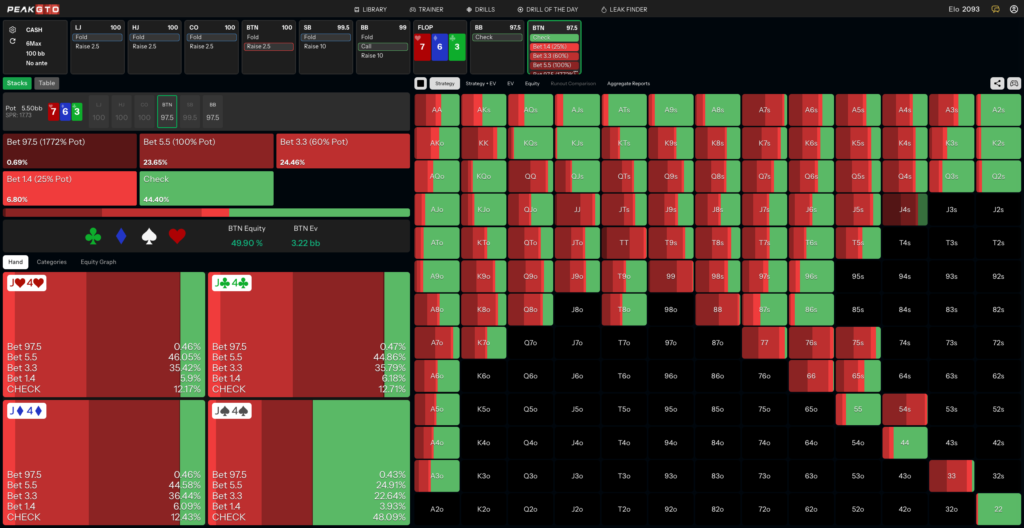
The big blind checks its entire range, since there is no reason to lead into the preflop raiser when deep. Hero holds J♣4♣, a gutshot to the straight, since any five completes the 76-54-three, plus a backdoor club flush draw. This is a board to bet a polarized continuation bet range of overpairs, top pairs, and middle pairs for value, plus a clean set of bluffs. The most logical bluffs are the overcard hands like T9 and T8 and any hand with a five or a four.
J♣4♣ is one of those bluffs, and the backdoor flush draw makes it noticeably better than the same hand without one. The club version bets around 88% of the time, while J♠4♠, with no backdoor flush, bets closer to half. When the board is not great for your range, the extra backdoor equity is exactly what tips a marginal bluff into a clear bet. Because the betting range is polarized and includes genuine nut hands like 54s, 76, and 33, Hero leans toward a larger size and bets the pot, 5.5bb. The big blind calls.
Turn: T♠
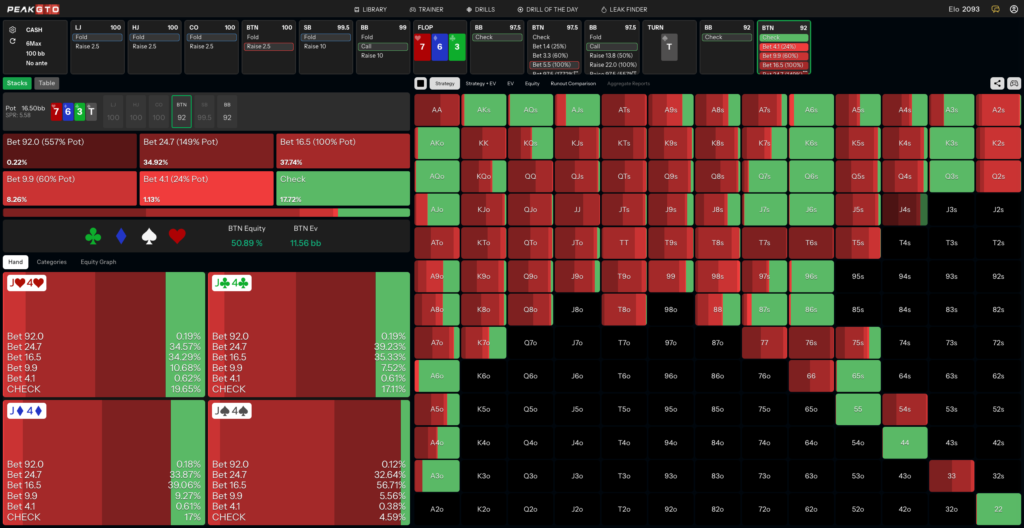
The T♠ is the card the whole hand turns on. The ten barely connects with Hero’s range and does not connect with the opponent’s range at all, which is exactly what makes it a great barreling card. The principle is broad: whenever the turn is a high overcard to a low board, you keep betting very frequently, because you c-bet the flop with hands like KT, QT, JT, and T9 that now make top pair, and your overcard bluffs like KQ and KJ pick up real equity. PeakGTO bets this turn around 82% of the time.
It is worth contrasting the ten with other turns to see why it is special. A queen or king would also be bet often, but a king gives the big blind a few more top pairs to defend with. An ace, counterintuitively, is a card to slow down on, because it strips the improvement potential from the overcard bluffs that needed to pair. The ten keeps everything alive: hands like QJ and Q9 still have outs, and the made hands can value bet because the big blind rarely has a ten after calling a pot-sized flop bet. Hero bets the pot again, 16.5bb. J4 keeps the same gutshot it had on the flop, and as a member of the barreling range it fires roughly 80% of the time. The big blind calls, and the pot reaches 49.5bb.
The general test for a good barreling card is simple: does it improve your range relative to your opponent’s, or does it help the caller? A high overcard to a low board almost always improves the in-position raiser, because you arrive on the turn with the broadway hands that just made top pair and the overcard combos that gained equity, while the big blind, who called a flop bet with pairs and draws, gains nothing from a ten. Cards that pair the board or complete the obvious draws do the opposite, handing equity and confidence to the defender. Running every turn through that one question, rather than reacting to whether your own specific hand improved, is what keeps your barreling disciplined and profitable.
River: Q♥
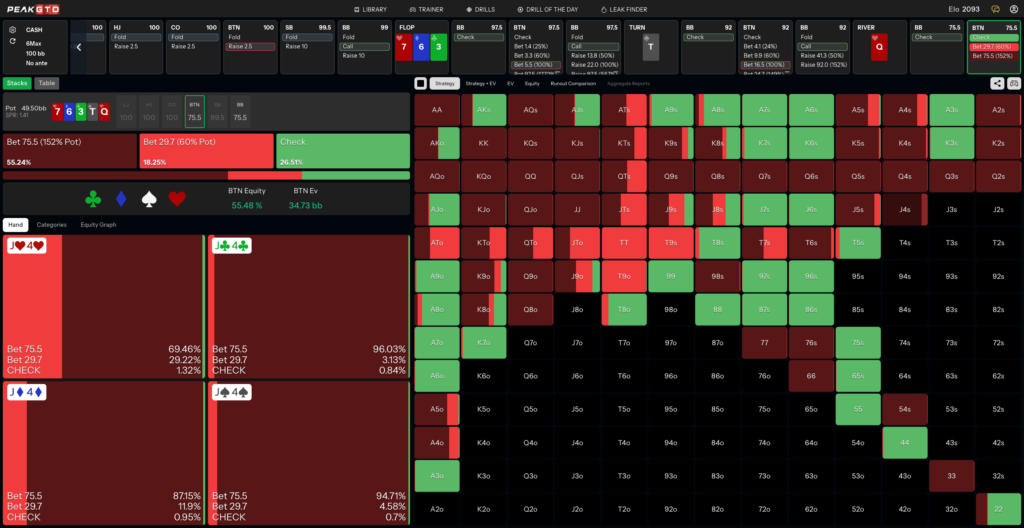
The Q♥ is another overcard, and the big blind checks again. Hero gets to keep betting around 73% of the time, in part because some of the bluffs from the turn just made top pair with the queen. The river is very polarized: the strong hands, a good queen or better, want to shove, while hands like T9 prefer a smaller value bet that worse hands can call. J4, however, has nothing, and a busted draw at the top of a polarized range is a natural bluff.
Hero ships it for 75.5bb into the 49.5bb pot, an overbet of about 1.5 times the pot. The solver does split sizes, sending some four-containing bluffs to a smaller bet and the rest of the busted draws all in, but as a practical matter shoving J4 is the clean and effective play. The GTO reason is that both the turn and river brought overcards the big blind rarely holds, so its range is full of hands like a bare seven or six that have to make a tough decision. The big blind folds about 62% of the time, and against most real opponents who overfold to a big shove, the bluff performs even better. The same gutshot that started as marginal air ends up applying maximum pressure, all because the turn was the right card.
Key Takeaways
- Flop: On 3♣6♦7♥ the button bets a polarized range, and the gutshot J♣4♣ is a clear bet because the backdoor flush draw pushes it to about 88%, well ahead of the no-backdoor version.
- Turn: The T♠ is a high overcard that misses the big blind entirely while giving Hero top pairs and live bluffs. That is the textbook card to keep barreling, and Hero fires the pot again. A queen or king is also good, but an ace would be a reason to slow down.
- River: The busted gutshot becomes a 1.5x pot shove. Because the turn and river brought overcards the big blind rarely has, its range is full of bare sevens and sixes that fold, and the big blind gives up about 62% of the time.
- Overall: A gutshot is a barreling hand only when the cards cooperate. A high overcard that misses your opponent and helps your range is the green light to keep firing, all the way to a polarized river overbet, while a board-pairing or draw-completing card would be the moment to slow down instead.