Try This Hand Yourself
Play this exact spot against the solver in PeakGTO before reading the analysis.
The same hand on the same line can be a thin bet you should sometimes check on one river and a slam-dunk jam on another. The deciding factor is what the final card does to the draws. When a river completes a flush or a straight, the draws that get there become value hands and the opponent’s remaining bluff-catchers thin out, so their calls dry up. When a river bricks every draw, all those missed flushes and straights are still in their range with no value, and they turn into call-happy bluff-catchers. Reading that difference is everything when you reach the river with a marginal made hand.
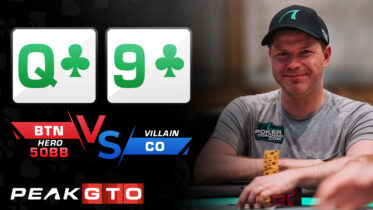
Today we will analyze a 50bb 8-handed MTT hand where the button calls a cutoff open with Q♣9♣ and plays top pair on a dynamic board (9♠8♠4♦), the 2♦ turn, and the 2♥ river. This hand, part of the [PokerCoaching](https://pokercoaching.com/dashboard) button-versus-cutoff series, shows why an uncapped opponent forces a small bet even on a draw-heavy flop, how a nut advantage drives a pot-sized turn, and why a river that bricks every draw makes top pair an easy overbet for value in a tournament.
Assumptions
- Stacks: 50bb effective
- Format: 8-handed MTT
- Positions: BTN (Hero) vs CO (Villain)
- Action: CO raises, BTN calls
- Flop: 9♠8♠4♦ (Pot: 6.9bb)
- Turn: 2♦ (Pot: 10.3bb)
- River: 2♥ (Pot: 30.9bb)
Preflop
The button flats the cutoff open with Q♣9♣, a routine call in position. The blinds fold and we take a flop heads-up against the cutoff, holding a suited hand that can make top pair or back into a draw depending on the board.
Flop: 9♠8♠4♦
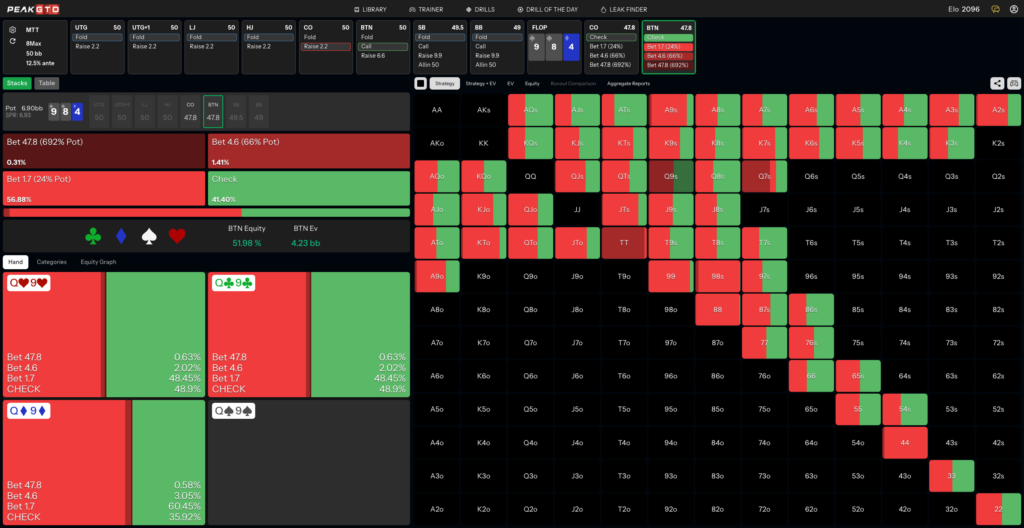
Hero flops top pair with a queen kicker on a very dynamic board, two spades and a connected 98 that bring a swarm of flush and straight draws. The cutoff checks, which it does about two-thirds of the time, and the natural instinct on a draw-heavy flop is to bet big to charge the draws. Here, that instinct is wrong, and the reason is range structure. The cutoff is checking a lot of its very good hands, so its checking range is uncapped, full of overpairs and a chunk of its sets. Against a range that strong, the principle is to bet small, because betting big only inflates the pot against the hands that beat us. This is a core tournament c-betting principle: the more often a player checks strong hands, the more uncapped they are, and against an uncapped range you bet small. So despite the dynamic texture, Hero takes the small 1.7bb size with a top pair that is good but vulnerable. The cutoff calls.
This is a great illustration of how a continuation bet size should respond to the opponent’s range rather than to the board alone. The usual rule of thumb, that wet boards want big bets, assumes the opponent is capped and you are trying to deny equity to their draws. But when the opponent has shown they will check their strongest hands, betting big mostly inflates the pot into a range that includes sets and overpairs, which is the last thing a vulnerable top pair wants to do. A small bet still charges the draws something, keeps the worse hands in, and lets Hero control the size of the pot against a range that can fight back hard. The texture matters, but the opponent’s range structure matters more.
Turn: 2♦
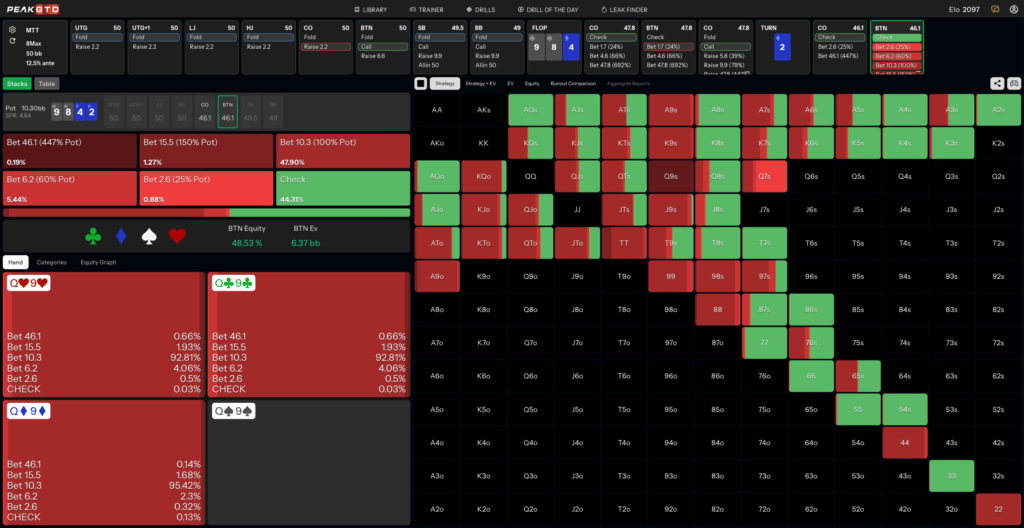
The 2♦ changes little and the cutoff checks its entire range. Hero is at a slight equity disadvantage here, but the equity graph reveals a large nut advantage at the top of the range. The button holds the sets, two pair, and strongest top pairs, and crucially the cutoff would have check-raised most of its overpairs on the flop rather than just check-calling, so the few that stayed in by checking are now a small slice and its range is effectively capped below the button’s best hands aside from the occasional set of eights or AA. Because the board is so dynamic, the bet goes large with everything Hero continues with. PeakGTO pots it, and Q♣9♣ takes the pot-sized line about 95% of the time.
This is a straightforward value bet, not a thin one. Q9 is the best hand a large share of the time, and if you ask which hands the cutoff calls the pot with that Hero beats, the list is long: many nine-x combinations, the eight-x hands, various fours, and a mountain of draws. Top pair with a decent kicker is comfortably ahead of all of that. The hands that have to be more careful are the weaker top pairs like 97, which can mix in a check, but J9 and better simply pot for value. Hero bets 10.3bb and the cutoff calls again.
The big sizing also serves the next street. By potting the turn, Hero leaves close to a pot-sized stack for the river, which sets up a clean jam without an awkward remaining bet. That geometry is deliberate: a value hand wants to get all the money in by the river when it expects to be ahead, and sizing up now rather than later is the smoothest way to do it. The dynamic board gives the bet extra force, because every spade and every straight card that the cutoff is drawing to is now being charged the maximum to continue. When you hold a clear value hand against a capped, draw-heavy range, there is rarely a reason to be timid.
River: 2♥
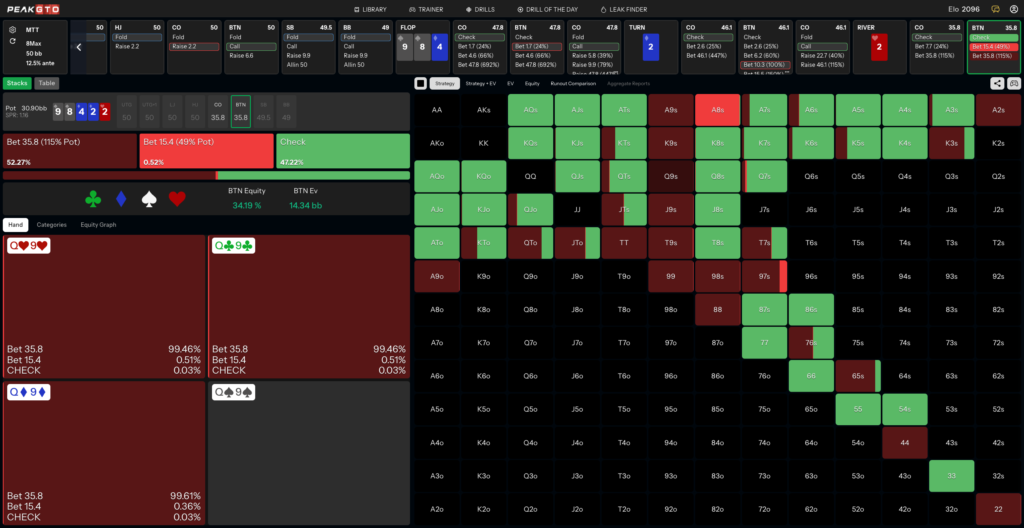
The 2♥ pairs the board and, more importantly, bricks every draw. With about a pot-sized stack behind, Hero overbet jams, and the solver agrees almost unanimously, betting Q9 close to 100% of the time. This is the key contrast with a river that completes a straight. On a board where the straight gets there, top pair is a thin bet that you sometimes check, because the opponent finds few calls with worse and the busted draws are gone. Here, on 9-8-4-2-2, the runout killed a huge number of flush and straight draws, and a player holding a busted draw has nothing to do but become a reluctant bluff-catcher.
That is exactly why the jam is a slam dunk. The cutoff arrives at the river with piles of missed draws and marginal made hands, and against an overbet jam they will call far too often with any nine, any eight, and even some underpairs. The GTO baseline has the opponent folding about 55%, but in practice they fold less, because real opponents hold more eight-x than the solver does, since GTO would lead many of those eights as a small river bet rather than checking them, while real opponents simply check-call. The overbet lays the opponent poor pot odds to call, but with this many busted draws and marginal made hands in their range, they pay it off far too often, which is exactly what makes the jam print. Notably, the bluffs that join Q9 in this jam are thin or no-showdown hands like 65, 86, and 76, not the busted flush draws. The reason is blocker logic: a busted spade flush draw removes the very combos the opponent is most likely to fold, so pure no-showdown hands make cleaner bluffs than draws that block the opponent’s folding range. Hero jams, and this time the cutoff calls a worse hand.
Key Takeaways
- Flop: On the dynamic 9♠8♠4♦, the button bets small because the cutoff checks an uncapped range full of overpairs and sets. An uncapped opponent means a small size even on a draw-heavy board.
- Turn: The 2♦ hands the button a nut advantage against the now-capped cutoff. Q9 pots about 95% of the time as a clean value bet, getting called by worse pairs and draws.
- River: The 2♥ bricks every draw, so Q9 overbet jams almost 100%. With the opponent full of busted draws, the value bet is a slam dunk, the opposite of a straight-completing river.
- Overall: Top pair on a dynamic board is all about how the runout treats the draws. Bet small against uncapped checks, barrel big with a nut advantage, and on the river read whether the draws got there. When they brick, fire for maximum value.