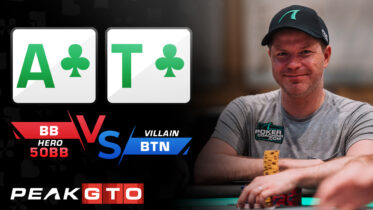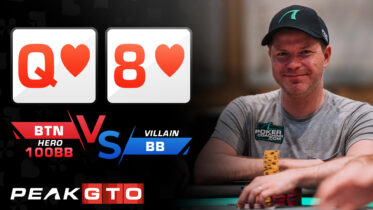
Try This Hand Yourself
Play this exact spot against the solver in PeakGTO before reading the analysis.
A weak draw is one of the most flexible hands in poker, and also one of the easiest to misplay. Fired correctly, a junky gutshot can apply enormous pressure across two streets, folding out better hands and setting up profitable bluffs. Fired carelessly, it becomes a money-burning spew on the river. The difference comes down to two ideas most players never combine: sizing your bets to the board, and matching your river bluffs to the exact cards that block the opponent’s calls. This hand puts both on display.
Today we will analyze a 100bb 8-handed cash game hand where the button opens Q♥8♥, flops a junky gutshot on J♣T♣4♦, barrels the 3♥ turn, and then faces a 5♣ river that completes a flush. This hand shows why a dynamic flop wants a big bet, why the turn is an overbet spot, and why a busted junky draw with no flush blocker has to give up on the river.
Assumptions
- Stacks: 100bb effective
- Format: 8-handed cash game
- Positions: BTN (Hero) vs BB (Villain)
- Action: BTN raises, BB calls
- Flop: J♣T♣4♦ (Pot: 6.5bb)
- Turn: 3♥ (Pot: 15.7bb)
- River: 5♣ (Pot: 62.9bb)
Preflop
From the button, Q♥8♥ is a comfortable open in a roughly 40% raising range, and against weak, tight blinds you can widen further, adding the suited cusp hands like Q8, J8, T8, and 98. The one caveat is that you do not want to open junk into players who call far too wide, since then your weak holdings get little fold equity. Hero opens, and the big blind calls. We take a flop heads-up and in position.
Flop: J♣T♣4♦
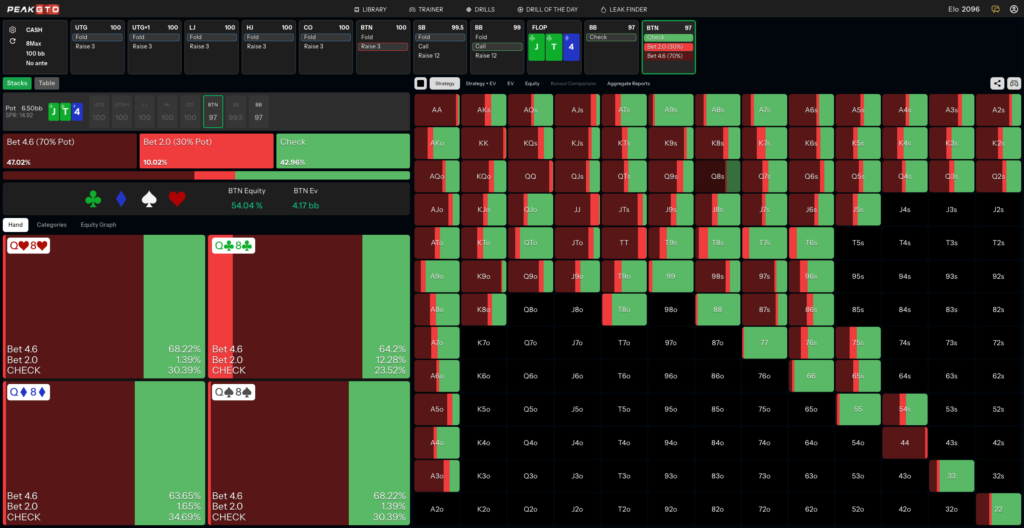
Hero flops a gutshot, needing a nine to make a straight, and it is not even a clean one, because a nine that completes the straight can also give an opponent with KQ a higher straight. This is a very dynamic, two-club board where the button has only about 54% equity, a real but modest edge. On these textures, the right approach is to continuation bet a polarized range using a large size, because a small bet on such a coordinated board invites the big blind to check-raise and put Hero in tough spots. The junky draws fit naturally into that polarized betting range, and Q♥8♥ fires the 4.6bb size, around 70% of the pot, a decent amount of the time.
The practical case for betting now is strong. In a live game, opponents fold a great deal to a 70% pot bet, and even when they call, a hand like Q8 has excellent barreling potential on the turn and river. Putting money in and applying pressure immediately is simply more profitable than checking and hoping to spike a nine. Hero bets 4.6bb and the big blind calls.
The choice of a big size over a small one is tied directly to the board and to Hero’s range. When your equity edge is large and the board is dry, a small bet lets your whole range fire cheaply. Here the edge is only modest and the texture is soaked in draws, so spreading the range across a small size would leave too many hands exposed to a check-raise and too little reward for the times you are ahead. A polarized large bet solves both problems: it charges the draws a real price, it makes your value hands maximally profitable, and it gives your bluffs, Q8 included, the fold equity they need. The size is not a coin flip of preference, it is a direct read of texture and equity.
Turn: 3♥
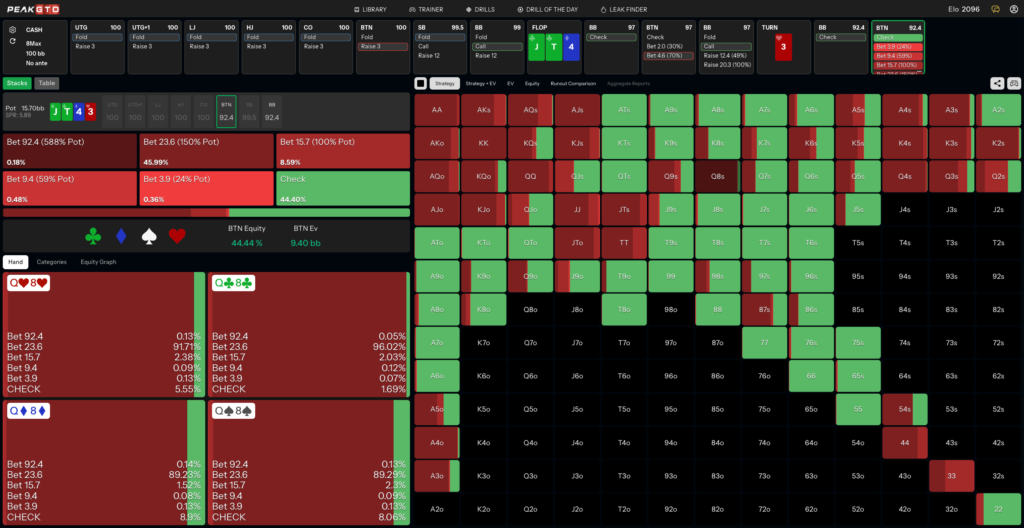
The 3♥ changes little, and the big blind checks. On a board this dynamic, with a flush draw and many straight draws the opponent can hold, the betting range stays polarized and the size goes big, in this case an overbet of about 150% of the pot. The value side is genuinely strong, KJ and better plus QJ and better, and it is balanced by draws like KQ and Q9 along with the junkier Q8 and 87. PeakGTO has Q♥8♥ blasting the overbet over 90% of the time.
The overbet is uncomfortable for many players, but it is exactly right. A large bet folds out hands like 99 and QT, and in live poker most opponents fold far too much to overbets, afraid that a big bet means a big hand. They do not realize that the bettor benefits enormously from those folds, especially when bluffing with a hand like Q8 that has almost no showdown value of its own. The pot odds a 150% pot bet lays look intimidating, which is the entire point, because it pressures the marginal made hands the gutshot needs to fold out. Hero overbets, and the big blind calls.
It is worth being precise about why Q8 in particular wants to fire rather than check. With no pair and only a gutshot, it has essentially no showdown value, so checking it back almost never wins the pot. A hand that cannot win by checking loses nothing by betting and gains all of the fold equity, which makes it a far better bluff than a hand with a sliver of showdown value that would rather see a free showdown. The gutshot also retains the backup of occasionally hitting its nine to make the second-best straight, so on the rare turn-into-river runout where it improves, it can stack a worse made hand. No showdown value plus a touch of equity is the textbook profile of a hand that belongs in the barreling range, not the checking range.
River: 5♣
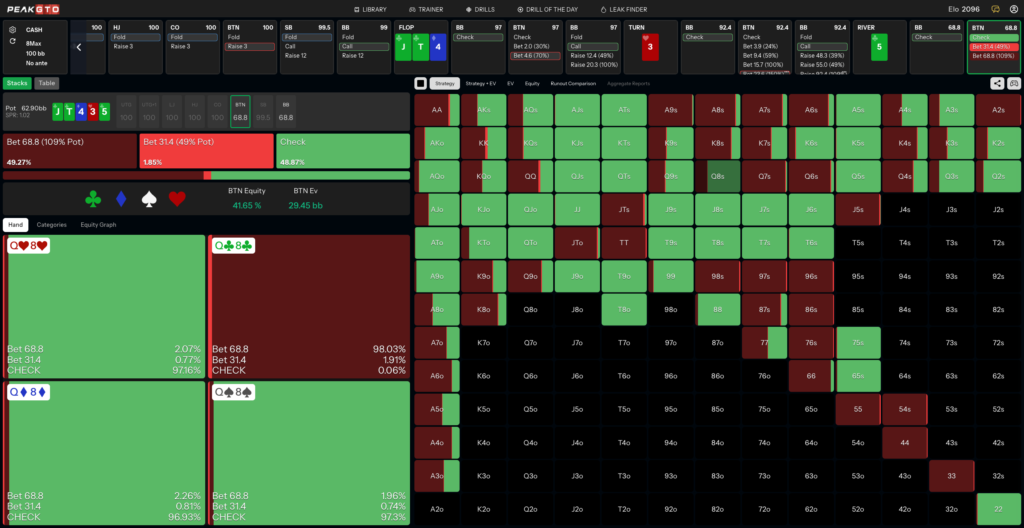
The 5♣ completes the club flush, the gutshot bricks, and this is where many players go wrong by bluffing too often. Having fired the flop and blasted the turn, the instinct is to fire a third time, but Q♥8♥ should give up. The GTO principle is to bluff with the hands that block the opponent’s auto-calls, and on a three-flush board the auto-calls are flushes. That means you need a club to bluff. The good river bluffs are hands like K9, Q9, and KQ that hold a club, along with busted-draw hands like A5 through A3 that hold the ace of clubs, using it as a nut-flush blocker. A busted straight draw with no club blocks none of the calling range, so it has to check, and Q♥8♥ is exactly that hand. The solver checks it back almost 100% of the time.
The river card flips the bluffing list entirely, which is the deeper lesson. Had the river been the five of spades, leaving no flush, Q♥8♥ would become a great bluff, and in that case holding two clubs would actually be bad, because the clubs would block the busted flush draws the opponent folds. On a flush river you bluff with the flush blockers and give up the rest; on a non-flush river you bluff with the busted straight draws and give up the flush blockers. Recognizing that the right bluff depends on the exact river, rather than mechanically firing because the board “blanked,” is what separates a disciplined triple barrel from a punt. Hero checks, and the hand is over.
Key Takeaways
- Flop: On the dynamic J♣T♣4♦, the button bets a polarized range for a large 70% pot size. The junky gutshot is a natural bet with great barreling potential.
- Turn: The 3♥ is an overbet spot at 150% pot. Q8 blasts over 90% of the time, folding out marginal made hands that live players surrender far too readily to overbets.
- River: The 5♣ completes the flush. Q♥8♥ has no club to block the auto-calls, so it gives up, checking back nearly 100%.
- Overall: Betting a junky draw is about sizing and follow-through. Bet big and polarized on dynamic boards, overbet the turn to apply maximum pressure, and on the river bluff only with the hands that block the opponent’s calls. When the flush gets there and you cannot block it, give up.