Try This Hand Yourself
Play this exact spot against the solver in PeakGTO before reading the analysis.
Top pair feels like a hand you should bet until someone stops you, but the truth is more nuanced. As the board changes, the value of top pair shifts, and an overcard on the turn can quietly demote the best pair on the flop to second pair. Knowing how to keep extracting value when that happens, and just as importantly knowing when to stop, is one of the most common and most misplayed situations in a cash game. This hand walks through top pair on a marginal turn from the first bet to the disciplined river check.
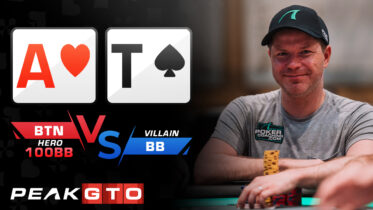
Today we will analyze a 100bb 6-handed hand where Hero opens A♥T♠ on the button, the big blind calls, and the board runs T♣6♦2♥, Q♠, 3♠. Hero flops top pair with the ace kicker, c-bets the flop, value bets the queen turn with a smaller size, and then checks back the river. This hand shows why top pair top kicker is a clear bet, why the overcard turn calls for a smaller value bet rather than a big one, and why a hand that was betting suddenly belongs in the checking range on the river.
Assumptions
- Stacks: 100bb effective
- Format: 6-handed cash game
- Positions: BTN (Hero) vs BB (Villain)
- Action: BTN raises, BB calls
- Flop: T♣6♦2♥ (Pot: 5.5bb): BB checks, BTN bets 5.5bb, BB calls
- Turn: Q♠ (Pot: 16.5bb): BB checks, BTN bets 9.9bb, BB calls
- River: 3♠ (Pot: 36.3bb): BB checks, BTN checks back
Preflop
Hero opens A♥T♠ to 2.5bb on the button and the big blind calls. ATo is a comfortable open from the button, and Hero takes the betting lead in position. The big blind defends a wide but capped range, mostly the kind of suited and connected hands that flat rather than three-bet, which means Hero will usually be ahead when this hand makes top pair.
Flop: T♣6♦2♥
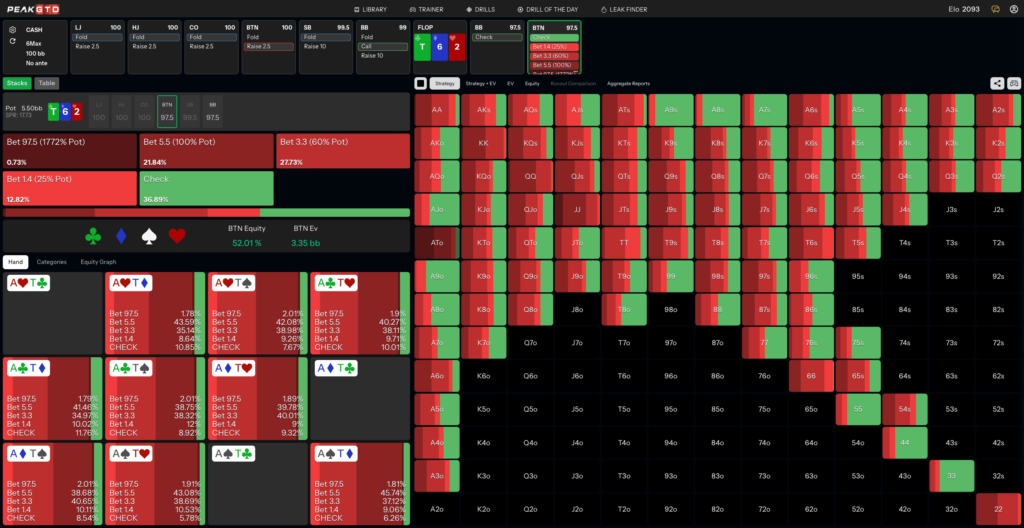
Hero flops top pair with the best kicker. The big blind checks, and this is a board where Hero bets a fairly polarized range and checks back about 37% of it, since a lot of the range is unpaired king-x, queen-x, and jack-x. Top pair top kicker, though, almost never wants to check. It is an excellent continuation bet because it gets called by all the worse top pairs and extracts value, whereas a weaker top pair like T7s would bet only about half the time to keep some strength in the checking range.
ATo also wants to use a bigger size. The heuristic is that top pair top kicker and overpairs prefer the larger bet, alongside the strongest bluffs, which here are the gutshots and the backdoor flush-and-straight draws that wrap the top card, like J9s and Q9s. Those hands bet big to fold out the opponent’s ace-highs and king-highs. Hero bets the pot, 5.5bb, and the big blind calls. So far this is a routine value bet with a strong made hand. The complication is the turn.
Turn: Q♠
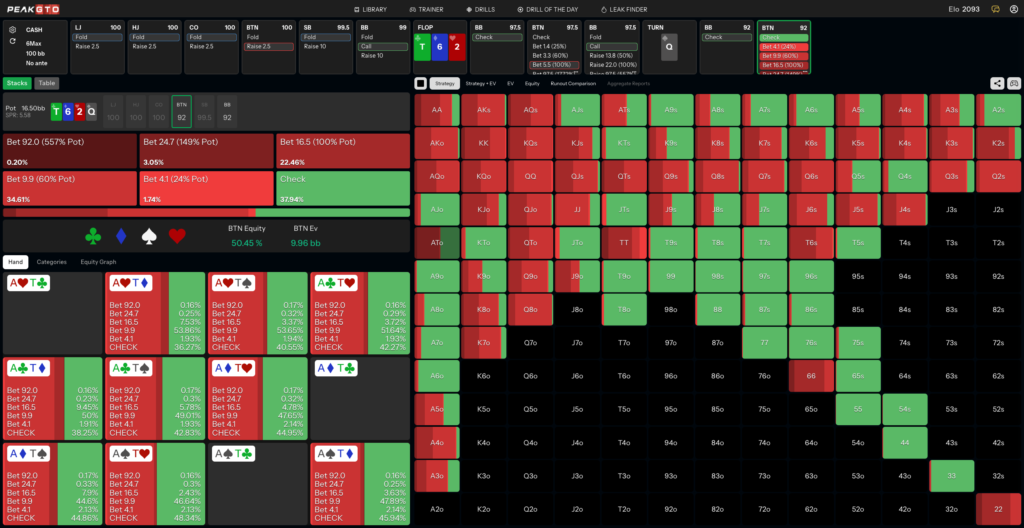
The Q♠ is the marginal card the hand is named for. It is an overcard to the tens, which technically demotes Hero from top pair to second pair, and it could improve some of the big blind’s hands. The question is whether ATo is still good enough to bet, and the answer is yes, but with care. Hero’s equity is only around 50% here, because a big chunk of the betting range from the flop was unpaired hands like J9 that had backdoor draws then and have nothing now. So this is not a spot to overbet. PeakGTO has ATo mixing close to evenly between a 60% pot bet and a check, and the lean here is toward betting.
The reasoning is practical. Most opponents do not check-call the flop with hands like QJo, and they do not call a pot-sized flop bet with many KQ either, so the big blind rarely holds the queen that just improved on this turn. When the card that scares you is one your opponent usually does not have, you should be more inclined to value bet your medium-strength hands, not less. The key is the sizing. A big bet would fold out the underpairs, draws, and weak sixes you are trying to get called by, so Hero uses a smaller 9.9bb bet, about 60% of the pot. Because Hero shows up with so many queens here, the big blind also will not raise often, which makes the thin value bet safe. The big blind calls, and the pot grows to 36.3bb.
This is the heart of playing top pair well: its value is not fixed, it floats with the board. On the flop, ATo was the effective nuts among one-pair hands, worth a big bet. One overcard later it is a good second pair, still ahead of most of what called but no longer a hand that wants to build a huge pot. The trap is to keep treating it like the monster it was a street ago, either by overbetting the turn or by firing a third barrel on the river. Reading the demotion correctly, and matching your aggression to the hand’s new, lower place in the range, is what keeps a strong-but-marginal made hand profitable instead of expensive.
River: 3♠
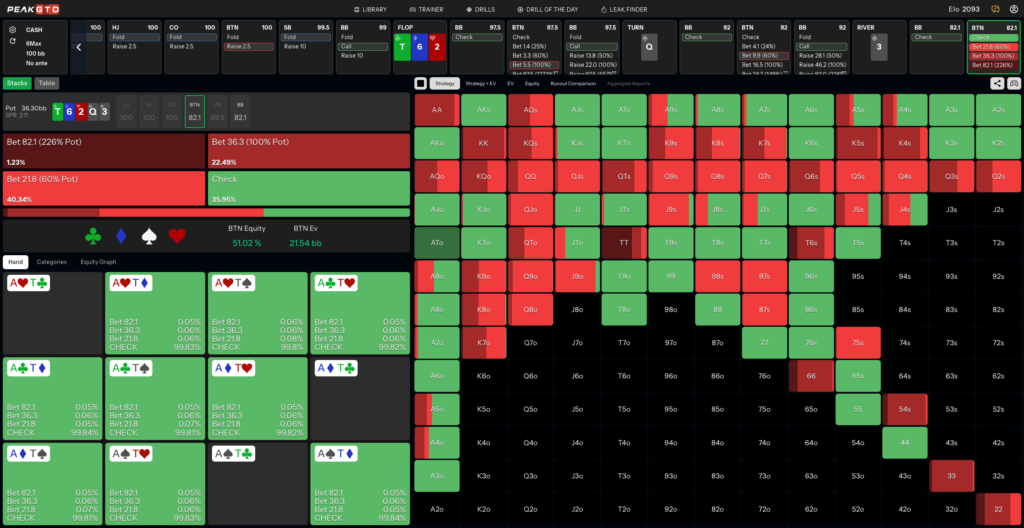
The 3♠ is a blank, and the big blind checks. It is tempting to fire one more value bet, but a clean heuristic settles it: when you bet the turn with a hand that was already mixing between betting and checking, unless the river is genuinely great for your specific hand, you almost always check it back. ATo checks back about 99% of the time, and this is exactly that situation. Hero’s equity is still only around 50%, and a third barrel runs into a problem of who actually calls.
This is where many players go wrong, reaching for a value bet because the opponent “can’t have a queen,” without asking what worse hands will pay. After Hero bet the pot on the flop and 60% on the turn, the big blind’s range is capped but not weak, and to get called by a river bet Hero would need the opponent to call with hands like 86, 77, and 76 that are mostly folding or mixing against a bet. On top of that, if Hero bets small the big blind can check-raise all in around 20% of the time with its two pairs and KQ. The whole range still bets the river often, with the aces, kings, queens, and other queen-x for value and the weak king-highs as bluffs, but ATo itself is not strong enough to join them. Checking back to take the showdown is the correct, disciplined play. Against a calling station who never raises and pays off light, a small GTO deviation toward a tiny value bet can be fine, but the default is to check.
Key Takeaways
- Flop: Top pair top kicker on T♣6♦2♥ almost never checks and prefers a bigger size, because it gets called by every worse top pair, and the bigger size is also what the strongest bluffs use to deny equity to the opponent’s ace-high and king-high.
- Turn: The Q♠ demotes the tens to second pair, but because the big blind rarely has the queen and rarely raises, ATo still value bets. The size drops to 60% pot so the underpairs, draws, and weak sixes keep calling.
- River: When a hand that mixed bets and checks on the turn does not improve, it almost always checks back. ATo checks 98% here, because a third barrel struggles to get called by worse and invites a check-raise.
- Overall: Top pair is a value hand, not an automatic three-street bet. Press your edge with the right size when the board lets you, and have the discipline to take a showdown once a marginal turn has thinned out the worse hands that would pay.