Try This Hand Yourself
Play this exact spot against the solver in PeakGTO before reading the analysis.
Value betting top pair sounds simple until you reach a big river bet and have to ask the uncomfortable question: who actually calls me here? On an uncoordinated flop, top pair is a clear bet. But as the board develops and the bets grow, the same hand can swing from an easy value bet to a spot where firing again only folds out the hands you beat and gets called by the hands that beat you. Knowing where that line sits, and how it shifts against different opponents, is the difference between extracting value and bluffing yourself out of a pot you should win at showdown.
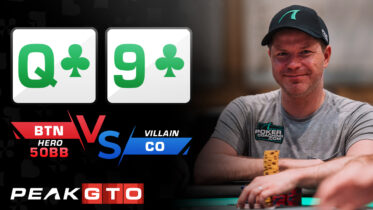
Today we will analyze a 50bb 8-handed MTT hand where the button calls a cutoff open with Q♣9♣, flops top pair on 9♠4♥2♦, and barrels the 7♣ turn and 8♣ river. This hand, part of the button-versus-cutoff series, shows why top pair bets a checked-to flop, how a nut advantage justifies a polarized turn barrel, and why the river is a fascinating overbet in a tournament that should sometimes become a check against weaker fields.
Assumptions
- Stacks: 50bb effective
- Format: 8-handed MTT
- Positions: BTN (Hero) vs CO (Villain)
- Action: CO raises, BTN calls
- Flop: 9♠4♥2♦ (Pot: 6.9bb)
- Turn: 7♣ (Pot: 10.3bb)
- River: 8♣ (Pot: 30.9bb)
Preflop
The button calls the cutoff open with Q♣9♣, a comfortable flat in position. It is worth noting now that the button only has the suited version of Q9 in this spot, not the offsuit one, which matters later because it keeps the hand near the top of the relevant pairs. The blinds fold and we see a flop heads-up with position and a hand that can flop a strong, if vulnerable, top pair.
Flop: 9♠4♥2♦
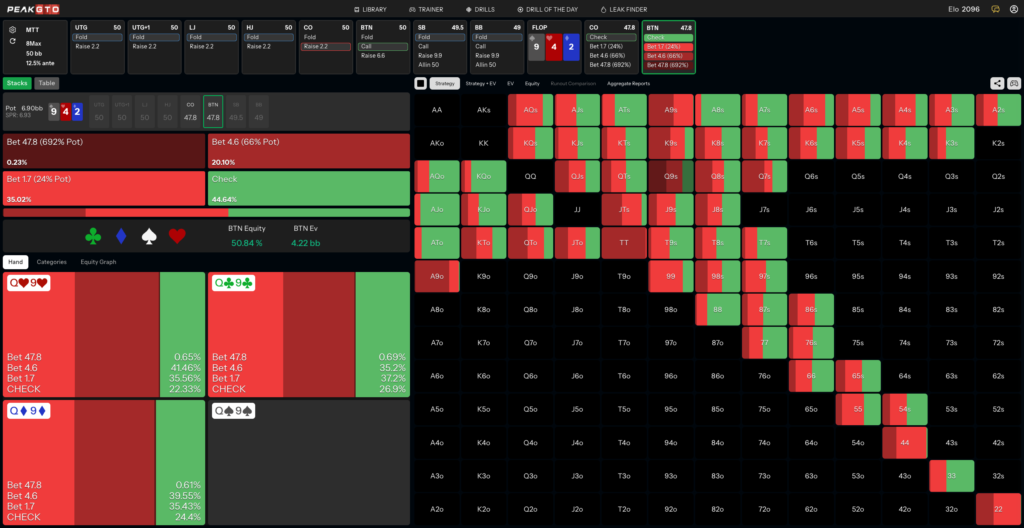
Hero flops top pair with a queen kicker on a dry, uncoordinated board. The cutoff has a range advantage here and should continuation bet about 45% of the time, usually large, because it opens offsuit nines and holds plenty of strong top pairs that want to build the pot. This time the cutoff checks, and the button gets to bet most of its top pairs. K9 and better bet a large amount, and Q♣9♣ bets around 75% of the time, mixing a 66% pot size, a small 24% pot size, and a check. Hero takes the small 1.7bb size, which keeps the weaker hands in and controls the pot with a holding that is good but not invulnerable. The cutoff calls.
The small sizing fits the texture and the hand. Top pair with a queen kicker is strong enough to bet for value but vulnerable enough that it does not want to bloat the pot against the cutoff’s many overcards that can turn a better pair. A small bet charges the floats and gutshots a little, keeps the worse hands that a big bet would fold in the range, and keeps Hero’s own decisions easy on later streets. The small size also matters for what it does to the cutoff: by risking so little, it lets the cutoff continue with overcards, backdoor draws, and weak pairs that a 66% pot bet would push out, which keeps the cutoff’s calling range wide and full of hands Hero is ahead of going to the turn. It is the kind of pot-control-while-betting line that good players use constantly with marginal made hands in position.
Turn: 7♣
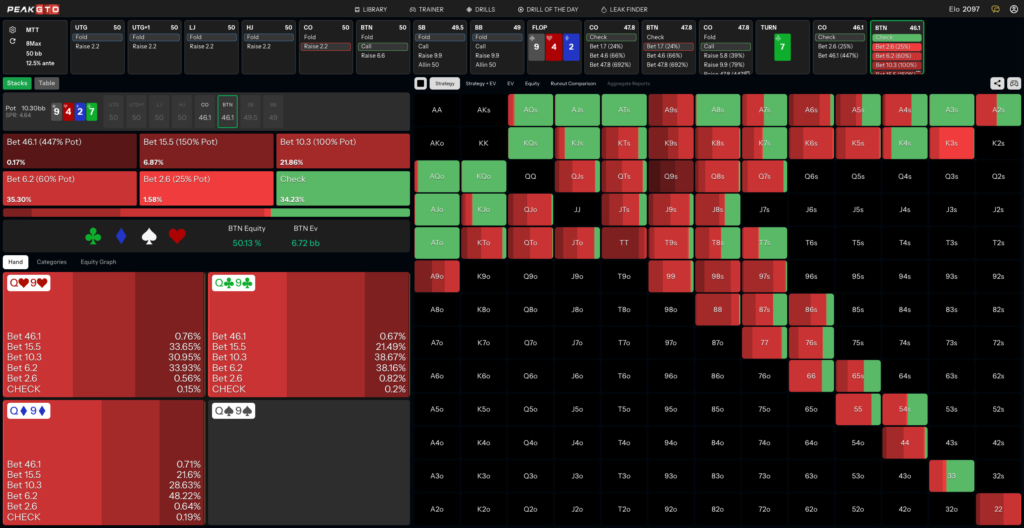
The 7♣ arrives and the cutoff checks its entire range. This is the moment the in-position player effectively gains the nut advantage. The button would have bet the flop with all of its sets and keeps betting them now, and the cutoff would have check-raised most of its hands stronger than top pair on the flop, so when it simply checks the turn its range is capped. Q9 is comfortably good enough to bet for value, and as the board grows a touch more coordinated, the right approach is to keep the betting polarized, pairing value hands like this with bluffs such as KT, QJ, QT, JT, and assorted king-high and A6 combinations with backdoor equity.
Because the flop was bet in a polarized way, the turn gets to stay polarized and large. The solver fires about two-thirds of the time, choosing between an overbet, a pot-sized bet, and a 60% pot bet, and Q9 in particular leans toward the chunky sizing. A useful practical approach, and the one Hero takes, is to use a big, roughly geometric size that sets up a clean river jam. Hero pots for 10.3bb, the same line it would take with A9 and K9, and the cutoff calls again.
It is worth dwelling on what the in-position player does with that nut advantage rather than just how it is earned. PeakGTO shows that because the button still holds every set and strong top pair while the cutoff is capped, the button gets to threaten the whole stack with a large size and force the cutoff to defend out of position with hands that are now drawing thin. That uncapped range is exactly what lets a clear value hand like Q9 bet big without worrying about reverse implied odds, since the few cards that beat it are largely absent from the cutoff’s checked-twice range. The big turn bet is not just value extraction, it is the price of admission the button charges the cutoff to keep seeing cards while behind.
River: 8♣
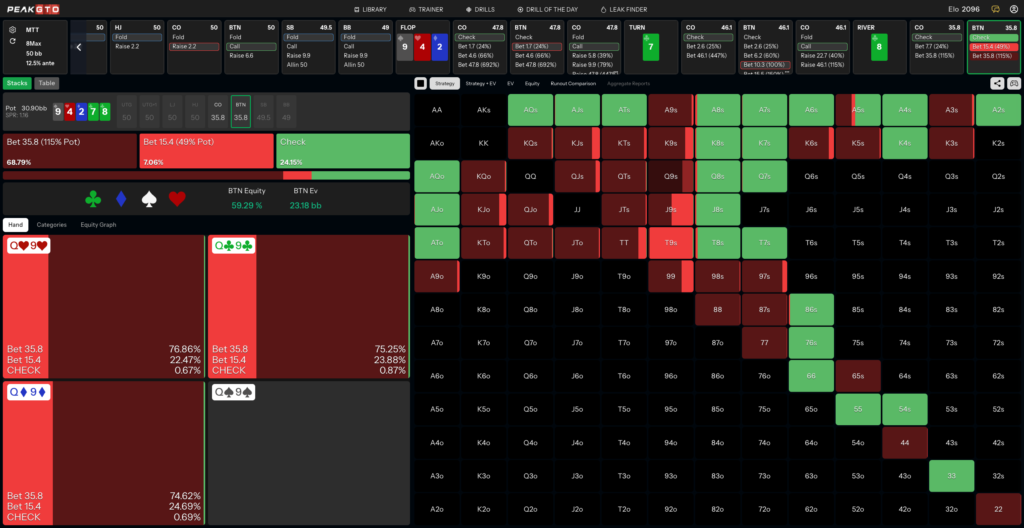
The 8♣ completes the board, leaving Hero with top pair and a queen kicker, roughly a pot-sized stack remaining. With a roughly pot-sized stack behind, the solver rarely uses the smaller half-pot size, and it overbets Q9 for a near jam about three-quarters of the time. From a pure GTO standpoint, this is a thin, polarized value bet that also carries the line’s bluffs.
Here is the catch, and it is the most instructive part of the hand. On the eight, it is hard to get called by many worse holdings. If you study which hands the solver uses to call the overbet, the bad news stacks up fast: AA, all the sets, and the two pairs like 98, 97, and 87, plus the made straights such as 65, all call, and all of them beat Q9. The hands Hero actually beats that still call are a thin slice, J9, T9, 96s, some ace-x, and a few straight-blocking combinations like 54 and 75, with 65 itself being a made straight rather than just a blocker. The overbet is correct only because, at equilibrium, the opponent defends those worse hands at the right frequency.
Against real opponents, that assumption often breaks. Most recreational and cautious players will not check-call the flop, call a big turn bet, and then call off the river with 87 or J9, which means they are not paying off Q9 often enough to justify the overbet. When that is true, Q9 slides from a value bet to a check-back, exactly as the solver does with its more marginal made hands. The pot odds you are laying only pay off if the opponent calls with the worse hands the solver assumes. Against strong, balanced players, take the GTO shove. Against a tight field, or when payout-ladder considerations make stacking off in a marginal spot dangerous, check it back and take the showdown. Hero fires the overbet here, and the cutoff folds.
Key Takeaways
- Flop: On the uncoordinated 9♠4♥2♦, the button bets most top pairs after the cutoff checks. Q9 bets about 75%, taking the small 1.7bb size to control the pot with a vulnerable top pair.
- Turn: The 7♣ hands the in-position player the nut advantage, since the cutoff is capped after checking. Q9 barrels a big, geometric size that sets up a river jam.
- River: The 8♣ overbet is correct at equilibrium but barely a value bet. Against opponents who will not call off with worse, Q9 should check back rather than bet.
- Overall: Value betting top pair is dynamic, not automatic. Bet freely on dry flops, barrel with a nut advantage, but on the river always ask whether your opponent actually pays you off with worse. When they will not, the value bet becomes a check.