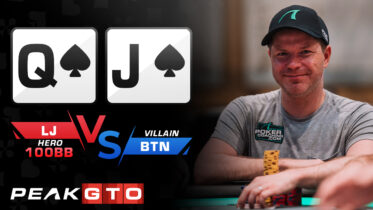
Flopping top pair feels like a reason to start building a pot, but out of position it is often a reason to slow down. When you raise preflop and a tight player calls behind you, your two ranges end up sitting almost on top of each other, and neither side has a real edge on most flops. In that world, firing every top pair just bloats a pot you are not favored to win. The higher-EV plan is patient: check, keep the pot small, let your opponent define its hand, and save your aggression for the street where its range has actually capped. This hand is a clinic in playing a strong-looking holding passively on purpose.
Today we will analyze a 100bb 6-handed cash game hand where the lojack opens Q♠J♠, gets called by the button, and flops top pair on J♣T♦4♥. This top pair checks the flop, check-calls a stab, checks the entire range on the turn, and then finally bets the river for thin value. The throughline is range structure: because the preflop ranges are so similar, the out-of-position player has to check often, and the value only comes once the button’s own line narrows its holdings. It is a hand about restraint, and about knowing exactly when restraint should end.
Assumptions
- Stacks: 100bb effective
- Format: 6-handed cash game
- Positions: LJ (Hero, preflop raiser) vs BTN (Villain)
- Action: LJ opens, BTN calls
- Flop: J♣T♦4♥ rainbow (Pot: 6.5bb)
- Turn: 2♠ (Pot: 15bb)
- River: 3♣ (Pot: 15bb)
Preflop
The lojack opens Q♠J♠ and the button calls. Both ranges are reasonably tight, and that is the detail that shapes everything. When a tight button flats a tight lojack open, the two ranges end up all on top of each other, so neither player will have much of a range advantage on most boards. That is the structural reason the out of position player has to check so often after the flop. Without an edge in strong hands, betting into a player who has position and a symmetric range is simply not rewarded.
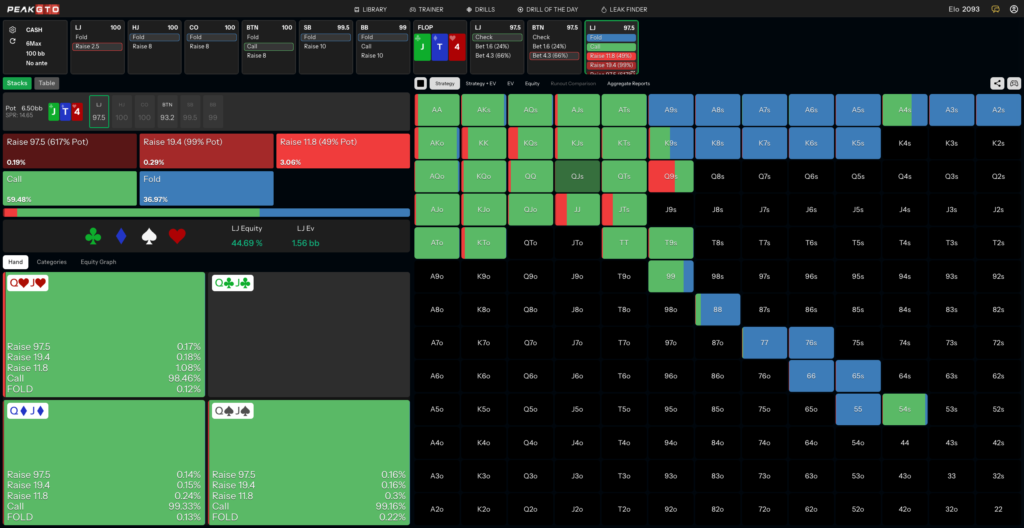
Flop: J♣T♦4♥
The flop gives Q♠J♠ top pair with a queen kicker, plus a backdoor straight draw. Q♠J♠ also carries a backdoor spade flush draw, small but real extra equity that helps the hand continue. It looks like an easy bet, but the solver checks a lot here, and Q♠J♠ is one of the hands that mostly checks. Equities are split roughly 50/50, so neither side has a meaningful range advantage, and when nobody is favored, the betting that does happen is polarized and small. Top pair like QJ bets only about 20% of the time, with the stronger top pairs and overpairs betting a bit more. There is no reason to fire a hand that does not want to build a big pot from out of position.
So Hero checks, and the button takes a stab. Because Hero declined the chance to make a continuation bet, the button gets to apply pressure with a stab of about two-thirds pot. Facing it, Q♠J♠ is a clear call, not a raise. The solver calls roughly 60% of its range here and only raises a tiny fraction, because against a larger bet you do not raise without the near-nuts. The goal is plain: fold the garbage, and call with any hands that have potential whatsoever. Top pair has 44% equity against the button’s betting range, which is plenty to continue but not enough to escalate. Hero check-calls.
This runs against most players’ instincts, because top pair feels like a hand that wants to “protect” itself by betting. But protection only matters when you are charging meaningful draws and folding out live overcards, and on a JT4 board the button only flatted preflop, so its strongest hands are mostly not in its range. There are few draws to deny, your own range is not strong enough to want a big pot, and betting simply gets you called by the hands that beat you while folding out the hands you already crush. Checking concedes nothing real and keeps your whole range, the bluff-catchers and the traps, intact and disguised. It also keeps you from getting blown off the hand. If you bet and face a raise, top pair with a third-best kicker is in an awful spot out of position, with no clean way to continue. By checking, you let the button price its own continuation and you never have to make a high-variance decision for stacks with a hand that is only marginally ahead.
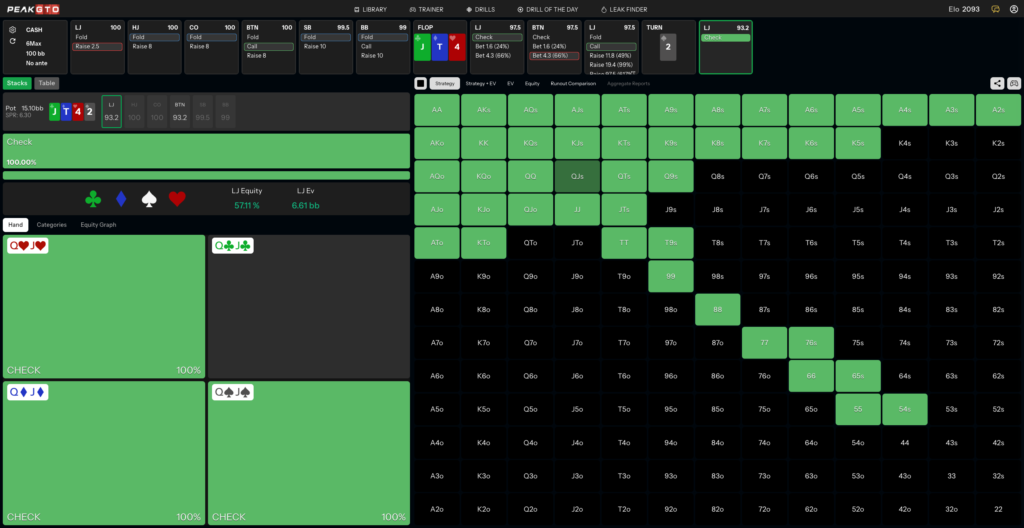
Turn: 2♠
The 2♠ is a blank, and the turn play could not be simpler: the out-of-position range checks 100% here. PeakGTO data shows the whole range, top pair included, holding a slight equity edge of about 57%, yet it still has nothing to gain by betting into the player with position on a blank turn. Checking keeps the pot manageable and avoids turning a marginal made hand into a target.
It is worth knowing what to do if the button bets rather than checks back. When the button does fire, it should be using a big size, around 150% pot, with a very polarized range of strong hands and a few bluffs. Against that, top pair becomes a bluff-catcher, indifferent between calling and folding. One practical warning: many opponents do not bluff this spot often enough, especially live, so do not be afraid to make a big fold if a straightforward player starts blasting. In this hand, though, the button checks back, which is exactly the outcome that sets up the river.
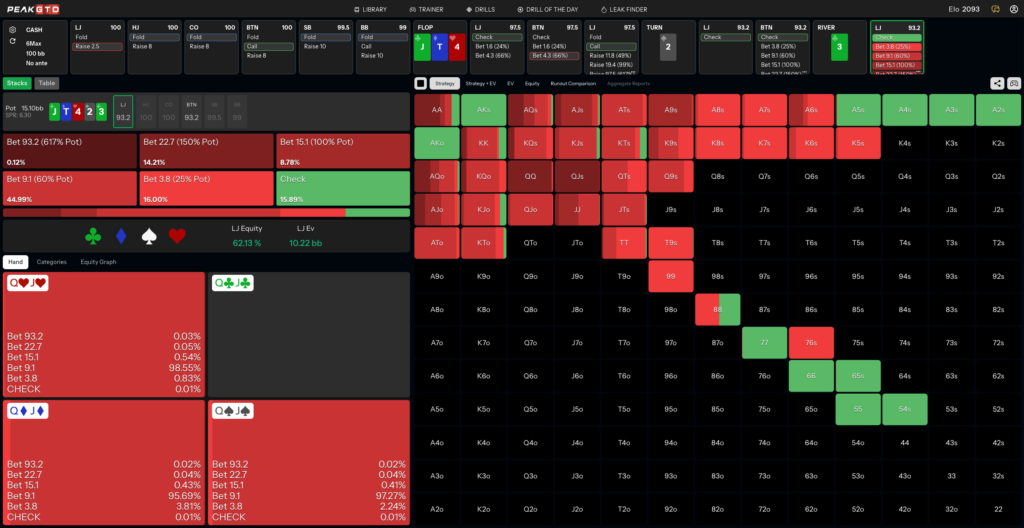
River: 3♣
The 3♣ bricks, and now the patience pays off. Because the button checked back the turn instead of betting its strong hands, it has quietly capped itself: most of its strongest holdings would have bet the turn, so by the river it is missing a lot of value. The out-of-position player, meanwhile, still holds all of its overpairs, sets, and strong top pairs. That asymmetry flips the script, and the solver now bets the river about 85% of the time. Top pair is no longer a hand to check and hope, it is a hand to bet.
The art is in the sizing. There is a clean ladder keyed to hand strength: overbet with the nutted hands, pot with the strong ones, around 60% pot with the medium hands, and small (about a quarter pot) with the barely-good ones. Q♠J♠ sits squarely in the medium tier, so it bets 9.1bb, about 60% of the pot. This is thin value: the bet targets worse pairs and the occasional stubborn ten while keeping the price low enough that they call. If the button raises small, top pair calls; if the button raises big, the solver still calls but real-world exploitation often says fold, since few players turn enough pairs into bluffs. The GTO baseline is the call; the read decides the deviation. Hero bets 9.1bb, and the button calls with second pair.
The reason this matters is that one-size-fits-all betting is exploitable. When a player picks one comfortable size for every hand, an observant opponent learns nothing from the bet itself and can defend perfectly against the whole range. Varying the size by strength hides the nuts among the medium hands and forces the opponent to guess, which is exactly what turns a thin value bet into one that prints instead of one that only ever gets called by better.
Key Takeaways
- Flop: With no range advantage, top pair checks. Q♠J♠ bets only about 20% and mostly checks, then check-calls the button’s stab with 44% equity. Do not raise a marginal top pair into a bigger bet.
- Turn: On a blank, the out-of-position range checks 100%. If the button bets big, top pair is a bluff-catcher, and folding to under-bluffing opponents is fine.
- River: The button’s turn check-back caps its range, so the out-of-position player bets about 85%. Q♠J♠ is a medium hand and bets 60% pot for thin value.
- Overall: Checking top pair is not weakness, it is range structure. When ranges are symmetric, stay patient out of position, and let the value come on the street where your opponent’s line has capped them.